Big systems change with value chain collaboration
The very nature of circular economy and decarbonisation is achieving circularity of materials with a collaborative and interconnected approach along value chains, and over long-time horizons. By working together, value chain partners can collectively design products for circularity, develop efficient material recovery processes, and create closed-loop systems.
For example, a manufacturer can partner with its suppliers to ensure that materials are returned and reused in the production process. This closed-loop approach reduces the need for extracting virgin resources and minimises waste generation. This is particularly important for hard-to-abate industries when incorporating recycled materials can significantly reduce carbon emissions (and energy use) and not draw on substantial virgin material inputs.
Products can be designed with durability, ease of disassembly, and recyclability in mind. Collaboration between value chain partners ensures that components and materials are standardised and compatible, simplifying the recycling and re-manufacturing processes.
Today, there are great opportunities for collaborative innovation to accelerate progress for narrowing, slowing and closing loops. One example is shared reverse logistics networks to reduce costs and facilitate the return of products to the market as ‘good as new’. Leading organisations recognise they don’t need to forgo economic value for environmental value, or vice versa. It’s a better environmental outcome when inputs to the system are minimised, however, it’s also a better economic outcome as quite often less materials are used during construction, and with reversible design, there’s potential financial gains at end-of-life.
Consideration of the end goal is environmental responsibility but also continuous revenue streams for economic prosperity, and resilient assets for organisations and communities.
Used the right way, circularity in the context of decarbonisation can help spur organisations and governments onwards, by bringing into focus what is truly in their commercial interest. If an organisation can see a clear carbon liability on its books in the form of materials and products that could otherwise be reinvested (either internally or along its value chain), it can rebalance using resource and knowledge exchange.
The synergies of circular economy and decarbonisation offer a systems solution to the challenge of resource consumption and climate change.
Embracing the circular path to decarbonisation is not only a necessity, but an unprecedented opportunity to innovate on assets and sustaining capital programmes of work to drive whole-of-systems change.
References
[1] Data source: United Nations Framework Convention on Climate Change, UNFCCC. (2022) 'National greenhouse gas inventory 2020', accessed 29 August 2023. Available at: National Inventory Submissions 2022 | UNFCCC*
[2] Department of Planning, Industry and Environment, NSW Waste and Sustainable Materials Strategy 2041, pages 26-27, accessed 1 August 2023.
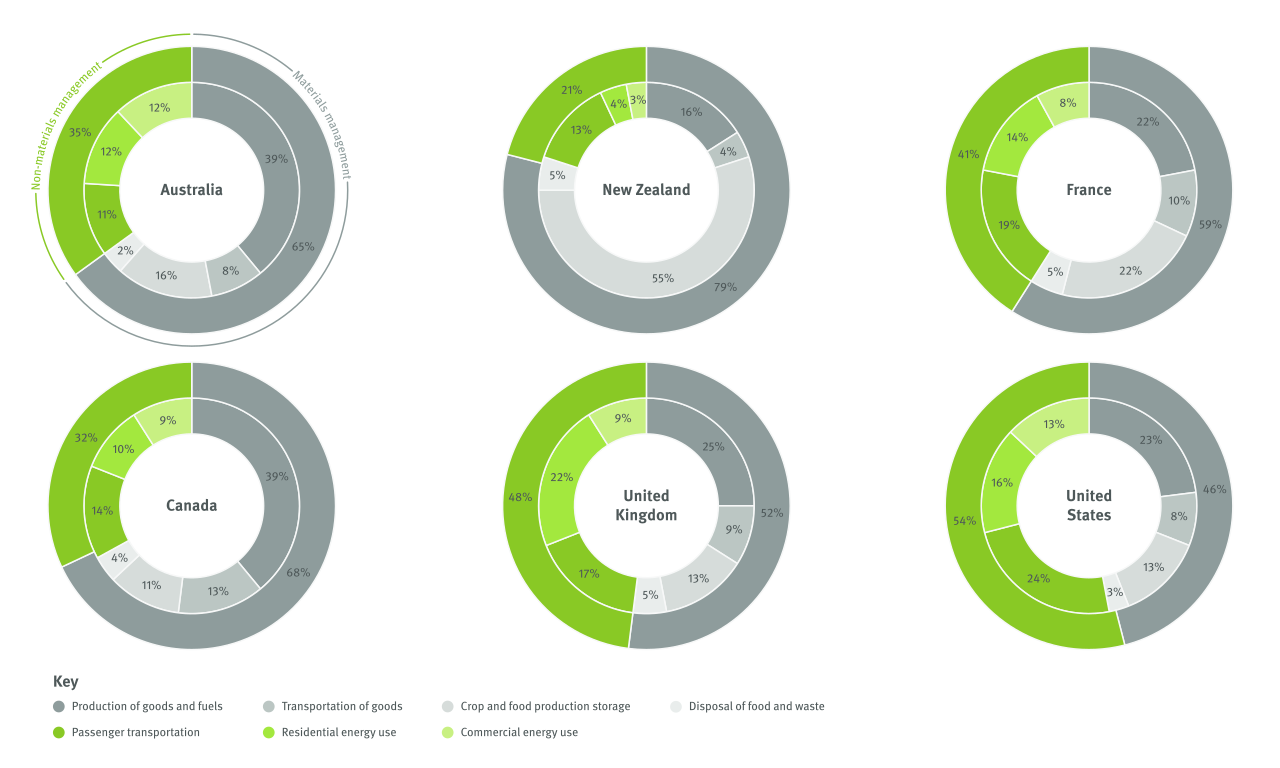
*Key assumptions in the research underpinning figure 1:
- UNFCCC category 4 Land Use, Land Use Change and Forestry (LULUCF) is excluded from this analysis. This category details estimates for carbon sinks from land use that would complicate the reallocation of emissions sources across other sectors.
- It should be noted that national GHG inventories do not include GHG emissions linked to imports and exports. In this analysis, a production rather than a consumption perspective is taken, i.e. allocating emissions to production rather than consumption.
- All source emissions data is for the year 2020 obtained from the respective countries national GHG inventory submissions to the UNFCCC.
- The distinction between ‘material management’ and ‘non-material management’ emissions sources is a deliberate simplification intended to highlight the important role of managing materials in decarbonising – in practice, as this article describes, emissions relating to energy and materials are inextricably related.
Contributing author & reviewer: Jodie Bricout