Sharpening investment in climate resilience for Australia's infrastructure
As climate impact events become increasingly prevalent, there is a sharpening focus on resilience investment for Australia's infrastructure across every sector.


Change your location to view content tailored for you.
What does a circular economy look like for the community it serves in Western Sydney?
Circular economy is a more resilient, balanced and sustainable way of living – propelling cities and towns towards net zero by deploying inclusive, regenerative and co-creative methods of design, and carefully considering the value and dependencies of social, environmental and economic systems.
There is an exciting opportunity to develop and apply this kind of thinking and new ways of doing things in Western Sydney. The region is already imbued with diversity, culture, Country, emerging industries and sparks of sustainability. For this reason, it also offers the ultimate circular economy opportunity to re-think how society removes waste, retains the value of materials and assets, and regenerates natural systems.
Current predications from the United Nations points to approximately 70 per cent of the world’s population living in urban areas by 2050. With an estimated one million additional people living in Western Sydney by 2036[1], the region is set for significant growth in the coming decade and beyond. This opens up myriad circular economy possibilities to design closed loop systems, full water cycle solutions, blue green cities and co-processing facilities.
For Western Sydney to realise the opportunity of a truly circular economy, new ways to strengthen collaboration across diverse stakeholder groups will need to be found using new forms of governance, and new approaches to calculating cost benefits – balancing ecology and economy.
The conversation around circularity in Western Sydney has well and truly begun. Aurecon recently partnered with Western Sydney Leadership Dialogue, Circular Australia, Sydney Water, and Western Parkland City Authority – each entity playing an important role in moving the dial forward in the delivery of better economic, social, and environmental outcomes in the region.
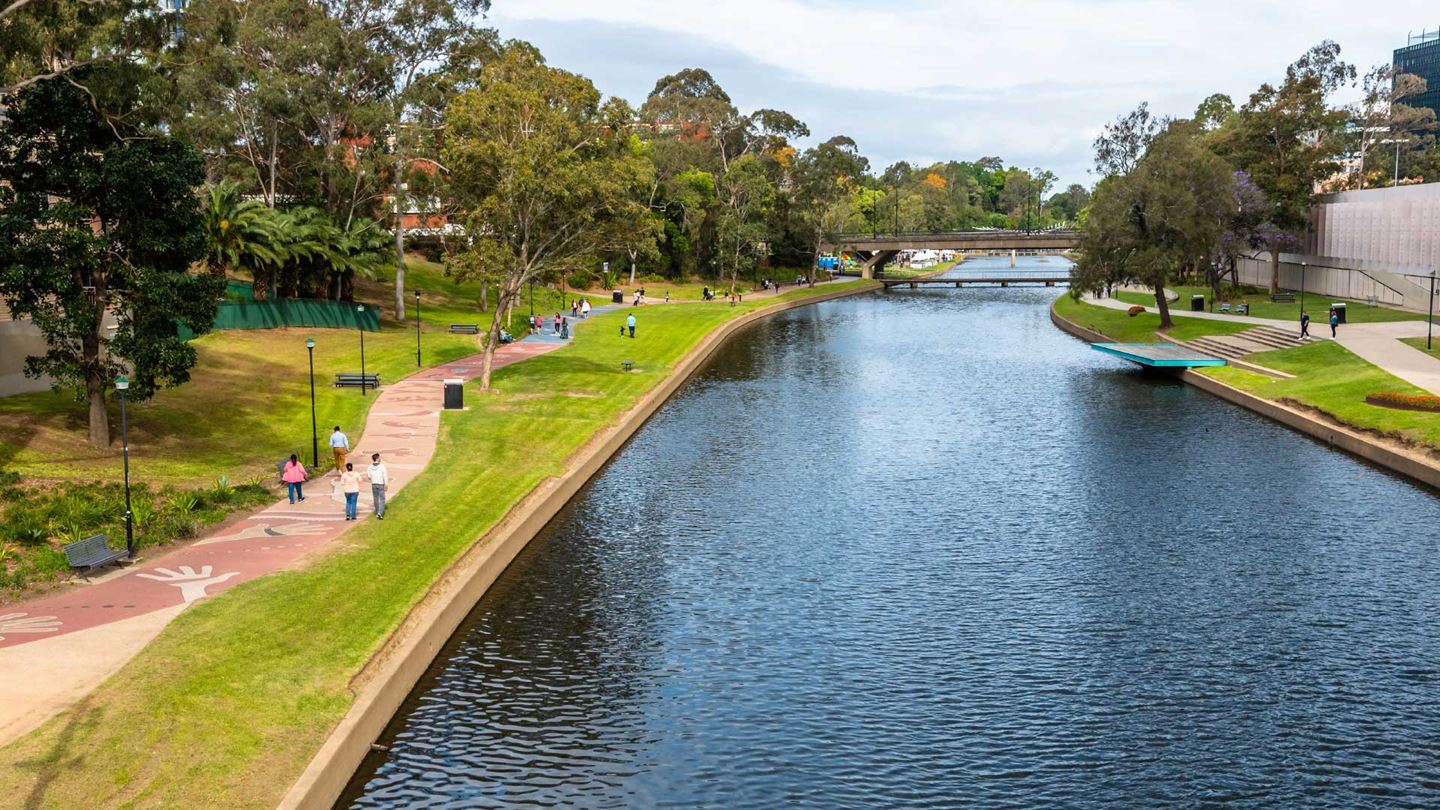
Like much of the world, Australia is greatly exposed to the effects of climate change, especially extreme weather events causing biodiversity loss and ecosystem overwhelm. The droughts, floods and bushfires are increasingly impacting people and natural systems. People in Western Sydney are already experiencing the effects of climate change with significant changes in weather patterns such as critically low dam levels from drought in 2019, flooding in 2022, and extreme heat. On 4 January 2020, Penrith was the hottest place on Earth at 48.9˚C while in 2019, Parramatta sweltered through 47 days with temperatures over 35˚C[2].
The NSW Government’s Six Cities Region announced in 2022 is intended to optimise infrastructure and business investment, employment and liveability outcomes in Western Sydney[3].
New city-shaping transport, water and waste infrastructure, and the airport, is expanding the region’s connectivity to Greater Sydney and other regional New South Wales towns.
Underpinned by these proposed projects, the region could emerge with the development of new neighbourhoods and centres, and with urban renewal close to existing centres. Placemaking would help to design neighbourhoods with circularity, health and well-being in mind. Attracting knowledge-intensive jobs and diverse housing options lies in globalised localism within the circular economy framework, and a focus on caring for Country and people.
Successfully implementing a circular economy demands a whole-of-system approach[4] (as everything is interconnected). This thinking through of impacts and benefits across multiple lifecycles avoids creating more magnified problems in the future.
A circular economy’s three principles are designing out waste, retaining value, and regenerating natural systems. Not a destination, circular economy is a continuous approach to improvement and innovation, embracing a mindset that acknowledges continual learning, and exploring new ways to approach challenges.
These principles are intrinsically linked to addressing climate change as circular economies are decarbonised, incorporating such elements as renewable energy, balancing renewable resources flows and lowering the energy and water use associated with materials manufacture by using fewer virgin products.
While population growth, urbanisation, climate and technologies change, many things stay the same – the importance of well-located housing, beautiful public places, efficient transport, local infrastructure and planning that is people focused. These are the factors underpinning precincts and their importance to regions such as Western Sydney.
If overlaid with a circular economy, the moving parts of a precinct – people, resources, energy, and water – work in harmony with fixed infrastructure (for instance, water treatment plants and re-manufacturing centres). In this way, new opportunities are unlocked to reduce carbon emissions associated with the extraction, manufacture, transportation and use of resources. The Ellen Macarthur Foundation estimates this equates to up to 45 per cent of global carbon emissions[5].
"A precinct’s ability to change and react over time should be designed in from the beginning of its inception."
Dr Jaqueline Cramer, an internationally-recognised circular economy expert, visited Western Sydney and highlighted the importance of flexibility within precinct planning to truly capture the potential of a circular economy. Her narrative centres on adaptation, that a precinct’s ability to change and react over time should be designed in from the beginning of its inception and development.
From Aurecon’s experience, precincts designed and delivered in collaboration with councils, state agencies, developers, communities and First Nations people can provide the appropriate infrastructure in the right places to support a circular economy, whilst still delivering what communities need.
In the context of Western Sydney, how would this work? Here are some approaches that may genuinely produce a circular economy in Western Sydney:
Realising a shared vision motivates stakeholders to work together and, in the case of achieving a circular economy at a precinct-scale, this means prioritising low carbon activity, self-sufficiency and zero-waste, while building a unique sense of community and social cohesion.
Some questions for your organisation to consider in Western Sydney:
Systemic change, which is change that refines every part of a system, across complex networks or systems relies on coordination and cohesion by entities or individuals. Dr Cramer advocates for network governance in her rationale on circular economy.
Whilst she didn’t come up with this term, in her book, ‘Ten Guiding Principles for building a circular economy’, she describes it as being about collaboration between stakeholders with clear goals and roles, which is critical for achieving the objectives of a circular economy initiative.
For Western Sydney, collaboration will be a hurdle with so many disparate groups of stakeholders, however persistence is worth it for the results that may be achieved.
In a linear economy, stakeholders at either end of a value chain rarely engage with each other, in which case, circular innovations may be costly, and levels of adoption may be low. A circular economy instead, enables communication and partnership opportunities throughout entire ecosystems.
The benefits of a collaborative ecosystem include:
Circular economy principles should be incorporated into precinct planning for several reasons:
The stages of development, implementation and management of circular economy considerations for Western Sydney are framed below.

Evidence based decision-making is a process for a programme, practice, or policy, that is grounded in the latest and most appropriate available research evidence.

Considers the immediate need of communities and a circular economy, whilst also the future needs in terms of environmental, economic and social sustainability

Implementing networks and systems that align to evidence based decision-making and vision-led approach to planning and design

Plan assets for long-term resilience, compliance, safety and accessibility to minimise future works to maintain them
Current predications from the United Nations points to approximately 70 per cent of the world’s population living in urban areas by 2050. With an estimated one million additional people living in Western Sydney by 2036, there is no doubt that significant growth will occur in the coming decade and beyond. This opens a myriad circular economy possibility to design closed loop systems, full water cycle solutions, blue green cities and co-processing facilities.
For Western Sydney to realise the opportunity of a truly circular economy, new ways to strengthen collaboration across diverse stakeholder groups will need to be adopted using new the forms of governance, and new approaches to calculating cost benefits, described in this insights paper. The rebalance of ecology and economy champions notions of resource valuing, reconfigured social consumption and investment strategy, and the transfer of skills, technology and outcomes to achieve circularity in the region.
[1] NSW Government, December 2010, Metropolitan Plan for Sydney 2036, accessed on 23 March 2023.
[2] Climate Council, 28 January 2021, Untouchable Playgrounds: Urban heat and the future of Western Sydney, accessed 23 March 2023.
[3] Greater Cities Commission, Six Cities Region Explained, accessed 14 March 2023.
[4] Roy, J., P. Tschakert, H. Waisman, S. Abdul Halim, P. Antwi-Agyei, P. Dasgupta, B. Hayward, M. Kanninen, D. Liverman, C. Okereke, P.F. Pinho, K. Riahi, and A.G. Suarez Rodriguez, 2018: Sustainable Development, Poverty Eradication and Reducing Inequalities, accessed 14 March 2023.
[5]Ellen Macarthur Foundation, 2021, Completing the picture: How the circular economy tackles climate change, accessed 10 March 2023.
Contributing authors & reviewers: Justine Jarvinen and Jodie Bricout.

Industry Director, Precincts – Australia

Director, Environment & Planning – Australia
As climate impact events become increasingly prevalent, there is a sharpening focus on resilience investment for Australia's infrastructure across every sector.
Australia's energy transition requires more than technical plans. Discover four ways to build the people, culture and capability to deliver infrastructure at scale.
Aurecon’s ecology and biodiversity expert shares how to achieve timely project approvals, what regulators want, and how to navigate regulatory changes.