Delivering energy infrastructure needs people, capability, and cohesion
Australia's energy transition requires more than technical plans. Discover four ways to build the people, culture and capability to deliver infrastructure at scale.


Change your location to view content tailored for you.
For as long as there have been macro-environmental pressures on business, deciding how to respond, and where to invest, has been a hurdle for organisations.
But something has shifted. The scale, speed and complexity of change has intensified. Organisations are being challenged to think differently about investments in their existing asset base to create and protect value, transforming business models and relying on connected data and digital insights to inform strategic decisions.
While organisations have embraced connectivity, artificial intelligence and analytics, in response to automation of equipment and workflow, it has predominantly been incorporated in the form of remote operations or plugins to existing assets.
In response to this, very few organisations reworked their operational methods of the past to adjust to the required operations of the future, therefore missing opportunities to leverage smart technologies to maximise asset productivity, resilience and agility, and value.
Aurecon is now seeing in many sectors a prolonged period of needing to address asset re-investment driven by assets reaching end-of-life, scarcer growth capital funding, and shareholder expectations for increased return on investment. Add to this safety priorities, volatile global markets, supply chain disruptions, sustainability and climate change risk, energy scarcity, and regulatory responses, and organisations must balance priorities in times of transformation.
In response, sustaining capital programmes make the complex understandable through data-driven insights. That’s when organisations receive better evidence for decision-making and improved understanding of which assets to replace or refurbish. It’s also possible to identify important opportunities to incrementally improve productivity, reduce costs and maintain a license to operate.
Delivering sustaining capital programmes has always been challenging. More recently, our clients have been telling us that macro-environmental pressures are exacerbating these challenges, resulting in:
Understanding how to transform existing assets in light of macro-environmental pressures, and how sustaining capital can create and protect value, is critical. When it comes to transformation, data-driven and informed decisions provide the opportunity to put in place asset investment programmes that deliver consistent value, continuous improvement and optimised productivity.
We believe this requires two types of asset planning:

Ensuring that organisations have the right assets functioning in the right way as close to long-term plan expectations, whilst also accounting for immediate external changes (such as weather) and internal changes (like equipment and workforce scheduling).
Systematic approach at the nexus of asset performance and understanding long-term macro environment trends to enable organisations to transition to new models of operation in response to change requirements and macro environmental pressures.
Rebalancing priorities to arrive at sustained asset value will be unique to the operational context of individual organisations, however, the common threads impacting them all are the scale, speed and complexity of change.
It is critical to distinguish between asset supply chains in different sectors as there is a distinct uniqueness between them regarding broad challenges and considerations. Clients in the sectors we work in have described the following challenges:
The necessary asset transformations that organisations must undergo will be varied, so sustaining capital programmes must integrate and balance between new growth asset investment through to operations and maintenance business as usual.
Organisations have long-term business strategies in place, with objectives to be achieved. They would also want to take advantage of new technologies to cut costs, improve quality and transparency, build value and deliver great customer experiences.
At present, we’re seeing two hurdles common to the majority of client organisations: prioritising investment; and having the ability to execute required investments.
The alignment required between strategy and execution to address these challenges can only be achieved by thinking differently about the problems to be solved. The sustaining capital framework is a step change enabling organisations to continuously improve efforts around supply chain integration, long-term asset performance, and integrated approaches and capabilities (figure 1).
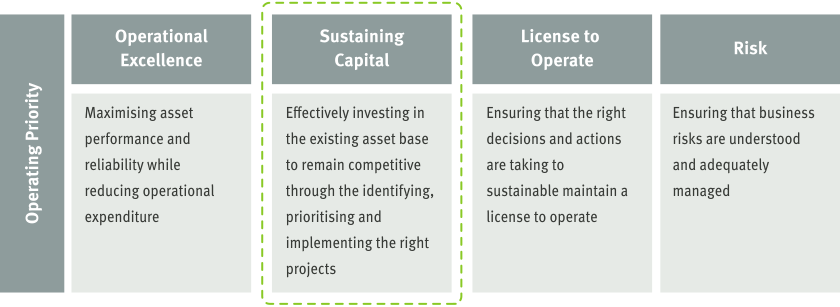
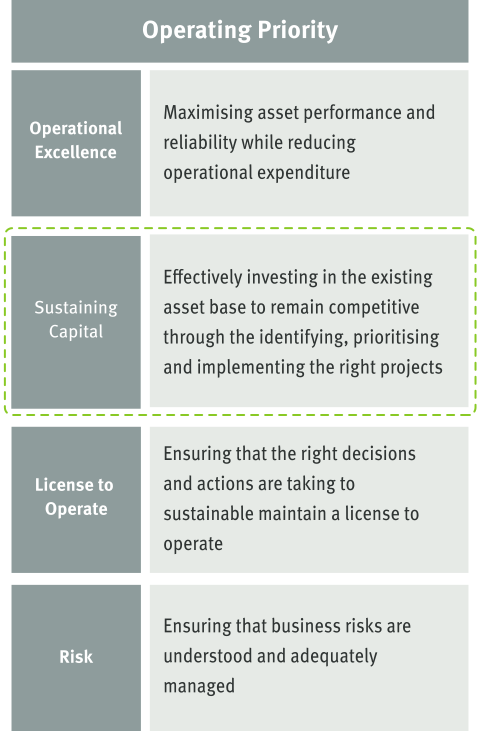
Figure 1: Effectively investing in existing asset portfolios to remain competitive and productive through identifying, prioritising and implement the right work, and doing the work in the right way.
Sustaining capital programmes cannot be a siloed effort. Introducing once-off asset investments or efficiency initiatives in separate units won’t have ecosystem-wide impact. We find that organisations which build value and achieve optimal productivity and efficiency outcomes, and compelling customer experiences, commit to rebalancing and optimising portfolios.
Bringing this involves:

Selecting, prioritising and planning to optimise the work involved in creating value for an organisation. This encompasses both capital investment projects and operational change projects, balanced to deliver asset value.

Developing and executing projects, often through programmes of work, that deliver high-quality solutions whilst controlling capital delivery costs and risk.

Understanding what value means to an organisation, together with a holistic approach to value that includes safety, economic, social licence to operate, organisational transformation and operational considerations.

Reducing operating costs, together with achieving peak operational performance.
Assets have always been mission critical infrastructure – the beating heart that enables organisations to stay in business, stay connected, and stay productive and competitive.
For decades, organisations have been focused on the construction of new assets in response to the strength of market signals, population growth and high product demand. Now, asset owners are faced with the challenge of sustaining these assets, quite often vying for limited capital budgets to do so.
In fact, there is an expectation that assets will always be available, no matter the circumstances.
In an era of capital infrastructure discipline, successfully delivering the right sustaining capital programmes requires flexibility and adaptability in the context of each organisation and the sector in which they operate. It is this application of priorities and needs, underpinned by advanced digital and data analytics, that ensures assets can deliver required levels of service to an organisation and its communities in a consistent and effective way in the long-term.

Industry Director, Resources Strategic Pursuits – Australia
Australia's energy transition requires more than technical plans. Discover four ways to build the people, culture and capability to deliver infrastructure at scale.
Aurecon’s ecology and biodiversity expert shares how to achieve timely project approvals, what regulators want, and how to navigate regulatory changes.
Aurecon shares insights on how renewable project delivery models are evolving to better manage risk and deliver long-term value through project partnerships.