
Safeguard Mechanism’s contribution towards ambitious 2035 NDC
This paper explores three individual change scenarios for the Safeguard Mechanism, illustrating different pathways for greater emissions reductions in Australia.


Change your location to view content tailored for you.
The cost and process of closing a power station is significant. Decommissioning and demolishing these facilities that have been powering Australia for generations comes with complex environmental, socio-economic and governance challenges.
This paper identifies the five major considerations for decommissioning and demolishing power stations, exploring how it can be achieved in responsible ways that begin with transition planning well before closure, sustaining an operator’s social licence, and leaving a long-term positive nature and community legacy.
As Australia accelerates its transition towards more sustainable energy sources, the decommissioning of thermal power stations attracts complex asset decisions. Beyond their environmental impact, these power stations often hold economic and socio-economic significance for local communities, as well as the stability of the nation’s energy supply.
With this imperative for change, companies must have confidence that they have considered every aspect of a site’s long-term legacy from an environmental, socio-economic and governance perspective.
That’s quite a shift from a few years ago, when companies might have demolished major assets with less detailed thought as to the potential of the site in the future, how materials might be reused in a circular loop, and how local communities – where workforces live or stay – will transition, and how the site can leave a positive legacy after closure.
Although it is acknowledged that power stations will, at some point, reach end-of-life, it is simply no longer acceptable to shareholders and communities that the site is abondoned or mothballed without considering its future. Rather, a more graduated decommissioning strategy is needed to obtain the best commercial return on assets, avoid unnecessary expenditure for assets on the site, and navigate the environmental and community-impact challenges and opportunities.
Against that backdrop, Aurecon shares its insights on decommissioning and demolishing power station facilities in responsible ways that begin transition planning well before closure, with a view to sustaining an operator’s social licence and leaving a long-term positive nature and community legacy.
Whilst this paper focused on thermal generation, many of the perspectives are applicable to the oil and gas, or mining industry, facing similar decommissioning and demolition decisions.
Asset closure is today’s reality for energy companies facing pressure to accelerate decarbonisation, renewable energy electrification, return financial profits, and respond to shareholder expectations for climate transition initiatives. This is particularly poignant for power stations as countries progress towards achieving carbon emissions reduction targets.
In Australia, closely examining different operating scenarios in the lead up to the closure of a power station is particularly crucial for companies. It is worth noting that for some companies, this planning is already occurring much earlier in the asset’s lifecycle.
When these scenarios are developed with a sustaining capital lens, they can provide powerful insights. Often, the integrity of assets can be maintained while minimising cost and negative community impacts. A social licence to operate may be ensured, and capital works planned to suitably maintain asset reliability.
In this context, it’s important to design a ‘purpose built’ governance and decision-making structure that can effectively enable multi-layer decisions. It must take account of past circumstances, current site conditions and operating requirements, and potential future uses of land and assets.
Investment options in a facility facing closure that previously seemed the most commercially viable can suddenly look overly expensive and riskier once the shortened return on investment lifecycle of an asset is calculated.
In addition, the skills needed to operate a power station for long-term growth now need to be transitioned to be able to plan for end-of-life decommissioning, closure, demolition and repurposing. It now becomes equal parts function, finance and engineering, and always within a broader social and economic lens (Figure 1).


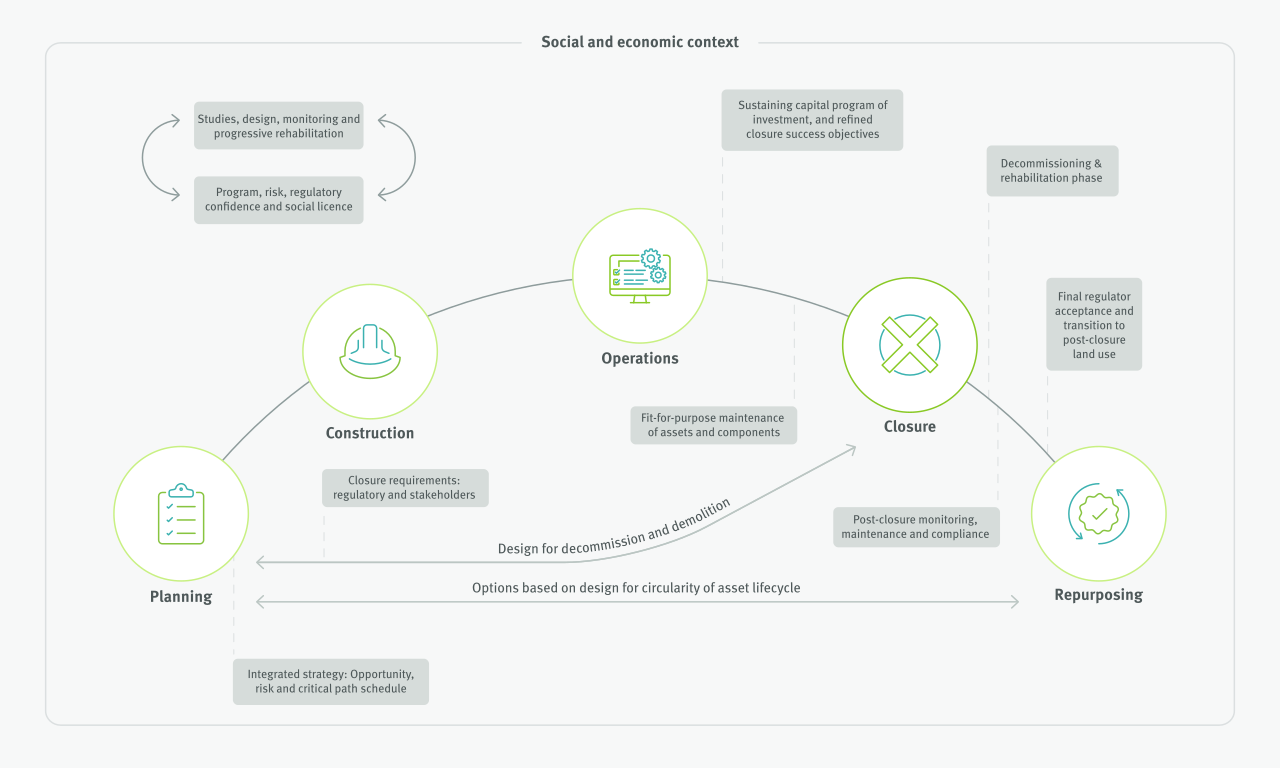
By strategically rethinking where and how to allocate budget to avoid overcapitalising on investment, the value and performance of assets can still be optimised in the lead up to decommissioning.
Companies will increasingly require a comprehensive closure and governance strategy, like other corporate strategies, which will need to encompass site analyses, social and economic impact assessments and responses (including workforce and community transition), economic revitalisation, and a decommissioning process that meets defined finance and integrity requirements.
Those companies without a structured and well thought out approach may struggle to leave the site in a safe and useful state, leading to potentially expensive works post-closure. On the flip side, companies that do it once, and do it properly, can find efficiencies and alternate revenue opportunities during the process, involve stakeholders, and leave a positive legacy afterwards.
One thing is key, the need for flexibility, because market and business dynamics can change.
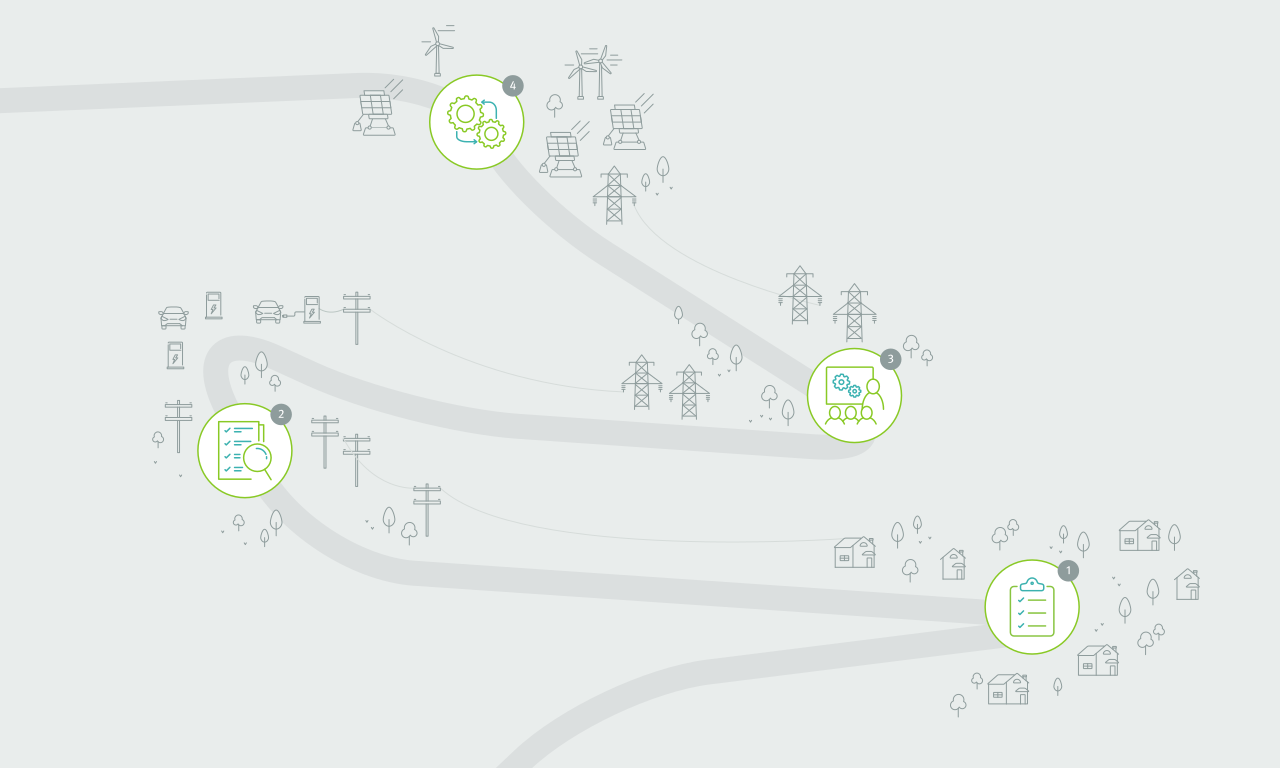




Figure 2. Example of decommissioning, demolition and rehabilitation methodology. Hover over the icons to learn more.
Used the right way, this methodology can propel companies onwards by bringing into focus what is required to close a power station. A well-developed decommissioning and demolition strategy minimises the cost of inaction (or late action). If a company can see a clear and transparent pathway to closure in the form of effective approaches, there is an important, and easily understood, ability to leave a positive legacy long after closure.
Striving for a positive legacy for the site, beyond solely compliance, brings about a range of opportunities for future value creation by applying a strategic approach to securing ongoing beneficial uses.
Environmental assessments and site surveys can identify potential hazards and pollutants. This then effective strategies for managing waste, pollution, and contamination during the decommissioning process.
For asset owners, waste management during decommissioning and demolition is complex and can be challenging. There are, however, pathways towards achieving sustainable solutions at manageable cost to the company and minimalised cost to the environment and communities. With good closure practices, works pertaining to a facility’s closure, while still in some form of operation, may negate risks associated with the licence to pollute and post-closure liability.
By closely examining how land can be transformed post remediation, decisions made during the decommissioning and demolishing phases may provide significant benefits for circularity of materials and products, and this has both a sustainability and economic benefit.
For instance, 98 per cent of the above ground structures at Munmorah Power Station in New South Wales were recycled when the facility was upgraded. Similarly, Battersea Power Station in England was repurposed into a mixed retail, commercial and residential precinct, receiving high praise from industry.
Any decommissioning and demolishing strategy must be nested within a transition plan, and this isn't just important for asset owners. Organisations across the whole value chain may have an important contribution to make, for instance, being able to reuse materials and assets, or remanufacture equipment in a controlled industrial process.
Organisations across the whole value chain may have an important contribution to make.
On the flip side, there are times when company leaders defer making definite decisions on the future of a site to retain optionality. It’s important to note that whilst technology advancements may assist in decommissioning and demolishing activities at future dates, sites in disrepair and decay are more difficult to reconcile and repurpose.
Reputational risk of inactivity may be on the line. The opportunity to capture environmental, social or economic value is also at risk. Notwithstanding countervailing factors with uncertain futures, there are different ideologies that must be weighed by asset owners needing to remediate sites.
Power stations and similar assets typically attract and build communities around them. The asset will have provided generational employment opportunities and helped to support local economies.
Expectations around asset closure have changed in recent decades, now becoming the responsibility of companies to consider how to deliver a long-term a positive legacy for communities. They could, as part of a social licence, play a leading role in facilitating alternative employment and local business revenue opportunities.
For this to be achieved, extensive collaboration between the asset owner, communities, businesses and government is required. If alternative economic development and financing approaches are able to be facilitated, there is the potential to mitigate social and economic impacts early.
How companies manage their social responsibility to communities, and deliver social value through this asset end stage, will impact reputation and a social licence to operate:
Involve stakeholders in discussions and asset staging decisions. Key stakeholders such as Councils, Chambers of Commerce, community members, and local networking and social groups are important partners in this process. Transparent communication is key to address areas of concern.
Bring those affected by the transition on the journey through clear and trust-based engagement and communication, together with socially, economically and environmentally responsible workforce transition planning.
The timing and sequencing of decommissioning, and which assets are to be demolished verses what will be repurposed needs to be undertaken as early as possible. This will provide an insight into the types of economic activity and employment opportunities that may exist post closure.
Collaborate with communities to support their transition as the power station progresses towards decommissioning and demolition. This may include fiscal or other forms of support for local community programmes and initiatives that will support community well-being and resilience, both in the short- and long-term.
Recent examples of innovative asset closures include real estate around power stations being redeployed for large-scale battery storage, port facilities exploring the role of large-scale hydrogen electrolysers, an abandoned gold mine acting as a hydro pumping scheme, a mine closure becoming a mountain biking mecca, and materials manufacturing plants converting to major retail distribution centres.
Although Australia has many unique aspects to its network of power stations, inspiration can be drawn from international examples.
In Germany, the government's Coal Phase-Out Act combines phased closures with support for affected regions, including retraining workers and investing in new industries. The UK has a similar plan. Its coal closure programme includes proactive community engagement, workforce transition support, and rehabilitation of former mining sites for sustainable land use. There are also numerous examples of asset-based community development in South Africa and Canada, where local communities have initiated development themselves by identifying and mobilising existing, but often unrecognised, assets.
Leading companies with interests in Australia will recognise that careful and sustained early action over time will generate greater efficiencies and lessen the risk of unforeseen issues, while simultaneously ensuring the longevity of operations until closure. For this reason, sustaining capital, engineering and planning advice provides a pathway to maintaining a facility’s social licence to operate, minimising costs and risks during the final phases of operation, maximising employee and public safety, and leaving a stable community legacy beyond closure.
When it comes to decommissioning, start early. For example, preliminary works and information gathering (such as original engineering drawings) is key for a holistic understanding of assets, both current and historic. Focus on the things that can be controlled to avoid future issues, such as making sure that pipes, tanks, bunkers, coal stockpiles, oil or diesel facilities are cleaned and organised during decommissioning, to reduce the stocks to be remediated post closure.
Decommissioning and demolishing a power station will, for many asset owners, be a once-in-a-lifetime experience. Assets have been operating for decades with the focus around maintaining and growing operations, business continuity and maximising returns.
Decommissioning and demolishing in today’s more complex and multi layered environment is new. It requires a new and open mindset to consider assets and sites in a different light. Different sets of skills may be required when investment choices with shorter paybacks become the priority.
Further, decisions to bring forward or move back closure dates requires team members to be agile and comfortable with ambiguity and uncertainty. Inevitably, difficult decisions will need to be made. This is where adopting a fit-for-purpose approach enables teams to effectively communicate on, and respond to, complex challenges with a wide stakeholder group.
Contributing author: Simon Mezger

Managing Director, Water & Environment – Australia

Lead Consultant, Energy – Australia
This paper explores three individual change scenarios for the Safeguard Mechanism, illustrating different pathways for greater emissions reductions in Australia.
Australia's energy transition requires more than technical plans. Discover four ways to build the people, culture and capability to deliver infrastructure at scale.
Aurecon’s ecology and biodiversity expert shares how to achieve timely project approvals, what regulators want, and how to navigate regulatory changes.