Western Harbour Tunnel, Sydney, NSW, Australia
Aurecon is transforming Sydney Harbour, replacing dredging with TBM tunnel engineering to deliver a faster, safer and more sustainable second harbour crossing.


Change your location to view content tailored for you.
Goulburn Valley Water in Victoria, Australia, is focused on leading a more sustainable, resilient and prosperous future for the Goulburn Valley region. In addition to implementing initiatives to reduce carbon emissions, it is investigating projects that have potential to maximise resource recovery and eliminate waste.
As part of this focus, Aurecon was appointed to investigate the region’s demand for green hydrogen.
This study follows a plan previously developed by Aurecon for the water utility which highlighted that hydrogen, as a product, may be able to be produced from the utility’s purified recycled water, with enough supply to meet demand.
That plan developed a pathway for the Goulburn Valley region to better integrate its energy, waste and water systems. It was not only to improve the environmental resilience of the region but also increase its prosperity through the generation of new business models and jobs. Hydrogen was identified as one of the key enablers, leading to Aurecon’s appointment to explore the commercial and technical viability in detail.
In exploring the hydrogen opportunities further, Aurecon studied the possibility of a renewable hydrogen ecosystem. The region’s industry base is dependent on agriculture and food manufacturing and is heavily reliant on consistent energy and water supplies. This also includes road transportation for connection to national and international supply chains.
Aurecon’s study revealed there is a demand for renewable hydrogen in the region. It highlighted if a renewable hydrogen ecosystem was established it may help to close the loops of hydrogen production and hydrogen transport identified in previous studies.
Opportunities were identified for the region to meet regional waste, water and energy challenges that build circularity into the economy and leverage the advantages offered across Goulburn Valley.
These were:
To make the necessary changes across the region, it will take private and public organisation collaboration with industry groups and communities. Responding to the transitions required over the coming decades is not something any one organisation can tackle alone. Partnerships will be required to create new industries, jobs and economic prosperity, whilst addressing physical and transition risks from climate change (Figure 1).


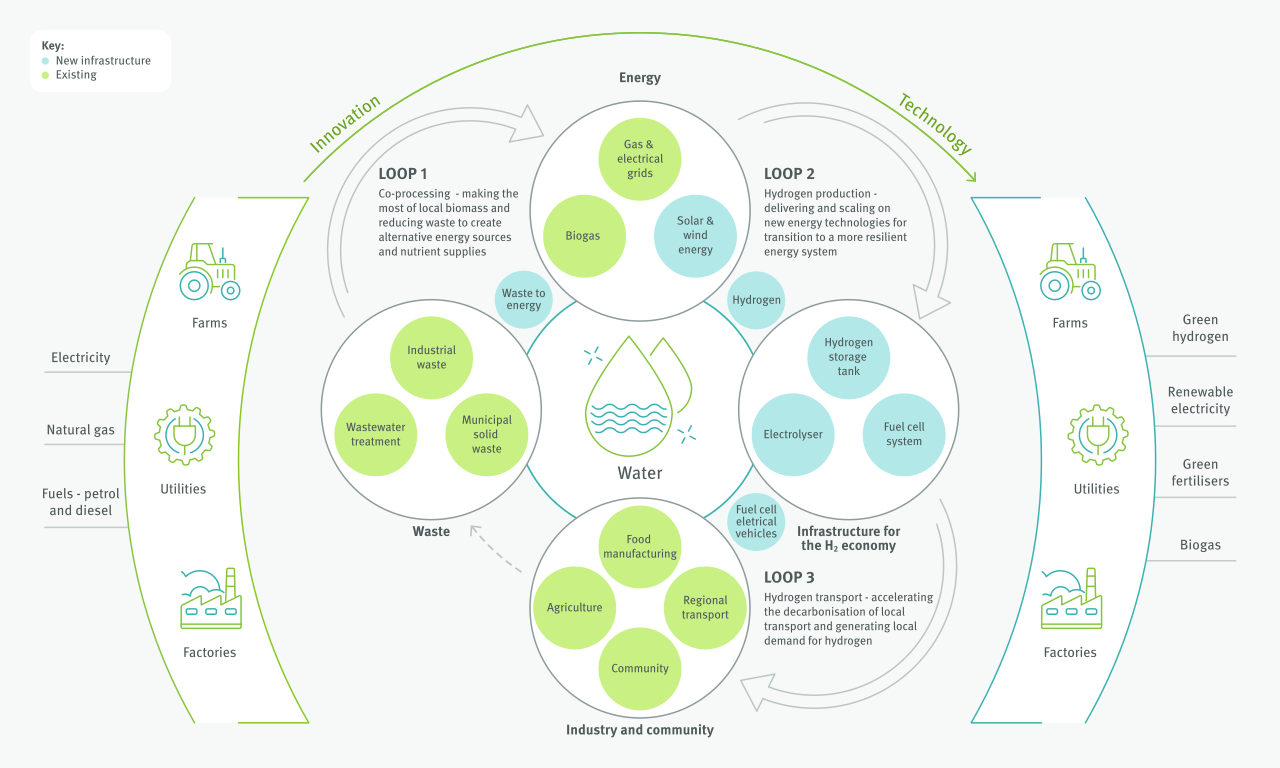
Determining local demand for renewable hydrogen across a broad range of industry sectors formed the basis of the study. These industries included manufacturing, agrifood, transportation, government operations and utility services.
45% of Goulburn Valley's exports come from food product manufacturing
48.5% of Victoria's fruit comes from the Goulburn Valley region
20% of Goulburn Valley's exports come from agriculture
$2.5 billion from food processing accounting for 18% of regional Victoria's food processing
25% of all truck registrations in Victoria are from the Goulburn Valley region
2.3M tonnes/year of GHG emissions produced in the region (estimate)
Aurecon identified transition pathways based on different levels of maturity of hydrogen production for different industries. This included industrial equipment as 80% in the region currently use natural gas (mainly for boilers).
A potential annual demand for renewable hydrogen of up to 11,000 tonnes with associated abatement of 870,000 tonnes of CO2-e was calculated if regional partnerships are established, however, it’s important to note this doesn’t include NOx emissions. This is based on total potential fossil energy use and doesn’t go into detail on other decarbonisation alternatives.
Across the sample group of industries used to analyse the fuel consumption data for this study, at this calculation, up to 80% of Scope 1 and 2 emissions may be achieved.
A successful hydrogen ecosystem must deliver co-benefits across industries from an environmental, social and economic perspective.
Aurecon used a multifaceted approach to determine the possible decarbonisation co-benefits for the region (Figure 2). With natural gas abatement through hydrogen fuel switching across the manufacturing and commercial industries, together with transport emissions abatement through hydrogen fuel cells, hydrogen demand opportunities can be found.
There is significant technical potential for green hydrogen alternatives, up to 1,370,000 GJ of energy per year, with associated Scope 1 and 2 annual emissions abatement of 870,000 tonnes of CO2-e.
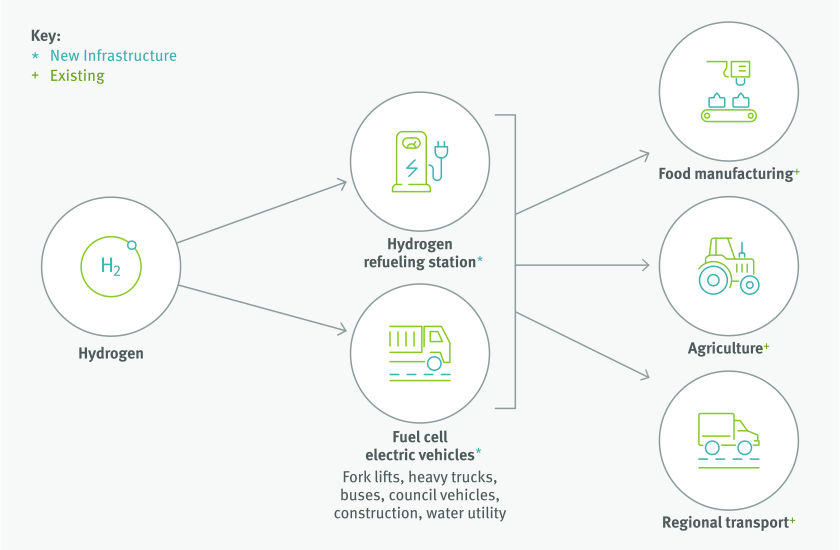
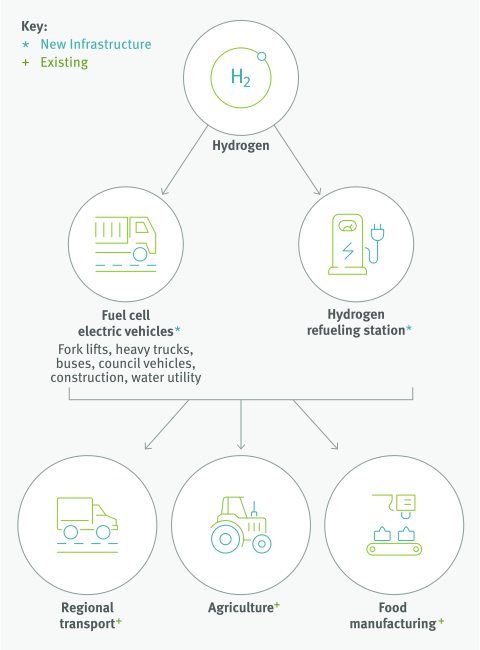
Figure 2. Generating local demand and creating pathways for decarbonisation in the Goulburn Valley region. Source: Goulburn Valley Water.
Aurecon’s study indicated Goulburn Valley may be able to deliver and scale new energy technologies to decarbonise regional industry. Realising this would require new infrastructure and skills, along with continued collaboration between public and private organisations to capture economic returns and circular economy benefits on offer.
This project was co-funded by Goulburn Valley Water and the Victorian Government’s Department of Land, Water and Planning with their project partners.
Aurecon is transforming Sydney Harbour, replacing dredging with TBM tunnel engineering to deliver a faster, safer and more sustainable second harbour crossing.
Aurecon delivers engineering, environment and planning advice to transform CleanCo’s Swanbank Precinct into a low-emission energy generation and storage hub.
Aurecon helps future-proof local education and careers with state-of-the-art education facility for Mount Gambier using 100% locally sourced engineered timber.