Q&A: What about hydrogen as a future energy, zero-emission technology?
Developing hydrogen as a future energy or fuel presents myriad risks and barriers to be navigated in order to unlock the benefits the technology can provide.


Change your location to view content tailored for you.
The climate change transition is not simply a move to cleaner fuels or a like-for-like replacement of raw material and energy exports. Instead, it is a complete metamorphosis of the energy and commodities ecosystem.
Such a fundamental shift in customer expectations and global market dynamics means there are significant opportunities for organisations and countries within the hydrogen economy to balance.
The utility value of hydrogen stems from its versatility as an energy carrier, storage medium, and chemical feedstock. It is expected to play a significant role in the deep decarbonisation of industries; however, it is more than that, with the potential to intermediate the provision of electricity, mobility, heat, movement, water and work.
Broadly, global investment markets are signalling that renewable and green hydrogen is the end game for supporting generational transition, diversification and emerging industries, as shown in Figure 1.


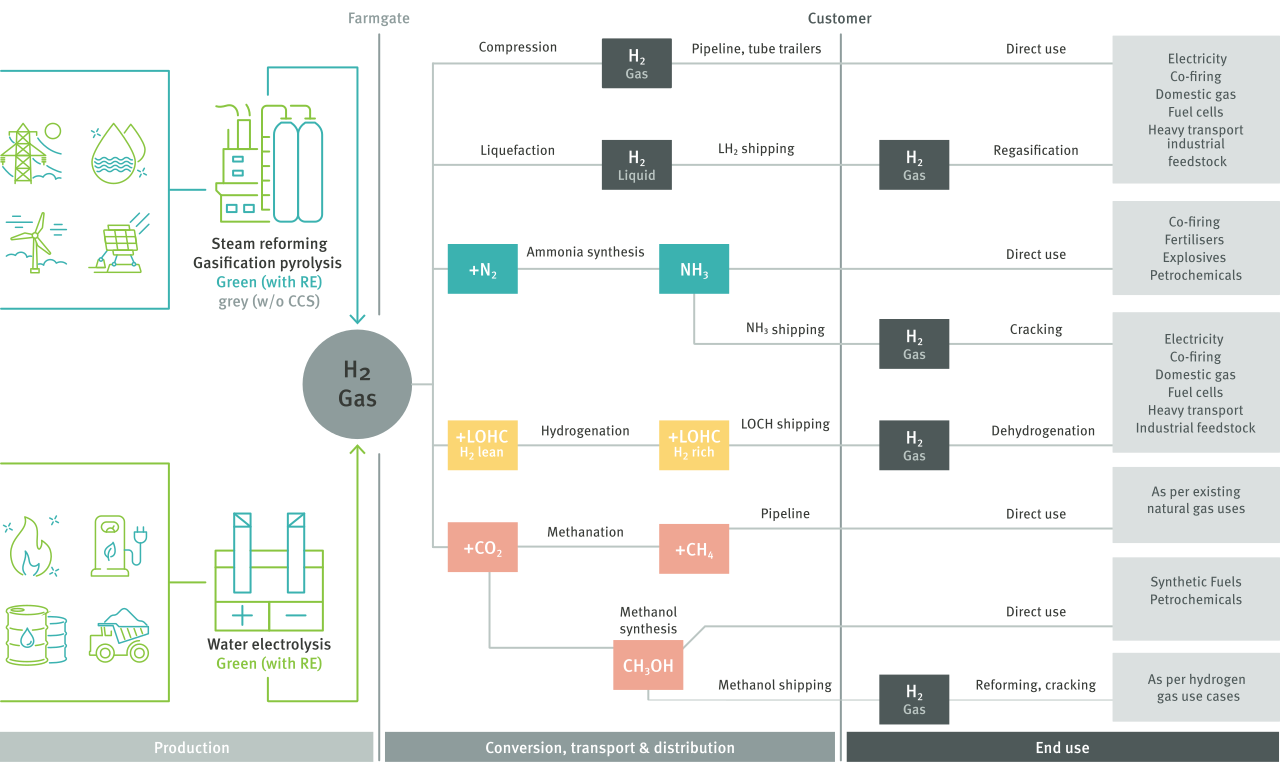
Confidence in the hydrogen economy will be boosted from policy commitments from governments, as well as heeding lessons learned from other sectors, such as renewable energy. The shift to a successful and viable hydrogen economy will require a number of factors to ensure that the transition takes place safely and effectively.

Nation-wide strategy and legislation to allow scaling of production and research into hydrogen use cases to encourage sectors to move away from fossil fuels use and therefore raise sufficient demand for hydrogen and its derivatives.

A well-dimensioned network of end-user infrastructure, an ecosystem of transport and storage infrastructure, and capacity at ports (for both export of product and import of equipment) is the backbone of a hydrogen economy. Future workforce opportunities and broad economic growth are benefits of this factor.

To enable a hydrogen economy, renewable power to hydrogen facilities need to proliferate, production methods need funding support to mature, and the costs of production need to be modelled as predictable revenue streams.

Success in a hydrogen context will hinge heavily on how well organisations can adjust to new ways of doing business (adapting business models), upskill their people and capitalise on a culture of change.
Projects to prove and develop hydrogen’s potential across a range of sectors is underway globally. As the opportunities to use hydrogen expands, demand for products will increase and production will scale-up. This in turn will bring down production costs, further attracting investment and demand.
These are the top 10 key factors to unlocking the hydrogen advantage:
Looking forward, the prospect of a hydrogen economy is very real. If organisations can remain competitive by taking a broader view than techo-economics alone, it will help this dynamic market flourish and thrive. This broader view includes adapting business models, upskilling teams and shifting incumbent business cultures.
We also recognise that it takes political will and alignment with investors and economy participants to accelerate an emerging economy.
As the certainty around hydrogen increases, hydrogen mobility application will be boosted. With this increase comes technical and product advances so that costs of production, distribution and use will becoming increasing affordable. The key to unlocking the hydrogen advantage is continuing partnerships between organisations, governments and educational institutions.
All sectors have the opportunity to play a leading role in shaping a hydrogen future with the ability to focus on areas for investment that offer the greatest certainty for growth to ensure that a hydrogen economy is a runaway success in the future.
Contributing author & reviewer: Megan Wheeldon

Principal, Future Industries – Australia
Developing hydrogen as a future energy or fuel presents myriad risks and barriers to be navigated in order to unlock the benefits the technology can provide.
Aurecon's future energy experts respond to key policy questions that will help to shape a National Hydrogen Strategy for Australia.
Hydrogen plays an integral part in a decarbonised future. How do organisations innovate their business models to meet shifting market priorities?