

How will hydrogen support climate change transition, and the rise of emerging industries?
In this thought leadership series, Aurecon explores the key advantages of a hydrogen economy for emerging industries in the transition to a net zero future.


Change your location to view content tailored for you.
Hydrogen is expected to play an integral part in a decarbonised future. Every sector – from oil, gas and mining through to electricity, transport and property is looking to decarbonise their businesses and supply chains in some way. For hard-to-abate sectors, hydrogen is one of the few options to enable this. Many forecasts predict the global demand for hydrogen will exceed 500 million tonnes per annum by 2050, compared to today’s modest demand of 90 million tonnes per annum.
Despite massive growth forecasts, the current state of hydrogen adoption is varied. Regardless of where various sectors are at in their hydrogen journey, the focus to date has largely been on techno-economic feasibility – the assessment of the technical and economic potential of producing hydrogen.
While the techno-economics of hydrogen are vitally important, securing a competitive advantage in the hydrogen economy will require looking beyond the cost of supply and relative economics, and focusing on business innovation.
Producing hydrogen is fundamentally a conversion business, in which a raw material is processed into a value-added product. In blue hydrogen production, natural gas is processed into hydrogen through steam methane reforming (with carbon capture). Green hydrogen is produced via electrolysis, in which electricity (sourced from renewable energy) is used to convert water into hydrogen and oxygen.
Hydrogen differs from traditional extraction businesses like coal, oil and gas because it relies on the conversion of feedstock such as gas or electricity. In contrast, mining and hydrocarbon businesses extract a raw material and export it at scale. Because hydrogen can be made and not extracted, it will be possible to produce it competitively in many locations around the world.
Additionally, the simplicity of green hydrogen production can only result in one outcome – a fiercely competitive market, which will attract new and nimble players to the energy sector.
While techno-economics are essential for business case development, what is also needed is disruptive innovation – not so much in hydrogen technologies (although this is required), but in how organisations innovate their business models to meet shifting market priorities and adapt organisational culture to support new market entry.
Success in a hydrogen context will hinge heavily on how well businesses can adjust to new ways of doing business (adapting business models), upskill their people and capitalise on shifting culture. Success will depend on how effectively businesses can navigate ‘disruptive innovation’.
According to Clayton Christensen, the founder of disruptive innovation theory, disruptive innovation describes the process in which new market entrants can displace incumbent businesses. His theory outlines that disruptive innovation is rarely a technological breakthrough, but a series of incremental adjustments that new entrants make to their business models to reflect changing market dynamics.
Christensen’s theory is hugely applicable to the growing hydrogen industry. The energy market has arguably never seen more disruption than it is seeing today, and never has it been more important to assess this disruption and use it to drive innovation in business approaches.
In the context of ‘disruptive innovation’, a business model relates to how organisations create, deliver and capture value. Business models are a framework of management systems, skills, and relationships, as outlined in Figure 1.
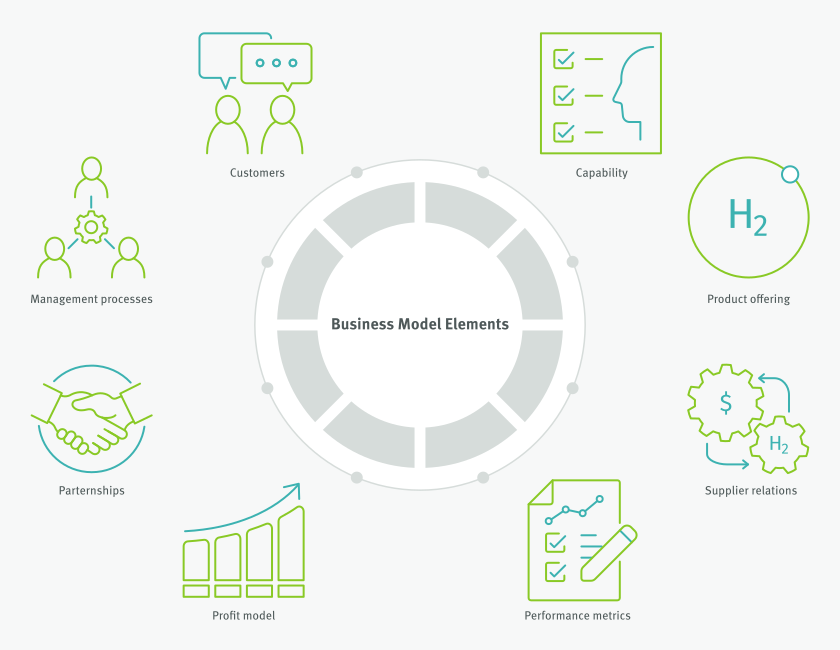
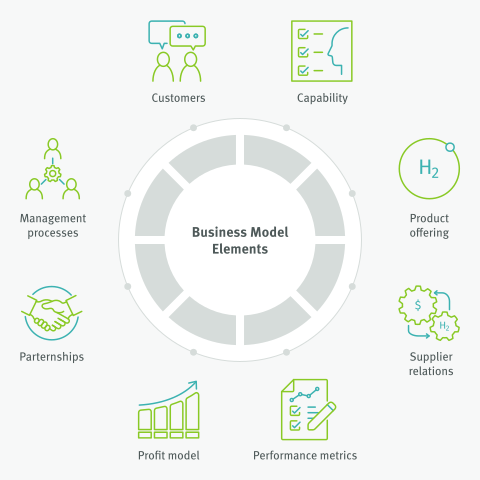
Figure 1. Business model framework.
Over time, businesses hone in on an effective business model which represents their existing product offering. However, ‘lifting and shifting’ a known business model to suit a new product offering like hydrogen, presents potential roadblocks for successfully developing a hydrogen business. If one element of the business model shifts – the product offering – then all elements of the business model should also be re-examined in order to support new business development.
For example, key elements of the traditional oil and gas sector business model include ownership of assets across the production value chain, long-standing bulk commodity offtake agreements and the ability to secure reserves through petroleum licences and tenures. In contrast, green hydrogen production does not require extraction from reserves, relying instead on access to cheap feedstock (electricity, renewable power, quality water).
Additionally, production of hydrogen via electrolysis does not require complex processing capability (unlike oil refining or liquefied natural gas production). The nature of reduced exploration and processing risk is already attracting new companies who have traditionally steered away from the energy market (for example, large mining and infrastructure companies in Australia).
Another key element of the oil and gas business model is the requirement to pay tax on profits generated from the sale of petroleum commodities (in Australia this is known as the Petroleum Resource Rent Tax or PRRT). As we continue towards a hydrogen future, not only will traditional hydrocarbon business models change, but so too will the business models of governments that rely on income from hydrocarbon taxation.
With such a fundamental shift in product offering and overall market dynamic, achieving hydrogen success means re-examining how business is done. It is vital to:
Identify opportunities for business model innovation well before disruption can permeate the market. This includes understanding the opportunities and pitfalls of your business model when competitors have experience operating at reduced margins and a lower cost of capital. Actively pursuing new ways of doing business and reflecting on the impact of emerging trends in the hydrogen market, will enable companies to expect and manage the impact of new entrants to the market.
Metrics typically used to assess traditional projects – rates of return, net present value thresholds, tolerance to risk – should be different for new ventures in hydrogen. Those leading the way are aligning performance metrics to decarbonisation and are making bold changes – some split out a new hydrogen business from their existing one, allowing two separate investment frameworks to be developed for disruptive vs incumbent projects.
Learn from innovative and emerging examples, such as the development of decentralised regional hydrogen supply that facilitates decarbonisation of developing nations while combatting energy poverty (The World Bank 2018). In this instance new entrants are looking to replicate successful energy storage and distribution business models, rather than bulk commodity export models, to concurrently disrupt existing petrochemical and energy markets.
Understand how evolving hydrogen business models will impact your offering such as the Power-to-X (P2X) business model, where renewable energy is converted to product ‘X’. In this instance, the customer can become the central player in a decarbonisation ecosystem – supplying their own energy and hydrogen needs while also supplying other energy customers with minimal additional investment.
P2X ecosystems will shift business models from a bulk commodity export mindset to ‘hydrogen as an intermediary or utility’. Internationally, this approach is gaining momentum, with the German Power-to-X Alliance investing EUR €1.1 billion in synthetic methane developments. A recent Australian example is the NSW State Government’s commitment to develop P2X ‘eco-precincts’ in favour of traditional ‘dig and ship’ product export models.
In line with Christensen’s disruptive innovation theory, keeping close to existing customers – while important for sustaining the incumbent business – can provide misleading signals for handling market disruption. It is an opportune time for companies to reflect on their customer base and adjust long-term expectations for hydrogen uptake. It is difficult to predict the scale of market disruption by relying on existing customer signals alone.
Companies must deviate from the customer-led approach and develop their own hydrogen uptake scenarios. Customers won’t know they need a hydrogen solution until they need it and, as such, an analytical view on demand scenarios will be crucial for successful growth of hydrogen businesses.
Having the right skills and creating customised processes, metrics, capabilities and performance targets is vital for developing hydrogen growth opportunities. Green hydrogen projects require electrical energy to make hydrogen (skills usually found in the electricity sector), which is then used to process hydrogen into a derivative (skills typically found in petrochemical industries).
With the integrated nature of producing hydrogen, upskilling is critical to enable growth of a green fuel and energy business. Those taking leaps forward in the transition to hydrogen are focused on hiring the right people for the future now, and are acutely aware of the importance of ‘integrator’ style roles in navigating the complexity of hydrogen skillsets, including how organisations can work together to deliver an end-to-end hydrogen concept.
For long lasting success, it’s also vital to adapt business culture, the uniting link between technology readiness, commercial scaling, and project planning. Many sectors have developed ways of doing and thinking which are heavily entrenched in how traditional projects are delivered, including the mindsets of employees.
For example, traditional project execution models adopted in hydrocarbon developments often rely on passing performance risk to suppliers in engineering, procurement and construction (EPC) style contracts. In a new industry like hydrogen, where process lacks maturity, developers will likely need to become comfortable with taking on more risk themselves, as it is unlikely that EPC companies will accept the same standard of performance guarantee risk seen in traditional hydrocarbon project execution contracts.
To get to the place where we see a thriving hydrogen industry, we need to reflect on traditional business approaches and ensure that new ways of thinking and doing achieve the same level of cultural entrenchment
Regardless of the specific steps each individual business takes, the potential for disruptive hydrogen business models is substantial. Rethinking how projects, customers, skills and culture are approached and assessed, and adjusting your business model, accordingly, is a necessity for hydrogen success.
The energy transition is not simply a move to cleaner fuels or a like-for-like replacement of raw material and energy exports. Instead, it is a complete metamorphosis of the global energy ecosystem. Such a fundamental shift in customer expectations and global market dynamic means there are significant opportunities for new and existing organisations to adapt how they approach their businesses in a new energy order.
In this decade, the prospect of a hydrogen economy is very real. To remain competitive, how businesses transition demands a broader view than just techno-economics alone. ‘Lifting and shifting’ existing business models will not be enough in this dynamic market. Disruptive innovation, the act of adjusting how business is done, will be essential to develop a competitive advantage.
Adapting business models, upskilling teams and shifting incumbent business cultures, will enable businesses to navigate beyond the bottom line and thrive in what is undoubtedly the emergence of a new approach to energy and commodities.
Contributing author & reviewer: Megan Wheeldon
In this thought leadership series, Aurecon explores the key advantages of a hydrogen economy for emerging industries in the transition to a net zero future.
Developing hydrogen as a future energy or fuel presents myriad risks and barriers to be navigated in order to unlock the benefits the technology can provide.
Aurecon's future energy experts respond to key policy questions that will help to shape a National Hydrogen Strategy for Australia.