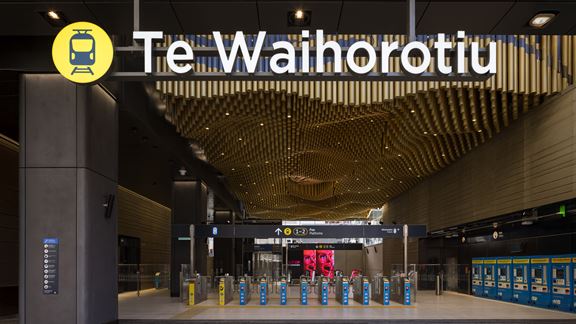

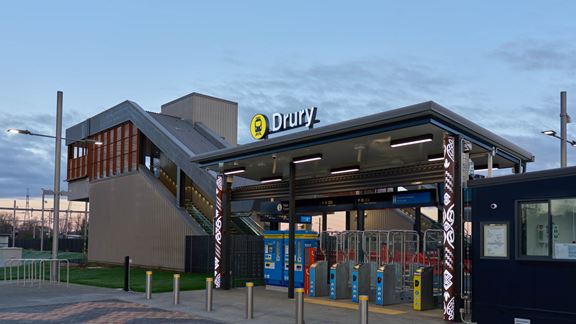
Drury Rail Stations, Auckland, New Zealand
Aurecon is delivering human-centred modular design to three new rail stations with integrated transport options for Auckland's southern growth area.


Change your location to view content tailored for you.
As transport systems worldwide face increasing scrutiny on carbon, climate risk, and community outcomes, government agencies are under pressure to demonstrate that public infrastructure investments deliver enduring value. They must also show the right decisions are being made early in the process.
The New Zealand Transport Agency Waka Kotahi (NZTA) engaged Aurecon to develop a tool that equips decision-makers with the necessary information to assess programs of work under the National Land Transport Programme (NLTP) and inform them about the implications of transport programs on projected GHG emissions.
Existing tools either offered only qualitative assessments or focused on individual projects, not large-scale programs. To close this gap, Aurecon conceptualised, designed, and delivered the Multiple Outcomes Assessment Tool (MOAT), a digital, data-driven platform that assesses the environmental implications of investment portfolios and at scale, with the capability to evaluate up to 10,000 projects in under a minute.
MOAT estimates greenhouse gas (GHG) and local air quality emissions across thousands of early-stage transport projects, even when business case data is incomplete or unavailable. It combines NZTA data sources, peer-reviewed modelling logic, and an interactive Power BI dashboard to produce high and low emissions estimates.
Decision makers can test ‘what if?’ scenarios – such as deferring, accelerating, or cancelling certain project types, across a national portfolio of projects – and immediately see the emissions impact at national or regional levels. Crucially, MOAT is not a forecasting tool for individual projects. Instead, it supports comparative decision-making during the earliest planning stages, helping NZTA quickly answer complex questions.
By providing this insight without attempting to rank projects, MOAT leaves space for professional judgement, contextual knowledge and stakeholder priorities.
Aurecon worked in close partnership with NZTA’s Quantify Outcomes team, and its technical reference and user testing groups. We also collaborated with Monash University, ClimateWorks and Emission Impossible to ensure the methodology was peer reviewed and future focused.
The work built on earlier development of the Climate Assessment of Transport Investment (CATI) tool. Where CATI provided qualitative insights, MOAT was conceived as its quantitative evolution.
Aurecon’s interdisciplinary team brought expertise in transport advisory, digital modelling, sustainability, climate change, infrastructure planning, and data analytics, combining these skills to deliver a powerful and transparent platform aligned with NZTA’s policy, data and emissions landscape.
Aurecon delivered MOAT in three key phases:
A Minimum Viable Product (MVP) was developed in Excel. It focused on carbon, using Transport Investment Online (TIO) data and existing emissions research to estimate enabled and embodied emissions for various activity classes. This first iteration offered a minimum viable product for emissions estimation across diverse investments from roads and public transport to walking and cycling infrastructure. Tested with real NLTP data, this proof-of-concept established the tool’s foundational logic.
The logic was then transitioned into a fully integrated Power BI platform, improving usability and computational speed to generate results across 10,000 projects in under a minute. In phase 2, Aurecon introduced local air quality modelling, integrated Vehicle Emissions Prediction Model (VEPM) data, and captured impacts from both light and heavy vehicles. Regional population densities and average speeds were added for more granular outputs.
To support interpretation, the tool adopted a GRADE methodology, adapted from the medical field, to score and weight the quality of evidence, and give users vital context when interpreting results.
Building on phase 2 (emissions modelling), Aurecon integrated economic, safety and transport resilience outcomes. This involved identifying and analysing new datasets, including NZTA’s national resilience assessment tool, which records data on landslips, fallen trees and other network hazards and their impacts.
Together these phases position MOAT to evolve into a truly multi-outcome assessment platform, supporting a wider range of measures aligned with the Land Transport Benefits Framework (LTBF).
MOAT fills a critical gap in New Zealand’s infrastructure decision-making toolkit. It is already supporting NZTA to inform NLTP planning and is helping uncover insights at the program and strategic investment case levels.
Beyond emissions, the tool helps decision-makers consider the long-term legacy of infrastructure investments across carbon footprint, resilience, economy and safety.
It is also supporting NZTA to identify where further investment in data and modelling refinement will deliver the greatest value.
MOAT has redefined how environmental and social outcomes are considered in early-stage transport planning. Its transparent methodology and range-based estimates help build trust, both internally and with stakeholders and decision makers.
The tool also shows how digital solutions can shift the focus from project-by-project analysis to system-wide insight. MOAT is set to become a cornerstone of sustainable transport investment in Aotearoa New Zealand, enabling faster, clearer and more confident infrastructure decisions that leave a positive legacy for people, place and planet.
Aurecon is delivering human-centred modular design to three new rail stations with integrated transport options for Auckland's southern growth area.
Auckland’s first underground railway system will reduce congestion, bring people closer to job and amenities, and unlock new development potential.
Aurecon is part of the Northern Alliance delivering NZ’s Ō2NL expressway, partnering with NZTA Waka Kotahi to improve safety, reliability and efficiency.