

Safeguard Mechanism’s contribution towards ambitious 2035 NDC
This paper explores three individual change scenarios for the Safeguard Mechanism, illustrating different pathways for greater emissions reductions in Australia.



Change your location to view content tailored for you.
Airports have been on a trajectory in recent years to tailor their passenger offerings and to find a balance between being a place of transit but also a destination – developing into miniature precincts.
While airports, airlines and their partners in the global aviation ecosystem have been justifiably focused on survival through the industry upheaval of the COVID-19 pandemic, an airport’s contribution to climate change remains a long-term risk that needs to be on the radar of owners and operators.
Reducing energy consumption and carbon emissions can be addressed hand in hand with the industry’s post-pandemic transformation and help airport owners to respond to changing social values and stakeholder expectations.
Now is the time for airport owners to formulate a decarbonisation roadmap towards Net Zero, to pivot towards operations and physical infrastructure that make a positive environmental and social impact. In this thinking paper, we explore the short-, medium- and long-term opportunities for airports on a pathway to decarbonisation.
Video: In this AAA webinar, Aviation Practice Leader Kevin Dearden and Future Energy Capability Leader Ben McGarry explore the short-, medium- and long-term opportunities for airports on a pathway to decarbonisation.
Airports could be our future energy ecosystems. Now, more than ever, airports can make a meaningful difference towards net zero emissions, and find new efficiencies and income streams to improve their environmental efforts.
With the arrival of the COVID-19 pandemic, airports experienced free-fall declines in customer numbers almost overnight. Consequently, revenue generators, all the way from aircraft landing fees to the retail shops, fell dramatically. Additionally, the commercial opportunities associated with non-aeronautical revenue became strained due to economic uncertainty.
To maintain lower operational expenditure and improve revenue generation, airport owners and operators must think beyond traditional infrastructure development and income streams.
Traditionally, airports played a passive or reactive role in energy generation and reticulation. What if they were energy agents, participating in energy markets and contracts in their own right? As part of a decarbonisation roadmap, airport owners could consider entering the energy provider arena by generating power on-site and exploring tangible solutions and commitments to becoming carbon neutral.
As most airports are significant land holders, they could take advantage of the opportunity to develop real estate and become superheroes of change by:

Controlling the usage and site wide impacts of their land holdings for positive environmental, social and economic outcomes

Providing the footprint for alternative energy generation or renewable energy harvesting (such as solar generation or hydrogen production)
An airport as an energy agent would behave much more flexibly in terms of energy consumption and use, as energy markets become more sophisticated. Energy agents use their own information and resources to create value.
For an airport, this may be through its own generation, and managing its own demand and energy storage, while employing a sophisticated energy trading strategy to anticipate future generation, demand and market price, and buy off the grid at the cheapest time. This may assist airports to continue to thrive in the face of major disruptions in the future, maybe not another COVID-19, but certainly environmental or technological disruptions.
Environmental factors will feature even more heavily on an airport’s ecosystem, such as comprehensive climate change resilience and adaptation risk management to ensure the continuity of operations and investments. Environmental commitment to surrounding communities could come in the form of noise dampening infrastructure or taxing operators with older engine technologies.
While the airport terminal and infrastructure contribute only a fraction of the total level of global aviation emissions, the spotlight is still on decarbonisation.
Key questions for airports to consider when formulating a decarbonisation pathway:
The growing expectation of airport owners is to find ways to expand non-aeronautical income to supplement aircraft landing fees and passenger charges. Traditionally this has been through airport-based experiences such as retail, dining, leisure and entertainment. In the future, this could be quite different.
For instance, what if airports could be the energy agent not just for themselves, but also for the precincts around them? They could be ‘hardened energy nodes’ – microgrids with better-than-average resilience to grid disturbances – able to restore power to the grid network to recover from a total or partial shutdown.
Reimagining an airport, not as a standalone business, but as a highly interconnected, living and adaptive environment reflects a broader trend towards ecosystem thinking. It aligns with the notion that airports are significant socio-economic drawcards to their surrounding areas. They provide direct and indirect employment, as well as social (and economic) benefits to people who fly.
These benefits result from two main areas: 1) construction on site, and daily operation of the airport terminals and ground operations; and 2) flights, access to the airport (cars, buses, trains, parking etc.) and associated projects such as hotels and airport-related precinct developments.
A factor in the successful transformation of airports beyond COVID-19 is the opportunity to decarbonise infrastructure, operations and systems. A decarbonised recovery would ensure that aviation continues to provide economic and social benefits to local, regional and national communities.
It is important to be pragmatic about the short-, medium- and long-term opportunities to decarbonise airports.
Purchasing carbon offsets, for example, is a less preferred approach than direct emissions reduction in reaching long-term goals. Some technology is not yet mature enough to implement across every airport estate successfully and cost-effectively, however with future improvements, implementation may become more viable. Successful initiatives, even small in terms of initial investment and return, can contribute to an altered decarbonisation mindset, inspiring an airport to focus on and monitor, emerging technologies.
The pathway to decarbonisation may not be the same for every region, in particular major city and regional, but that is expected, with some regions achieving their milestones earlier than others.
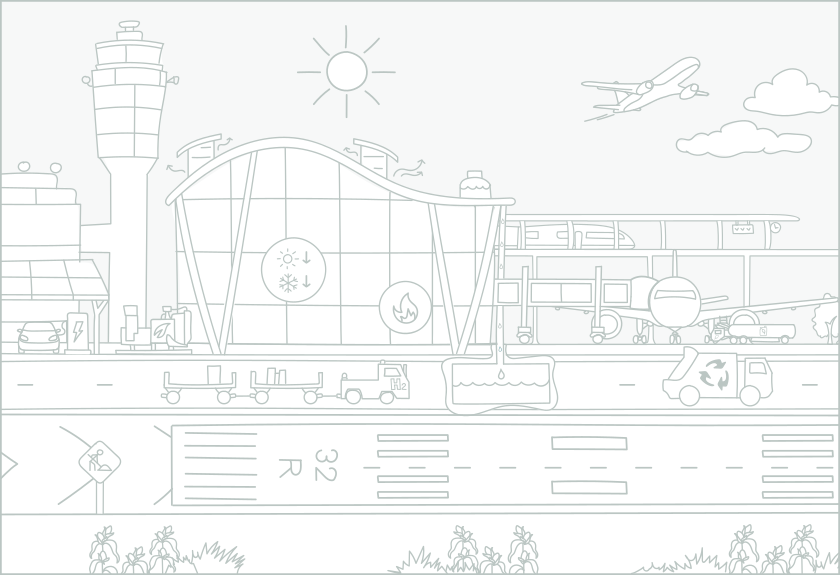
Measures in the short-term (ie those that can be implemented immediately), which may assist airport owners to decarbonise their operations and reduce climate impacts. Short-term measures applied as a long-term strategy to decarbonisation could be the most productive at laying the foundation for a prosperous and sustainable industry.

3
Inverse runway line marking to reduce the heat island effect from vast expanses of pavement.
2
Electrical fixed ground power and pre-conditioned air provisions to reduce airport auxiliary power unit inefficiencies.
8
Roof water collection in rainwater tanks reduces mains potable water use.
4
Ceramic window films that reflect heat to reduce the greenhouse effects of large, glazed terminal buildings.
9
Deploy passive daylighting systems, using less energy to keep buildings lit.
6
Predictive modelling of heating, ventilation and cooling to vary ambient temperatures and reduce the cooling/heating efforts of these systems, optimising performance and economics.
10
Tactical ground support equipment storage and scheduling to reduce distance driven.
11
Operational planning to reduce aircraft delays.
13
Turn the airport facilities into a smart building with low emissions.
5
Solar canopies on ground-level carparks to offset electricity purchase and power electric vehicle (EV) charging stations.
7
Deploy hybrid / low emissions landside transport and ground support equipment.
12
Planning and design of airside to reduce aircraft taxiing distances and congestion.
1
Ambient temperature reductions at the airport through use of recycled water, pavement sprinklers and introduction of cooling grass crops.













Hover over the numbers to reveal the opportunities to decarbonise in the short-term.
Measures in the medium-term (ie those that are feasible with new assets or modifications to traditional assets), which may assist airports to decarbonise their operations and reduce climate impacts. To succeed in putting the aviation industry on a pathway to decarbonisation, new types of alternative fuels need to be introduced in the medium-term, alongside consideration of heat recovery systems.
4
Natural ventilation system that drives fresh air into the building, while the warm, stuffy air inside rises and is expelled.
5
Passive heating and cooling systems reduce total annual energy consumption.
2
Vehicle to grid, allowing electric vehicles with known multi-day idle times (based on passenger itinerary) to be part of the on-site electricity storage system.
7
Improved public transport infrastructure to and from the airport.
6
Supply of sustainable aviation fuel, such as biofuel.
8
Heat recovery from chiller plants to generate hot water for buildings.
1
Biofuel (biomass) energy supplementation/generation, instead of diesel, to reduce reliance on fossil fuels and provide additional revenue and cost savings by participating in grid services markets.
3
Increased electrification of ground transport using mix of battery-electric and hydrogen.
9
Farms and agricultural production in surrounding areas to reduce food transport distance for distribution by air.
10
Alternative airfield construction methods to lower material use, transport and waste along the supply chain supporting the airport.
11
Centralised waste and recycling facility – capture waste for energy, and recycle energy.
12
Recycled stormwater to irrigate vegetative cover to lower air temperature on hot days.












Hover over the numbers to reveal the opportunities to decarbonise in the medium-term.
Measures in the long-term (ie those that are reliant on emerging technologies still to mature), which may assist airports to decarbonise their operations and reduce climate impacts.
A collaborative approach is essential to achieving the opportunities to decarbonise, and to deliver a framework that benefits economies and societies. Net zero carbon emissions at airports is achievable, but it will take hard work.
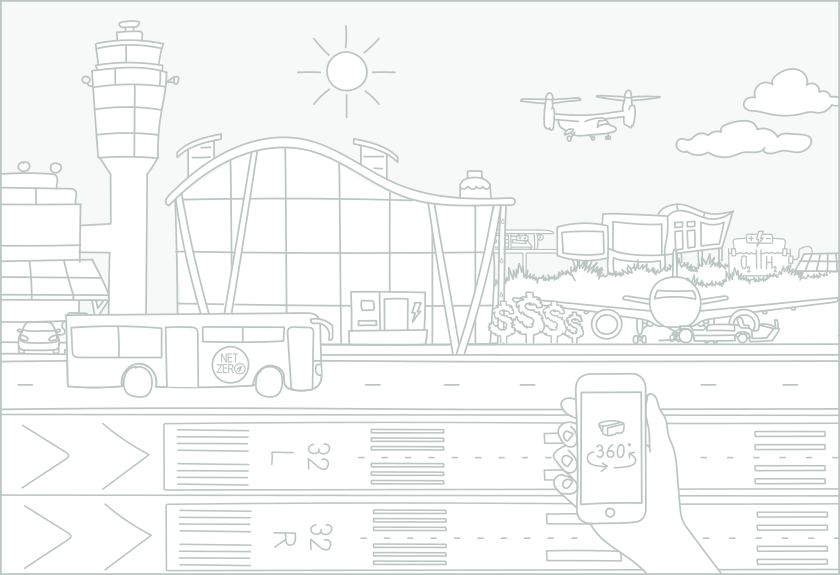
1
Use onsite power generation as an alternative source of income.
3
SkyCity developments close to airports to increase public transport use and accommodate population growth.
2
Green hydrogen production from onsite renewables, for use in e.g. ground support vehicles.
6
Green finance loans to develop and deliver non-aviation income projects. Interest calculated from annual assessment of the airport’s overall environmental, social and governance risk and performance.
5
Fully electrified ground transport, and serving as zero-emissions charging/fuelling hub for precinct transport networks.
4
‘Meet and Greet’ scheme. Aircraft main engine shut down after arrival with electric or hydrogen-powered tug tow to gate.
7
Develop airside movement infrastructure that reduces taxiing times and minimises the length of time that aircraft spend circling the airport while waiting to land.
8
Re-purpose traditional aviation assets as some people choose not to fly, instead, accepting virtual reality and augmented reality experiences.








Hover over the numbers to reveal the opportunities to decarbonise in the long-term.
Addressing the challenge of climate change will require investments in energy-efficient terminals, runways, land development and building systems. It is essential that we explain how changes to airports ‒ just like more efficient aircraft ‒ will actually advance the case of decarbonisation.
If investments are focused on future-proofing an airport, from an environmental, economic and social perspective, they will make use of a range of technologies, some of which may not be fully matured.
To decarbonise, airports and their partners in the aviation industry need the support of appropriate regulation and government policies to facilitate real change.
Appropriate government support and facilitation will help the aviation industry to transition energy sources from fossil fuel to sustainable aviation fuel, as well as accelerate research and development of electric, hybrid and hydrogen aircraft, and vehicles. We are seeing partnerships evolving on a range of green energy projects for the aviation sector, including the development of sustainable fuels for the industry that target net-zero emissions.
In the short-, medium- and long-term, airports have opportunities to demonstrate their ability to combine innovation and technology, to mitigate against and to reduce the effects of climate change, and to create modern state-of-the-art destinations that people will celebrate as they power a region’s growth and resilience into the future.
Contributing author & reviewer: Erik Kriel
This paper explores three individual change scenarios for the Safeguard Mechanism, illustrating different pathways for greater emissions reductions in Australia.
Australia's energy transition requires more than technical plans. Discover four ways to build the people, culture and capability to deliver infrastructure at scale.
Aurecon’s ecology and biodiversity expert shares how to achieve timely project approvals, what regulators want, and how to navigate regulatory changes.