


Making choices for de-risking renewable project delivery
Aurecon shares insights on how renewable project delivery models are evolving to better manage risk and deliver long-term value through project partnerships.



Change your location to view content tailored for you.
There should be a shift towards the measurement of sustainability performance on major projects, whatever the industry. Often the focus is too late or centred around ‘ticking the box’ compliance, missing the opportunity for true sustainability leadership with a project-specific strategy and objectives.
Achieving effective sustainability performance management requires strong leadership and a desire to leave a legacy for future projects. Focusing on the ‘why’ of sustainability is one way to keep the big picture in mind. Considering the four pillars of sustainability below, each project has a unique sustainability context depending on its purpose, geography and function.




Based on this context, sustainability leadership seeks to advocate for the implementation of sustainability outcomes that promote transparency and accountability, engage communities and result in the creation of shared value.
Sustainability infrastructure assessment systems provide the platform and the guide to measure and verify sustainability performance. However, it is often difficult to define and articulate meaningful sustainability outcomes and narratives if there’s only a checklist mentality.
Stories are everything – in sustainability as in life. By framing the context, setting meaningful targets, and measuring a project’s sustainability outcomes, they build a narrative that gives genuine meaning to the data and evidence. Engaging the project team, stakeholders and community early in a project’s development is part of the storytelling approach.
The sustainability narrative tells the story of a project’s outcomes, why they were pursued and their tangible measured benefits.
Sustainability leaders are wielding the power of narrative to engage project teams, stakeholders, and communities on the four pillars of sustainability and how these contextually relate to project performance management. Growing demands from project owners, governments, and communities, for transparency of sustainability performance and disclosure, means prioritising this storytelling as an imperative for success.
The merging of ideas, perspectives and areas of expertise, facilitated by an open communication process, reaps benefits for a sustainability performance journey. In practice, it means that a project team, from the outset, challenges the status-quo and searches out more sustainable ways to deliver a project. This influences everything; from the design of the project, to the materials used, waste management processes, and how the team works with the community and stakeholders.
Meaningful sustainability is achieved through collaboration among project partners, stakeholders and the supply chain. Sustainability leadership combines facilitation skills and pragmatism to deliver impactful outcomes with multiple benefits. These include minimising a project’s footprint and creating a safer and more integrated infrastructure that responds to its social, economic, environmental and governance context. The outcome is creating resilience to future changes such as climatic, social expectations, and user behaviour.
It takes strong sustainability leadership to champion monitoring and driving performance in project delivery and beyond. The advantage of sustainability leadership is that it’s more than ‘ticking the box’. It’s the project team, stakeholders and community, working in partnership, to deliver more sustainable infrastructure that conserves and enhances the environment for future generations, and creates positive social outcomes throughout its lifecycle (Figure 1).


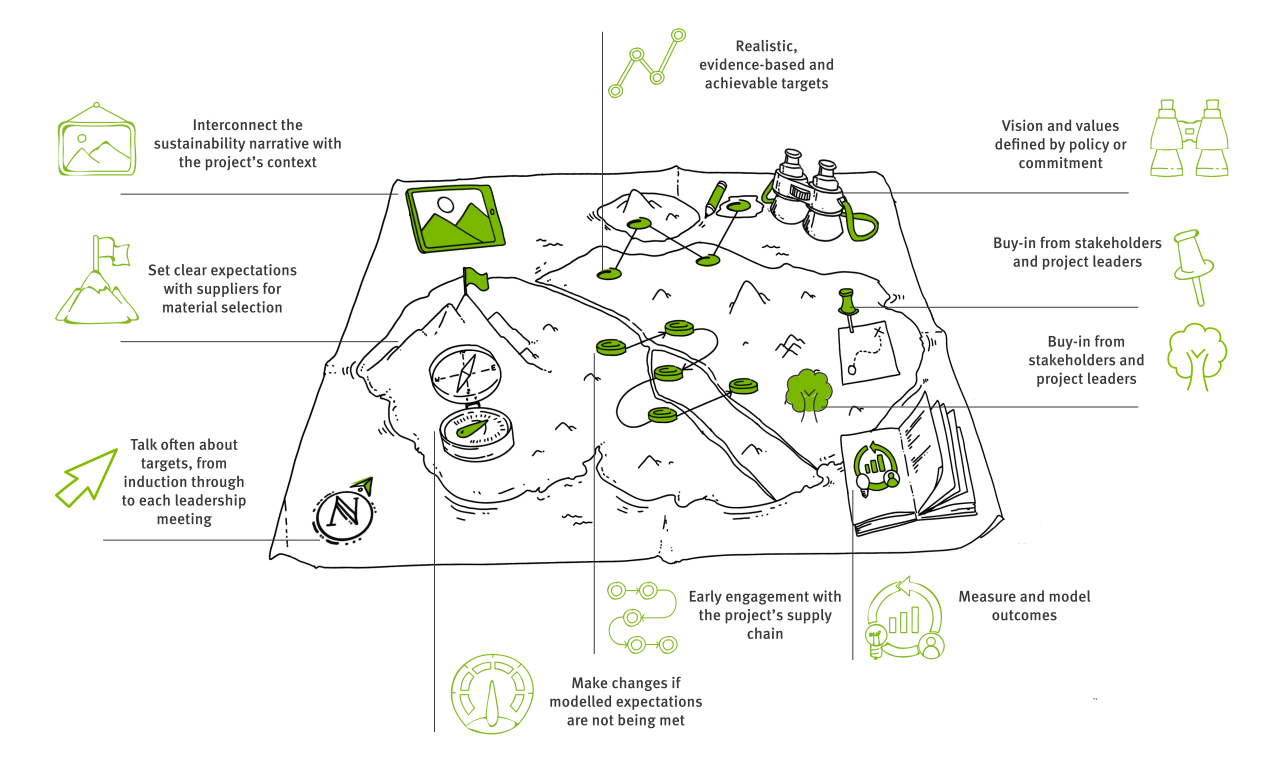
Infrastructure assets are long-term investments with lasting impacts over multiple decades. It is vital to integrate sustainability into the development and delivery of these projects, right now, to be able to tackle the global challenges of climate change in the future.
A project that benefits its customers, proponents, and the environment will provide a legacy for future generations.
A selection of transport infrastructure case studies demonstrate sustainability leadership from engineering, design and advisory company, Aurecon, are presented here:
Balancing the four pillars of sustainability on a major project is not a straightforward task. Unique for every project, it is a journey to define what sustainability is. Different sustainability factors should be weighted differently depending on which factors are important to the context of the project. Whether that be offering employment to local disadvantaged groups, preserving specific native flora or fauna, or achieving a reduction in the project’s carbon footprint.
Sustainability rating tools are a credible and transparent way to demonstrate outcomes. Contracts create accountability for design and delivery teams, often linking sustainability performance to performance requirements or to a specific ‘score’ using an assessment and verification framework, similar to the Infrastructure Sustainability Rating scheme, to provide a comprehensive scale verification for a project meeting its specific benchmark for sustainability performance.
A solid foundation, strong sustainability reporting and effective narrative communication are key to moving beyond simply achieving sustainability requirements and toward meaningful sustainability outcomes.
Contributing author & reviewer: Ellen Worthington
Aurecon shares insights on how renewable project delivery models are evolving to better manage risk and deliver long-term value through project partnerships.
The economic case for integrated asset and investment management in New Zealand and how well-governed infrastructure delivers lasting cross-sector value.
Aurecon draws insights from Committee for Sydney’s Jeremy Gill on how we grow Auckland's tech economy through placed-based, connected innovation precincts.