

Energy stability and security: From smelters to digital mega loads
Hyperscale data centres are reshaping grid design, stability and security. Grid-forming energy storage can restore local strength for digital infrastructure growth.


Change your location to view content tailored for you.
Power Usage Effectiveness (PUE) is a well-established way to quantify the energy efficiency of a data centre – but does it tell the full story with server racks and IT equipment becoming increasingly efficient? Is there a better measure and does PUE limit the ICT industry’s ability to support broader goals like reducing carbon emissions? How does it address changes in technology such as direct-to-chip liquid cooling?
In a world where data centres are an increasingly critical component of global digital enablement, we must explore whether there is a more complete measure of energy efficiency that supports the industry’s ability to reduce carbon emissions.
PUE is a simple metric that is used to compare data centre efficiency and is calculated by dividing the data centre’s total annual energy consumption by the total energy consumed by the IT equipment. The closer the figure is to a perfect ‘1’ the more energy efficient the data centre.
The global average PUE for data centres has largely flatlined in recent years, averaging between 1.55 and 1.59, reflecting an industry that has reached diminishing returns on efficiency improvements like optimising cooling systems and power distribution. But with large increases in AI loads and liquid cooling seeing a massive resurgence, a PUE measurement is not accurate on its own. Paradoxically, with more efficient server racks and the resurgence of liquid cooling, the PUE rate shows an increased figure rather than a reduced result.
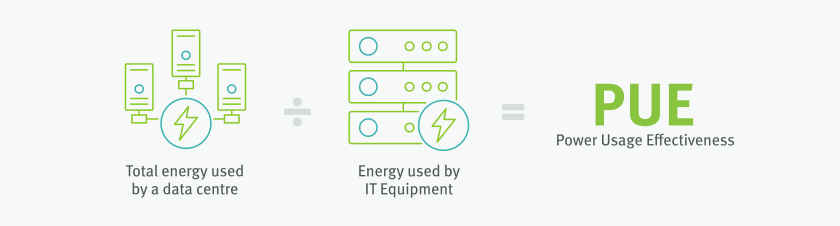
Figure 1. How Power Usage Effectiveness (PUE) is calculated.
PUE has long been the gold standard and industry benchmark for measuring data centre efficiency, however it provides limited incentives for organisations to make their IT infrastructure and computing more efficient (since more efficient computing results in a worsening PUE score). As a result, when tenants explore options for data centres to house their servers, consideration is sometimes only given to how power efficient the data centre infrastructure is, rather than the power efficiency of the compute infrastructure.
The primary purpose of a data centre is to process data efficiently but as AI workloads and more sophisticated server technologies emerge, the impact is felt on both the numerator and denominator of the PUE equation, resulting in misleading efficiency readings.
While PUE is not entirely obsolete, it is insufficient on its own. In a data centre, roughly 80 per cent of energy runs computers, and roughly 20 per cent runs the supporting infrastructure. Focusing only on minimising the 20 per cent of energy consumption attributed to supporting infrastructure overlooks the potential savings from optimising the 80 per cent used by IT equipment.
Improving IT efficiency can significantly enhance overall data centre performance, reducing energy used, and this highlights the need for a broader set of metrics that address both elements of the energy equation. If you just improve the IT equipment efficiency in an existing data centre, you actually increase the PUE.
At Aurecon, we work closely with data centre clients to develop reliable, efficient, and sustainable data centres that match their needs in terms of facility type, size, capacity, reliability, capital and operating cost, together with commercial return on investment.
Data centres have always been mission critical infrastructure and we must ensure we can not only design ones that are fit for the future, but also can be measured in the most helpful way possible for our clients.
As an industry, getting the next version of a suitable metric is important – we would argue that PUE isn’t sufficient. We are seeing that this is becoming more urgent – we note that the Australian Government’s New Data Centre Panel requires providers to 'target a PUE of 1.4 or better' amongst other requirements.
As an industry we must work together to enable our customers to be confident in the metrics that are reported, and that they are both helpful and accurate. We are working with our clients now to do this. What do you think?

Technical Director, Buildings Electrical – Australia

Technical Director, Project Management – New Zealand

Industry Director, Digital Infrastructure – APAC

Client Director – Australia

Industry Director, Infrastructure & Data Centres – Southeast Asia

Director of Operations, Built Environment – Singapore

Director of Growth & Delivery, Indonesia & Key Client Director, Data Centre – Southeast Asia
Hyperscale data centres are reshaping grid design, stability and security. Grid-forming energy storage can restore local strength for digital infrastructure growth.
Australia's energy transition requires more than technical plans. Discover four ways to build the people, culture and capability to deliver infrastructure at scale.
Aurecon’s ecology and biodiversity expert shares how to achieve timely project approvals, what regulators want, and how to navigate regulatory changes.