
Brisbane 2032: Creating lasting impact through transformative infrastructure
Aurecon shares insights on how the 2032 Brisbane Games can deliver legacy infrastructure and lasting economic, environmental and community value.



Change your location to view content tailored for you.
This paper describes a 6-step methodology to support the transition towards low-carbon and sustainable ICT infrastructure.
Our increasing use of digital tools, and global warming, are inextricably linked. As an example, a recent lifecycle assessment study for training large AI models, conducted by the University of Massachusetts, found that the training of the models emitted nearly five times the lifetime emissions of the average car, including its manufacture[1].
Information communications technology (ICT) infrastructure is vital to digitally-enabled operations, but as the demand for digital technologies and services grows, energy consumption and related emissions from ICT infrastructure also significantly increases.
For organisations that own, are refurbishing, or building new capital assets, the journey toward decarbonisation is crucial as the world tackles the ongoing climate crisis, and ICT infrastructure should be considered as part of the decarbonisation equation.
Every digitally-enabled action creates and stores data that uses energy and emits greenhouse gases. To effectively address the United Nations Sustainable Development Goal 13, Climate Action, society must implement new measures in national ICT policies, infrastructure design, installation, and adaptive planning.
So, how can organisations contribute effectively to these goals by transitioning toward low-carbon and sustainable ICT infrastructure? How can this be done in a way that is practical while simultaneously achieving expectations on cost, programme and quality? Let’s explore how choosing the right ICT infrastructure, leveraging innovation, and implementing an overarching decarbonisation methodology can help accelerate your organisation’s transition towards low-carbon and sustainable ICT infrastructure.
At COP26 in 2021, the International Telecommunication Union (ITU) signalled its strong interest in working with the United Nations to combat climate change.
This commitment to an agenda for global telecommunication/ICT development resulted in a call for a 30 per cent increase in net telecommunication/ICT-enabled greenhouse gas abatement[2] by 2023 compared to the 2015 baseline, a resolution that was adopted by 193 Member States.
The broad range of ITU standards linking ICT with the global drive towards net zero carbon emissions include technical and policy guidance for organisations, countries, and industries to innovate with digital technologies to reduce emissions and accelerate adaptation actions and resilience. Methodologies to measure the growing carbon footprint of ICT, and the first ICT sector science-based pathway, are in line with the Paris Agreement.
"This new ITU standard offers authoritative guidance on the pathway towards net zero emissions for the ICT industry. The standard is an example of what can be achieved with good collaboration between key partners. It represents a significant contribution to the international effort in pursuit of the United Nations Sustainable Development Goals."
Houlin Zhao, Secretary-General of the International Telecommunication Union
Investments in renewable energy to power ICT infrastructure, the decarbonisation of data centres, decreasing reliance on fossil fuels, and self-monitoring, analysis and reporting technology also known as SMART monitoring, have the potential to slash global carbon emissions by helping organisations and industries use and save energy more intelligently.
In addition, using ICT for sustainability in all sectors will create better solutions for delivering efficient energy, water, building, resource, and transport systems. Innovations on 500 Bourke St in Melbourne is one example of how the building owner, ISPT, committed to creating a building of the future, with appropriate ICT infrastructure, while also minimising embodied and operational carbon emissions.
In this instance, a decision was made to electrify an existing commercial building, incorporating an integrated converged network (ICN), whereby network ICT infrastructure is converged with the non-IT systems of electrical, hydraulic and HVAC, to be connected to the same data network. The benefits of just one network include simplified operations, improved management of the facility, lower operating costs and the potential to reduce carbon emissions.
In other words, the use of technology could help to increase environmental sustainability by continuously improving operations and processes. The challenge for the future is that digitalisation is not occurring at the same pace across every country, region, sector or organisation.
What we need is sustainability strategies that work from an economic perspective. Some of the innovations underway to assist organisations in reducing carbon emissions associated with ICT include:
Reducing ICT to optimise product supply chains, enable the conservation of resources, and prevent wastage from the production of products or services is key. One example is the circularity of ICT equipment, such as manufacturers taking explicit responsibility for product management from production to end-of-life. Similarly, ‘products’ here can include tailored commercial approaches to energy market exposure, and procurement of renewable electricity and carbon credits, as applicable.
ICT systems can benefit building systems in many ways and as a further contribution to sustainability. These include making provisions for the energy transition to all-electric buildings, SMART monitoring and individual automated controls systems that provide asset owners and occupants with opportunities to lower carbon emissions. For instance, using the Internet of Things (IoT) and SMART buildings systems to manage the volume and timing of energy consumption. An example of this is a project Aurecon worked on to optimise a chiller plant in a large commercial building that demonstrated a potential reduction in energy of between 10 and 15 per cent.
Modern AI models consume a massive amount of energy, and these energy requirements are growing at a breathtaking rate. In the deep learning era, the computational resources needed to produce a best-in-class AI model has on average doubled every 3.4 months[3]. Perhaps over a period, what we learn from AI may offset wastage?
A digital twin makes it possible to establish feedback loops to monitor, understand, optimise and reduce carbon emissions. Aurecon and the University of Melbourne created a digital twin for improved end-to-end asset management, strategic decision-making, and user experience at the Life Sciences complex. It accurately reflects real-world operating conditions, responds to changes, predicts outcomes, and distils information that enables the university to make better decisions for managing assets across their whole lifecycle.
The Jevons paradox is perhaps the most widely known paradox in environmental economics. In 1865, William Stanley Jevons predicted that as the UK’s use of coal became more efficient, it would make coal more attractive, increasing demand for coal rather than reducing it. This was certainly the case as people’s reliance on coal increased during the Industrial Revolution (and beyond).
Jevons Paradox refers to a situation in which an efficiency improvement leads to an even greater proportionate increase in total demand.
Admittedly, the young and rapidly growing industrial world that Jevons lived in no longer exists. However, ICT has similarities to coal usage as it has an ever-growing role in society and brings with it, carbon emissions. This is due to hardware infrastructure manufacturing, data storage and warehousing, and the energy required to power and cool ICT systems.
However, as the chart below shows (Figure 1), ICT infrastructure innovations, if delivered, could help save around 12 gigatonnes of CO2 by 2030.
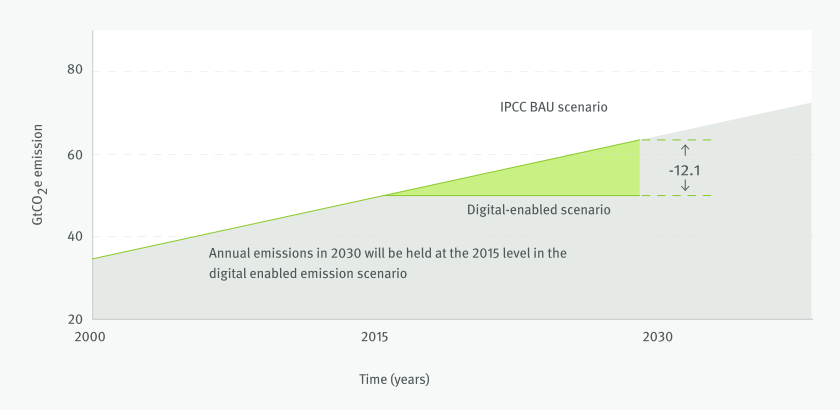
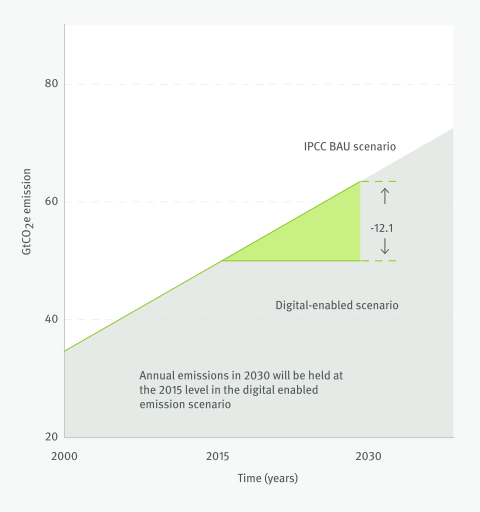
Figure 1: Intergovernmental Panel on Climate Change (IPCC) business as usual scenario compared to digitally-enabled carbon emissions trajectory towards 2030.
No-one would propose that society return to life experienced by people in the 1800s with none of the advantages that ICT provides. However, it is possible for organisations and industries to install, or upgrade, ICT infrastructure in a manner that minimises carbon emissions in the long-term.
It is important for organisations to have an overarching strategy that directs the transition towards low-carbon and sustainable ICT infrastructure. Aurecon’s asset decarbonisation methodology encompasses:

Confirm and establish the challenges and impacts of decarbonisation on your assets. Decarbonisation scope, objectives, strategies, and decision criteria need to be assessed as an initial stage of your journey towards net zero emissions. For example, are there customer-specific or sector-specific requirements? Is the business willing to set and achieve Science Based Targets?[4]
For effective decision-making, it’s recommended to capture, or develop, an investment decision process and co-benefit requirements during this initial stage, which will assist in formulating and implementing successful strategies towards decarbonisation

Define and establish emissions boundaries from an operational and organisational control perspective. Develop an emissions inventory for a base year to include relevant, material and controllable emissions (Scope 1, 2 and 3)[5] resulting from direct and indirect activities. The emissions inventory will indicate key levers and opportunities towards asset decarbonisation.

The key objective is to identify and define high-level opportunities that move the business or asset towards its decarbonisation objectives. These opportunities can be assessed against project criteria to determine their relative merit and flag any fatal flaws (for example, capital requirements, technology readiness, delivery risk). For shortlisted priority opportunities, the business can then identify, and source the necessary asset strategies, data and other resources needed to investigate the opportunity context and assess its value.

Undertake analysis of shortlisted options for decarbonisation opportunities and establish cost/benefits, project life, risk and impacts of the opportunities. At this stage, it is important to understand low-hanging fruit, and outline different project sets or scenarios based on the level of risk, cost, or timing (i.e. to identify alignment with the overall corporate objectives identified earlier).

Having rationalised and analysed the opportunity list, establish clear definitions (budget, scope, design/operational impacts, emissions abatement, risk, timing) and identify any synergies, interdependencies or conflicts between opportunities and options being assessed. In many organisations this would be reflected as an overall ‘directional’ business case for executive approval.

With business support confirmed, the goal should be to develop a detailed and comprehensive roadmap for implementing the project or programme, which includes phasing, timing, and optimisation of the implementation. This detailed definition and investment approval phase varies substantially, depending on businesses’ processes.
Establish an organisation strategy and procurement strategy for delivering the decarbonisation programme, ensuring effective governance, and determining detailed approval and delivery assurance processes. Consider conducting a readiness gap-analysis to establish what delivery and operational resources are required to carry out this programme, to reduce delivery risk and ensure seamless operational integration once complete.
Every sustainability-related ICT infrastructure project is unique, but what success looks like is consistent: measurably improved sustainability outcomes that are clearly mapped back to objectives and demonstrating progress to net zero and beyond.
Energy-intensive ICT infrastructure will continue to improve lives and enable sustainable growth. At the same time, there are plenty of opportunities to make it possible to achieve the United Nations Sustainable Development Goal 13.
Solutions can drive a sustainable future if organisations, industries and countries use the right ICT infrastructure, reduce ICT consumption with innovation and best practices, and create strategies to achieve net zero carbon emissions.
With the introduction of benchmarks, such as those from the International Telecommunication Union, together with frameworks and carbon constraint structures, organisations can be guided on ICT infrastructure-specific constraints on carbon or energy consumption. This will ensure that the full impacts of ICT infrastructure can be considered systematically, creating regular boundaries for analysis that are site-specific, but also network and supply-chain wide.
The ICT infrastructure share of each organisation’s carbon footprint varies in significance, however, collectively, all organisations and industries can contribute to lowering carbon emissions further by paying attention to their Scope 1, 2 and 3 activities – including ICT infrastructure – as a part of their overall net zero carbon strategy.
[1] Karen Hao, 6 June 2019, 'Training a single AI model can emit as much carbon as five cars in their lifetimes', MIT Technology Review.
[2] The UN specialised agency for ICTs, November 2021, 'Standards needed to achieve net-zero, said UN SG at COP26', accessed August 2022.
[3] Rob Toews, 17 June 2020, 'Deep Learning’s Carbon Emissions Problem', Forbes.
[4] Science based targets are net zero carbon standards that organisations can voluntarily commit to as a framework for net zero target setting, in line with climate science. It includes the guidance, criteria, and recommendations that organisations need to be able to set science-based net zero carbon emissions targets consistent with limiting a global temperature rise to 1.5°C.
[5] GHG Protocol: Scope 1 emissions are direct emissions from owned or controlled sources. Scope 2 emissions are indirect emissions from the generation of purchased energy. Scope 3 emissions are all indirect emissions (not included in Scope 2) that occur in the value chain of the business, including both upstream and downstream emissions.
Contributing authors & reviewers: Krishna Gopal

Design Director – Australia

Client Director, Clients & Growth
Aurecon shares insights on how the 2032 Brisbane Games can deliver legacy infrastructure and lasting economic, environmental and community value.
This fact sheet compares the community and environmental impacts of wind farm projects, and how ecologically sensitive design can deliver better outcomes.
How engineering and construction projects are evolving to champion biodiversity, through early planning, advanced technologies, and ecosystem stewardship.