Strategic Asset Management: New Zealand's missing link
The economic case for integrated asset and investment management in New Zealand and how well-governed infrastructure delivers lasting cross-sector value.


Change your location to view content tailored for you.
Light rail designed with purpose, underpinned by a strong and enduring vision, is relevant in the transport mix of modern cities because it shapes urban precincts as attractive places to live, work and visit.
Laced through an urban transport network of hubs and precincts connecting communities, it can be admired for its underlying connectivity of city life by attracting and moving significant numbers of people.
Today, light rail designers understand the broader benefits of precinct and placemaking to better integrate networks into the urban fabric and built environment. Visions for a corridor are built upon future land-use planning for precincts to support knowledge, employment, housing, health, leisure and tourism.
The attraction is to shape the future of a city through improved access and connectivity, the removal of cars from the road to reduce carbon emissions and ignite value capture through urban development adjacencies.
This thinking paper highlights the value proposition of light rail as a relevant and appropriate mode of transport in a city’s broader public transport network. Three light rail projects are featured as examples of how this transport mode can be a catalyst for urban revitalisation, decarbonisation and generational equity if developed for the right time, place and city.
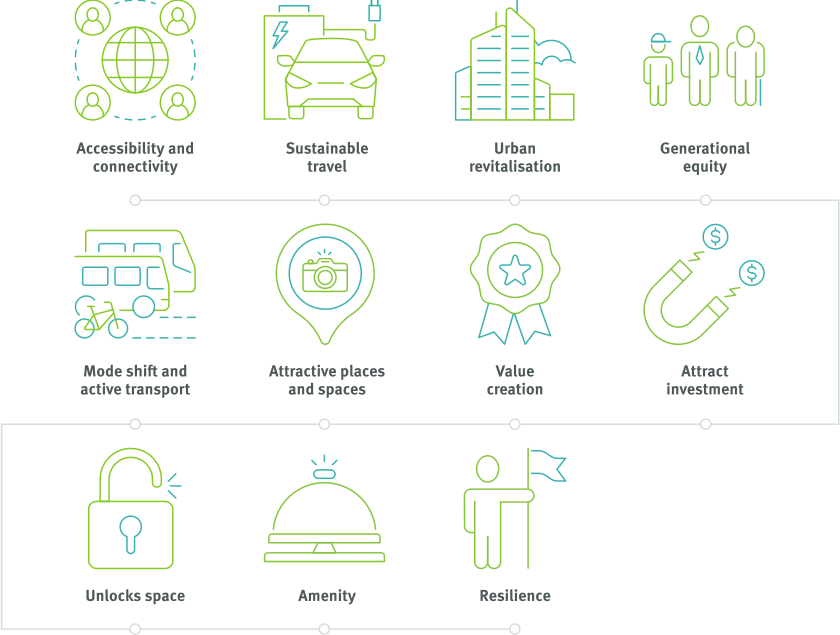
We acknowledge that light rail is not the only solution to a city’s transport challenges, but it can be an equitable and sustainable mode of public transport as part of a broader integrated transport network. When there are broader urban revitalisation, decarbonisation and intergenerational equity outcomes that are needed in a city, light rail may be well placed to deliver a number of benefits:

Accessibility and connectivity

Sustainable travel

Urban revitalisation

Generational equity

Mode shift and active transport

Attractive places and spaces

Value creation

Attracts investment

Unlocks space

Amenity

Resilience
Cities with growing populations are challenged to provide inclusive and liveable places as well as make transport more sustainable, accessible and cost-effective. This validates the role of light rail in promoting healthy communities by intersecting with active transport modes, and providing more diversity in mobility options for communities in urban and suburban city areas.
There are clear benefits of integrating transport projects with land-use plans, and outlining infrastructure funding mechanisms for value capture or value sharing, whereby urban development can assist the business case for investment in urban renewal and transportation infrastructure.
When choosing the appropriate transport mode (e.g. bus, bus rapid transit (BRT), trackless tram, light rail or heavy rail), the scale of infrastructure should depend on the existing or forecasted problem to be solved and equally, the opportunity or benefit that can be realised.
Light rail realises the benefit of being a catalyst for land-use change through facilitating urban revitalisation. While a light rail project may be designed and built in this generation, it’s the urban realm improvements that will also benefit future generations.
Bearing this in mind, it is important that light rail projects ensure today’s socio-economic demographic surrounding a corridor is not constrained in the future by private development pushing land values higher and higher.
The answer to this challenge is smart land-use planning that is considerate of that socio-economics and demographics that the public transport mode was developed for. It has been evidenced in cities globally that the places and spaces that emerge along a light rail corridor have deep meaning for communities.
Whether it be the convenience to quickly buy bread and milk on the way home, more time at Nan’s and less time taken to get there, or the stop precinct’s late-night pharmacy to aid an unwell child.
Because light rail has a design life of up to 100 years for much of its civil infrastructure, its permanence necessitates that the planning, designing and consulting on urban outcomes is undertaken with a systemic and deliberate approach. It is important to create a light rail corridor that reflects the needs of communities, as well as the character and attraction of an individual city. This means each network will look different for different cities.
The public transport mode shift is being challenged in cities in a post COVID-19 landscape. A mix of being cautious to step into enclosed spaces, along with working from home, has seen a trend in people using their cars for short trips. This is a challenge for city planners as they plan the future of their cities.
On the flip side, the widespread shift to working from home could be good news for the 20-minute neighbourhood concept that many cities are adopting. Central to this principle is a long-term plan to balance population growth with an increase in the quality of life by providing the majority of what people need within 15 or 20-minutes. It is an idea that is as much about lifestyle as infrastructure.
This plays into the benefits of light rail – a public transport mode – as an enabler of connectivity to mixed-use services in a more sustainable way than door-to-door car trips.
One important aspect for city planners to consider is how a light rail corridor will ensure service frequency to meet the kind of lifestyle people not only want today, but also in the future.
We look at three examples of light rail projects that are delivering benefits beyond the corridor to broader urban revitalisation, sustainability and liveability outcomes:
Accessibility and connectivity
Unlocks space
Generational equity
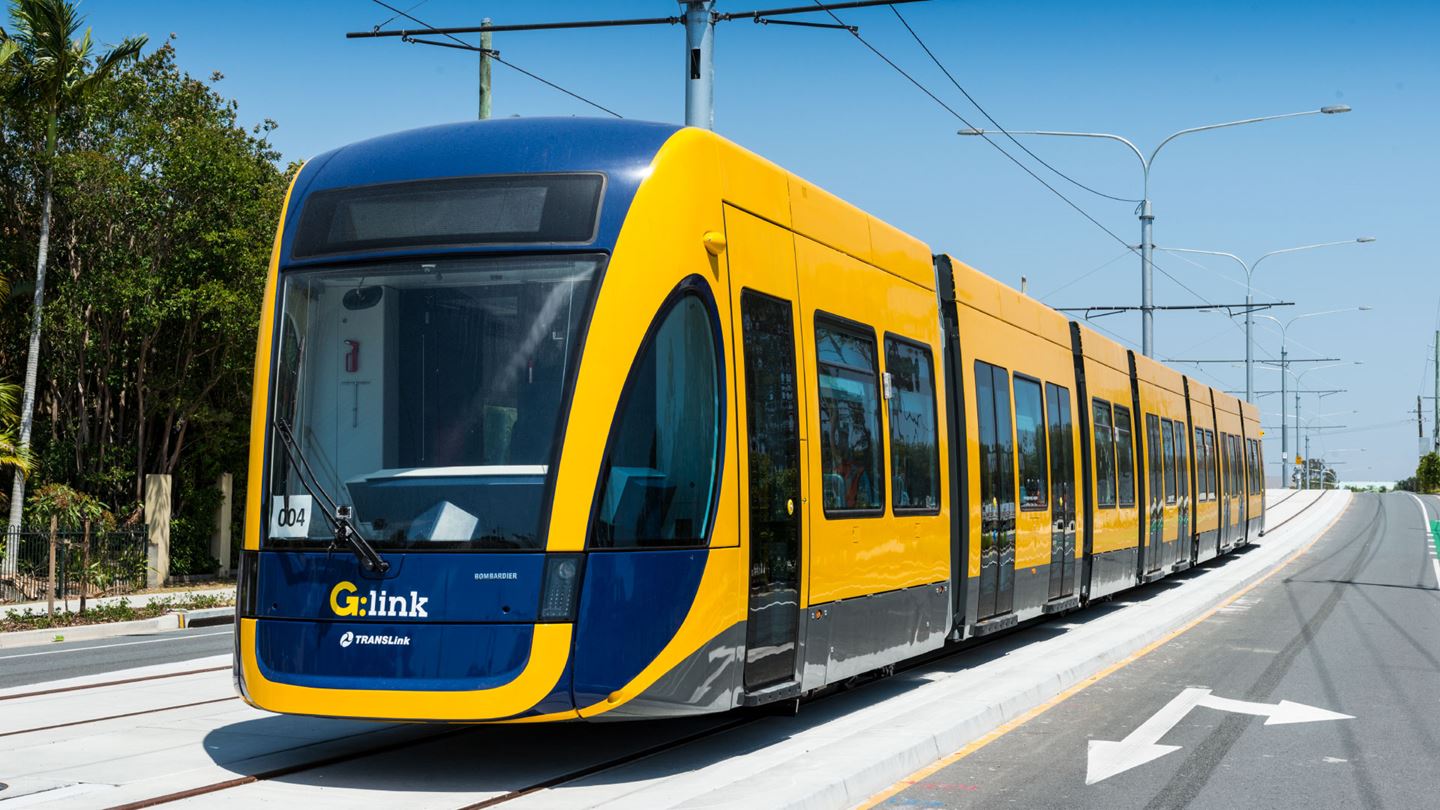
The Gold Coast Light Rail was a bold infrastructure project, now part of a high-capacity public transport system that connects suburbs of the Gold Coast. The project unlocks the city to reduce traffic congestion with patronage rising to nearly one million passenger trips each month. It is widely considered as the catalyst for exploring light rail feasibility for the nearby Sunshine Coast.
The light rail network is currently 27 kilometres in length with 27 stations serviced by 23 trams.
This project has significantly improved liveability and supported economic growth of the city. The total walkable catchment includes all areas that pedestrians access on their way to a stop. A significant reduction in car use in some areas along the alignment is resulting in cleaner, healthier streets.
The public transport corridor connects communities with business and jobs along the coastal fringe, Gold Coast University Hospital, medical facilities, education, shopping, dining, entertainment and sporting centres.
Stops have been positioned to take full advantage of bus interchanges and feeder services at the hospital, city university, as well as major employment and retail hubs. The network plan is to continue expanding the light rail corridor until it connects the city to the airport.
Urban revitalisation
Attractive places and spaces
Value creation
Newcastle Light Rail revitalises Newcastle’s city centre and has been credited as key to turning around declining public transport use across the city.
Once divided by a heavy haul rail line for decades, communities are now reconnected after the removal of 7300 sleepers, four kilometres of overhead wiring and 18 000 tonnes of ballast.
In its place, activated precincts along the light rail corridor better connect the city and encourage healthier lifestyles through more active transport options, such as walking and cycling, interconnecting with the corridor.
The project demonstrates leadership in sustainable infrastructure. On-board energy-storage systems reduce energy and material use, and the system operates without any overhead wires (an Australian first). Photovoltaic cells provide the light rail depot with solar power for its operating requirements. It is the first light rail project in the country to achieve the sustainability ISCA 'Excellent' As Built v1.2 IS rating.
Mode shift and active transport
Unlocks space
Amenity
This regenerative light rail project from 2014 was a 5.6-kilometre extension that connected Dulwich Hill to the Sydney Light Rail network at the time, servicing some of the city’s busiest inner-city areas. Patronage has exceeded forecasts developed for the design.
Repurposing the old freight rail corridor has transformed residential living and access to this area of Sydney, providing alternative access to shopping and entertainment districts, and the city centre.
This was a technically challenging project with great flexibility required in the planning, design and construction process through an alignment of dilapidated infrastructure. The successful uptake of the project demonstrates the commitment from all stakeholders to realise the opportunity for revitalisation for local communities in Sydney’s Inner West.
No longer an optional extra, rail infrastructure projects must look to mandate sustainability and decarbonisation as part of a project’s outcomes, with the end game being net zero emissions.
If we look at just one international city, Auckland, the transport sector is reported to contribute 44 per cent of total greenhouse gas emissions. The city is expected to be home to one million more people in 30 years, placing increasing pressure on transport systems and decarbonisation goals.
The country’s government is currently considering its broader approach to sustainable transport solutions (including light rail) to integrate with its urban masterplans that support the Government Policy Statement on land transport.
This is one of the reasons that international cities are considering light rail, to help reduce carbon emissions, while providing quality mass transit to move people safely and inclusively.
Another reason is that light rail may contribute to people’s health and well-being with the introduction of connections to active transport infrastructure – cycling, walking – for the first or last mile of a person’s journey. If there are healthy patronage numbers, light rail lowers the number of carbon-emitting cars on roads as customers instead choose the mass transit option.
It’s likely that industry will experience an increasing focus on decarbonisation and sustainability as key design factors of light rail projects going forward. The opportunity to embed sustainability correctly is now.
This includes incorporating circular economy principles in the types of materials chosen for construction, such as ‘green’ concrete, or ‘green’ steel manufactured using hydrogen rather than coking coal. It also means focusing on mitigating carbon emissions by reducing the amount of energy used, and then the emissions intensity of the energy that is used. Illustrating this in Australia is Melbourne’s fleet of trams that is 100 per cent solar electricity powered.
Similar to other rail infrastructure, light rail isn’t immune to the changing climate. The escalating volatility of climate patterns challenges the choice of light rail routes and elevations, which demands future modelling on aspects such as flood mitigation and the dispersion of urban heat island effect.
Up-front strategies and frameworks for how light rail infrastructure is designed and constructed in a sustainable way will make a major impact on how it contributes to a city’s decarbonisation pathway and ambitions.
With the correct long-term lens applied to any light rail project, it has the potential to play a vital role in a city’s broader transport system by accommodating increasing levels of demand, improving public transport access, facilitating urban revitalisation and lowering carbon emissions.

Principal, Rail & Mass Transit – APAC

Director, Infrastructure & Energy Advisory – Australia

Principal, Transport – New Zealand

Principal, Transport – New Zealand
The economic case for integrated asset and investment management in New Zealand and how well-governed infrastructure delivers lasting cross-sector value.
Aurecon draws insights from Committee for Sydney’s Jeremy Gill on how we grow Auckland's tech economy through placed-based, connected innovation precincts.
As climate impact events become increasingly prevalent, there is a sharpening focus on resilience investment for Australia's infrastructure across every sector.