Brisbane 2032: Creating lasting impact through transformative infrastructure
Aurecon shares insights on how the 2032 Brisbane Games can deliver legacy infrastructure and lasting economic, environmental and community value.


Change your location to view content tailored for you.
Aurecon’s study – Workplace Ecology 2.0 – explores the shifting workforce expectations and habits that are redefining the ecosystem of places to work.
As 2020 evolved, headlines were filled with predictions of what a post-pandemic world would look like. In particular, how would our traditional narrative on the nature of ‘work’, in essence… work?
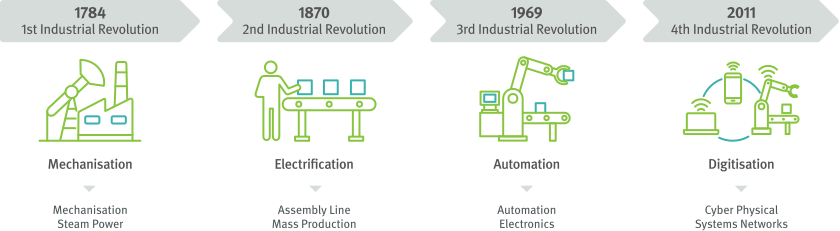
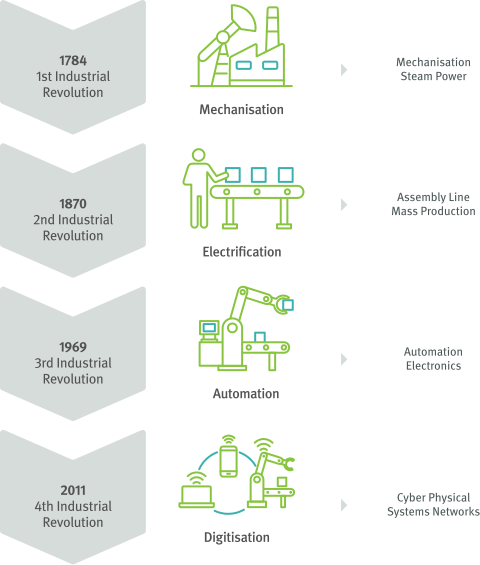
By definition, a ‘workplace’ is a location where the activity of ‘work’ takes place. Prior to the 1st Industrial Revolution and the advent of factories, work was mostly undertaken on farms, cottages, or in small shops. The contemporary workplace, characterised by centralised activities and open office spaces, is only a recent phenomenon heralding the dawn of the modern professional workplace.
COVID-19 has disrupted the world of workplace as we have known it. CBRE’s Workforce Sentiment Survey[1], which collected employee experience and expectations data while working remotely during COVID-19, found that 90 per cent of employees and employers discovered that productivity either stayed the same or increased.
This does, however, beg the question of what a workplace of the future looks like beyond a pandemic and lockdowns. While 85 per cent of employees preferred to work remotely two to three days a week, 60 per cent said they would return to the office for community and collaboration.
Boston Consulting Group analysis found that productivity increased by 15 to 40 per cent for workers with optimised remote working models, absenteeism reduced by 40 per cent, staff turnover decreased by 10 to 15 per cent and companies saved over 20 per cent on their real estate costs[2].
While these statistics provide a compelling case for change, we are nevertheless struggling with the uncertainty of how to prepare for a future yet unknown.
"Man owes his strength in the struggle for existence to the fact that he is a social animal."
Albert Einstein
As Einstein hypothesised, we owe our strength in the struggle for existence to the fact that we are social animals.
In 1945, Abraham Maslow published a book entitled 'Motivation and Personality', suggesting a hierarchy of needs for human beings that starts with the basic needs of food and shelter, moving up the pyramid to the nirvana of self-actualisation, exemplified by creativity and problem-solving, along the way ensuring that our desires for love and belonging are also met.
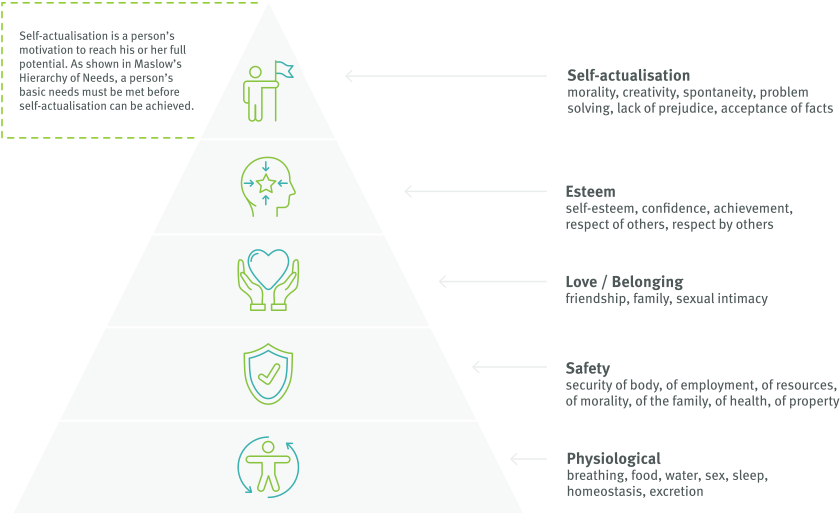
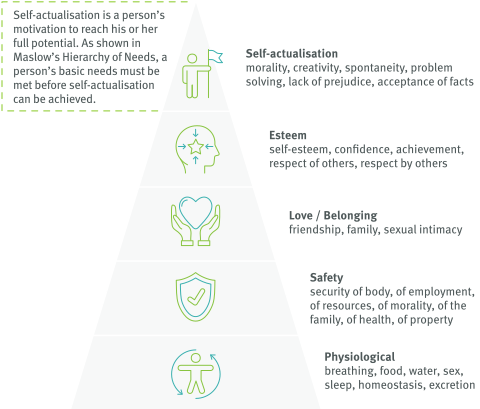
Figure 1. Abraham Harold Maslow (1908-1970) was a psychologist who studied positive human qualities and the lives of exemplary people. In 1954, Maslow created the Hierarchy of Human Needs and expresses his theories in his book, Motivation and Personality.
During the COVID-19 pandemic, you could argue that we traversed the pyramid a bit more than usual, from bunkering down in the safety of our homes during lockdown, to relishing connecting with friends and family in restaurants and cafes when released from confinement, demonstrating our desire to meet both our physiological and emotional needs in variable proportions at different times.
In his book, 'Social – Why our brains are wired to connect', psychologist Professor Matthew D. Lieberman from the Departments of Psychology, Psychiatry and Behavioural Sciences at the University of California, states that our need to connect with others is even more fundamental than our need for food or shelter.
In fact, our brains’ reactions to social pain and pleasure are similar to the way we react to their physical equivalents. Our survival as a human race is based on our ability to understand ourselves and others and modify our behaviour accordingly. Based on his and others’ research, Prof. Lieberman argues that any activities that minimise social interaction, actually restrict our ability to engage and learn, and live happy, healthy and productive lives.
In an address to Google in 2019, 'The social brain and the workplace', Prof. Lieberman argued that while companies often spent time and energy on building their human capital, what was more important was to create the connections between employees, thereby creating powerful social capital. He stated that for those people who declare a love for working with their particular company, 40 per cent say it is because they enjoy working with their colleagues. Further research by his team has shown that to ensure co-workers are in ‘synchrony’ they need to ‘share the same experience’ as opposed to just being ‘exposed to the same experience.’
What this tells us is that humans, despite our sometimes self-centred behaviours, are essentially wired towards community and social interactions, to pick up the non-verbal cues and other signals that enable us to make sense of ourselves, others and our complex world.
We cannot change our physiology. While online interactions have a role to play, the ultimate goal, whether it’s a dating app, a job interview, a project brainstorm or a medical consultation, is to ‘connect’ physically, at least occasionally, to create a sense of social cohesion, meaning, belonging, camaraderie and being part of a greater ‘whole’.
"No man is an island, entire of itself; every man is a piece of the Continent, a part of the main."
John Dunne
Research by Gallup has shown that people who have a best friend at work are seven times more likely to be engaged in their job, are better at connecting with clients, produce higher quality outcomes, report higher levels of health and well-being and lower rates of injury[3].
Proximity is important too – a friend who you can physically connect with has a greater impact on your well-being, and if you have a mutual friend then this leads to even higher levels of health and well-being, demonstrating the importance of team cohesion.
As John Dunne famously pointed out in 1624, we are not alone – we are all a piece of the whole.
For decades we have discussed the enabling power of technology, and this was brought to the fore during the COVID-19 pandemic when we experienced a massive and unprecedented uptake of digital ways of working, allowing remote delivery of work previously undertaken in specific ‘places of work’.
However, as our lives are becoming increasingly enabled by digital devices we can hold in the palm of our hand, allowing us to do everything from checking emails to monitoring our health, are we becoming too reliant on technology? Is it the whole answer? Or are we ignoring our innate need for social interaction?
One school of thought is that we are in fact entering a kind of ‘renaissance’, or 5th Industrial Revolution, where our physiological traits of humanism, critical thinking, diversity, creativity and purpose will thrive alongside technology.
The very meaning of homo sapiens – ‘homo’ being the Latin word for ‘human’ and ‘sapiens’ derived from the Latin for ‘astute’ or ‘wise’, instructs us to leave the mundane algorithms to ‘machines’, while we humans continue to make sense of the world through our higher abilities of reasoning and creativity.
"We need to grasp this opportunity to ensure our creativity is not lost – that we continue to use our higher human thinking skills to create and craft."
The Institute for the Future and Dell Technologies, in their report, Future of Work, identify four emerging technologies that they predict will reshape human and machine interaction and thus enable the pursuit of more meaningful, creative and sustaining work for all:
The report paints a picture of a future workforce that is more inclusive, more empowered and more fluent in technologies[4].
As we spend roughly 30 per cent of our lives working, then ensuring our ‘workplace’ is delivering the creativity, sense of belonging, self-actualisation and connectedness we crave, in spite of, or perhaps enabled by, technology, is vital.
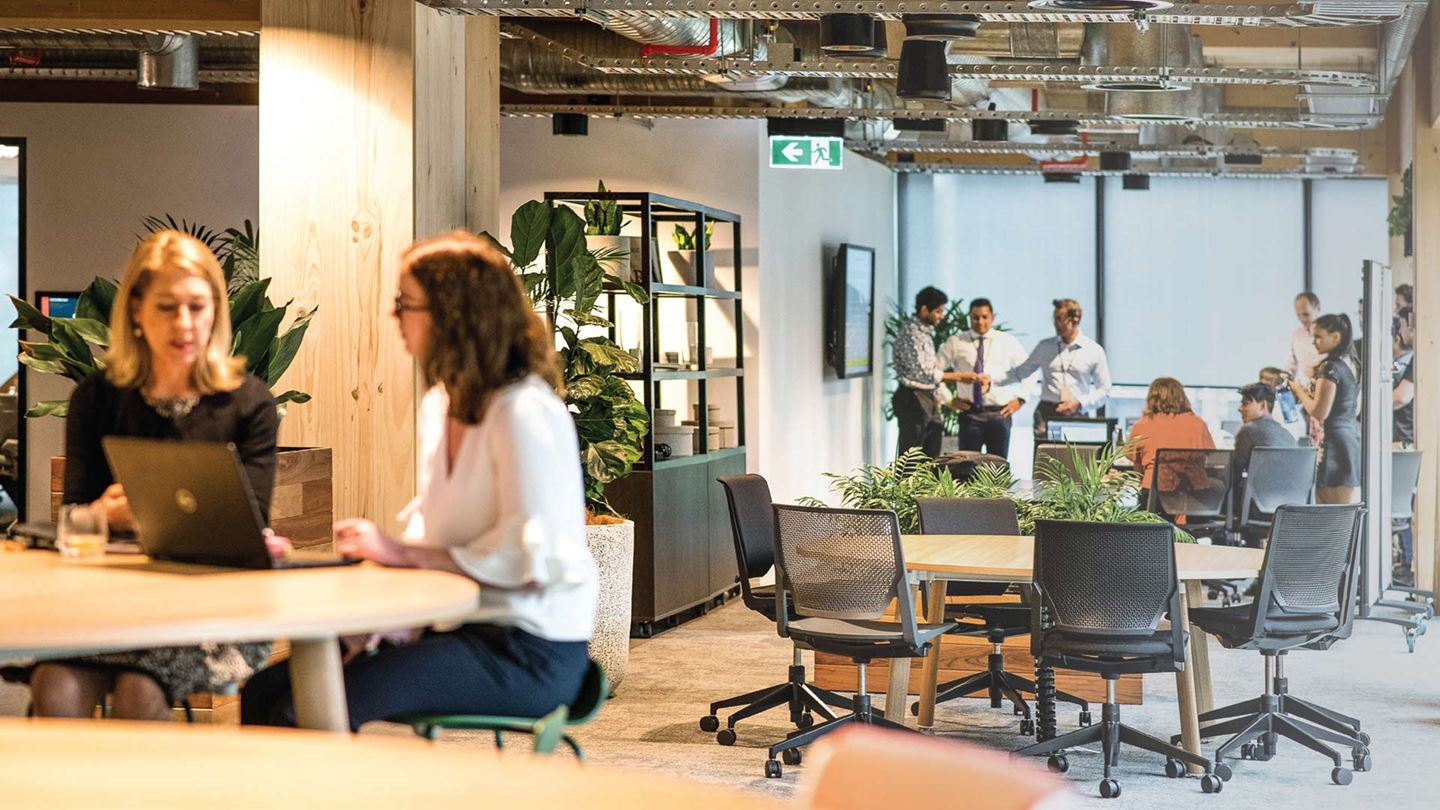
To understand the implications of recent workforce trends and the impact on workplace, Aurecon undertook a study, with the assistance of the Bright Group, on 'Workplace Ecology 2.0 – Aurecon’s New World of Work'. The study highlighted the fact that the ‘workplace’ is no longer necessarily one place where workers congregate to deliver a product or service.
In fact, we believe the ‘workplace’ is transforming into an ecosystem of places to work that:
An ecosystem of places to work will likely consist of:

A thriving place for interactions and collaborations. It is an environment for company brand and culture to thrive and its primary purpose is for engagement, experience, attraction and retention.

The place for me to be productive on focused tasks in the physical proximity of my work colleagues.

The place for me to be productive on focused tasks in the virtual proximity of my work colleagues.

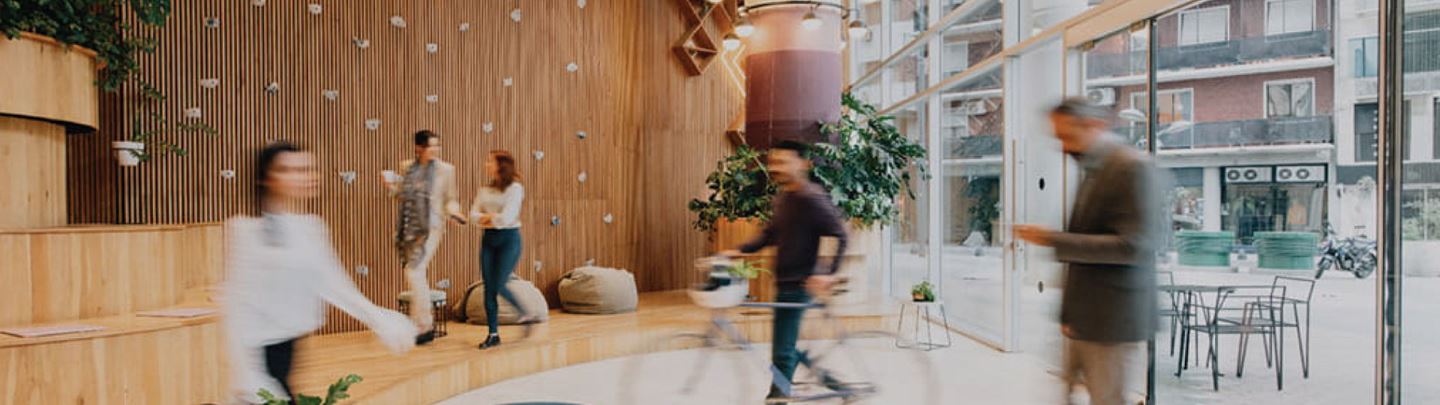
Opportunistic places to connect, revive or focus. This could be a client’s office, the park, a coffee shop, building lobby or co-working space.
In making decisions about where to work each day, empowered workers will ask themselves:
From there the person picks the place – this is how, in turn, the place empowers people.
Workplace metrics are both quantitative and qualitative and the challenge will be to balance these metrics in the new workplace ecosystem to ensure desired outcomes, aligned to business strategy, are being realised.
In Gartner’s 'How to Measure Success of a Hybrid Workforce'[5], the two overarching metrics of workforce outcomes and business outcomes are explored.
Workforce metrics tracking progress towards:

Collaboration – Effective team collaboration, including mutual respect and understanding, a sense of connectedness, willingness to collaborate and effective conflict resolution

Workplace culture – A culture of trust and accountability

Clear process – Seamless, agile and transparent processes for a consistent employee experience, including having the tools, processes and technology available to enable effective hybrid working

Health & wellbeing – Prioritised mental and physical well-being, including effective work-life balance, positive manager/employee relationships, utilised wellness programmes and team bonding

Organisational alignment – Employee performance aligned to business objectives, requiring an understanding of the vision of the organisation, roles in driving business growth, how to prioritise tasks and their impact on organisational priorities and culture, and a shared sense of ownership for success
Business metrics tracking progress towards:

Optimised workforce – Cost-optimised workforce footprint enabled through the ability to hire across locations, diversify skillsets and operate lean offices

Strong brand – Strengthened employer brand enabling attraction and retention of high-quality talent

Innovation rate – Not just productivity – as a contribution to revenue
Understanding how to use these metrics, and what to do if the model is not meeting objectives, will be essential to ensuring the workplace ecosystem is appropriate for the needs of the business and employees, and ultimately, sustainable.
As we look to the future, how do we make sense of this new workplace paradigm, one that is complex and evolving? We need to consider it in the context of the ecosystem in which it exists, an environment that allows people to thrive wherever they choose to work.
Vital to success of the workplace ecosystem will be its ability to:
These metrics are also being considered:
Precincts have a unique opportunity to create the ‘live work play’ neighbourhoods that fulfil all our basic and higher-level needs. Emerging from former industrial landscapes, two mixed-use precincts, commenced before COVID-19, are transforming communities, and setting new benchmarks for an ‘ecosystem of places’. While they have received much acclaim, ultimately, will they fulfil the expectations of a post-pandemic workforce?
Hudson Yards on New York’s West Side, is transforming 11 hectares of working rail tracks into the largest private mixed-use real estate development in the history of America. Planned to incorporate 16 new buildings, including 4 000 new dwellings (1000 subsidised housing), public art, restaurants, a hotel, retail, public transport infrastructure, a school, parkland and over 55 000 jobs, it has its supporters and detractors.
Hailed as an architectural masterpiece and a triumph of commerce (enticing names such as SAP, Wells Fargo, CNN, Facebook and BlackRock to relocate their offices there), it has also been criticised for doing little more than stroking the egos of the designers and developers involved, and lacking in open ‘green’ space of the ilk of Manhattan’s Central Park.
The first neighbourhood in Manhattan to be awarded a LEED Neighbourhood Development Gold certification by the World Green Building Council, its sustainability focus is admirable – encompassing a first-of-its-kind microgrid and stormwater reuse.
Two eco-friendly cogeneration plants will generate electricity and use waste heat to both cool and heat precinct buildings. It estimates to reduce carbon emissions by 25 000 metric tonnes a year – the equivalent of taking 5100 cars off the road. However, a commitment to a full circular economy approach is lacking, and the design of its skyscrapers as towering glass boxes will adversely impact energy efficiency.
Despite the chaos the COVID pandemic has inflicted on our world, and the predictions of a more technology-enabled way of working, our basic human needs, wants, desires, and expectations haven’t changed.
As per Maslow’s Hierarchy of Needs, we still crave the basics of physiology and safety, as well as the more esoteric desires of belonging, esteem and self-actualisation – and Leiberman’s more recent research supports this theory of social connectedness.
"This is a moment in history. As we make a quantum leap towards the empowerment of people who will decide how, where and when we live and work, our built environment will be forever changed."
What this means for the future and our ways of working, is that our workplace ecosystem will need to ‘work harder’ to fulfil our physiological needs, to connect, collaborate, create and enable organisations, employees and customers to thrive. Instead of ‘mandating’, our workplace ecosystem will need to be a human ‘magnet’ – creating the spaces that support the goals of productivity, personal and professional fulfilment, as well as vision and purpose.
[1] CBRE, 2020, Workforce Sentiment Survey Insights Report.
[2] Kaufman E., et al. 30 June 2020, Remote work works – Where do we go from here?, Boston Consulting Group.
[3] Rath, T. & Harter J. 19 August 2010, Your friends and your social well-being, Gallup.
[4] Institute for the Future for Dell Technologies, 2019, Future of work: Forecasting emerging technologies' impact on work in the next era of human-machine partnerships.
[5] Gartner, September 2020, How to measure success of a hybrid workforce.
Contributing authors & reviewers: Maureen Thurston
Principal – QLD, Australia
Aurecon shares insights on how the 2032 Brisbane Games can deliver legacy infrastructure and lasting economic, environmental and community value.
This fact sheet compares the community and environmental impacts of wind farm projects, and how ecologically sensitive design can deliver better outcomes.
How engineering and construction projects are evolving to champion biodiversity, through early planning, advanced technologies, and ecosystem stewardship.