
How will Asia connect billions through resilient transport systems?
Asia’s transport networks must evolve to deliver sustainable, connected mobility. Learn how Aurecon is shaping Asia with innovative infrastructure solutions.


Change your location to view content tailored for you.
Energy yield analysis is crucial for wind farm developments to articulate project boundaries and assumptions in full alignment with risk assessment for investors to make informed investment decisions. This article provides an overview of energy yield analysis and its importance for wind farm developments in Asia.
Across most parts of Asia, energy demand is anticipated to increase by 60 per cent by 2040[1] due to population rise as well as increased commercialisation and manufacturing. The heavy reliance on traditional sources of energy supply won’t be as feasible in the future as it has been in the past, as many countries commit to decarbonisation and net zero targets. Increasingly, renewable energy, such as wind and solar, will be introduced to augment traditional energy supply.
Going forward, energy yield analysis will be crucial for wind farm developments across Asia. Energy yield analyis helps articulate project boundaries and assumptions, aligning with risk assessments to enable investors to make informed decisions. The analysis includes important probability metrics such as P50 and P90, which are key to understanding the potential energy output of wind projects.
Energy yield is a fundamental concept in the renewable energy industry, particularly for wind developments. It provides a realistic estimate of the actual energy production of a renewable energy system by accounting for various factors such as environmental conditions, site-specific characteristics, and operational considerations, that impact output. The analysis also includes important probability metrics such as P50 and P90, which we'll explore in detail below.
An energy yield assessment is carried out during the development phase of a project and as part of the feasibility study, aiming to develop scenarios of the energy production of a wind farm development over its lifetime.
There are four important factors for energy yield analysis:
Maximising energy yield is crucial for lowering the levelised cost of wind energy and enhancing the competitiveness of renewable energy sources. By calculating energy yield through modelling and engineering, system specifications can be determined for a development that will maximise return on investment and optimise the ability of the project to meaningfully contribute to a country’s energy transition.
Energy yield assessment is a critical process that occurs at multiple stages of a wind farm project. Figure 1 below shows the lifecycle of wind resource and energy yield assessment in a wind project, from strategic planning and concept development, project definition and engineering design, through to asset management and decommissioning.
Each stage involves specific activities related to energy yield assessment, ensuring that the project's potential is accurately evaluated and optimised at every phase. Each stage involves specific activities crucial for accurately assessing and optimising energy yield.


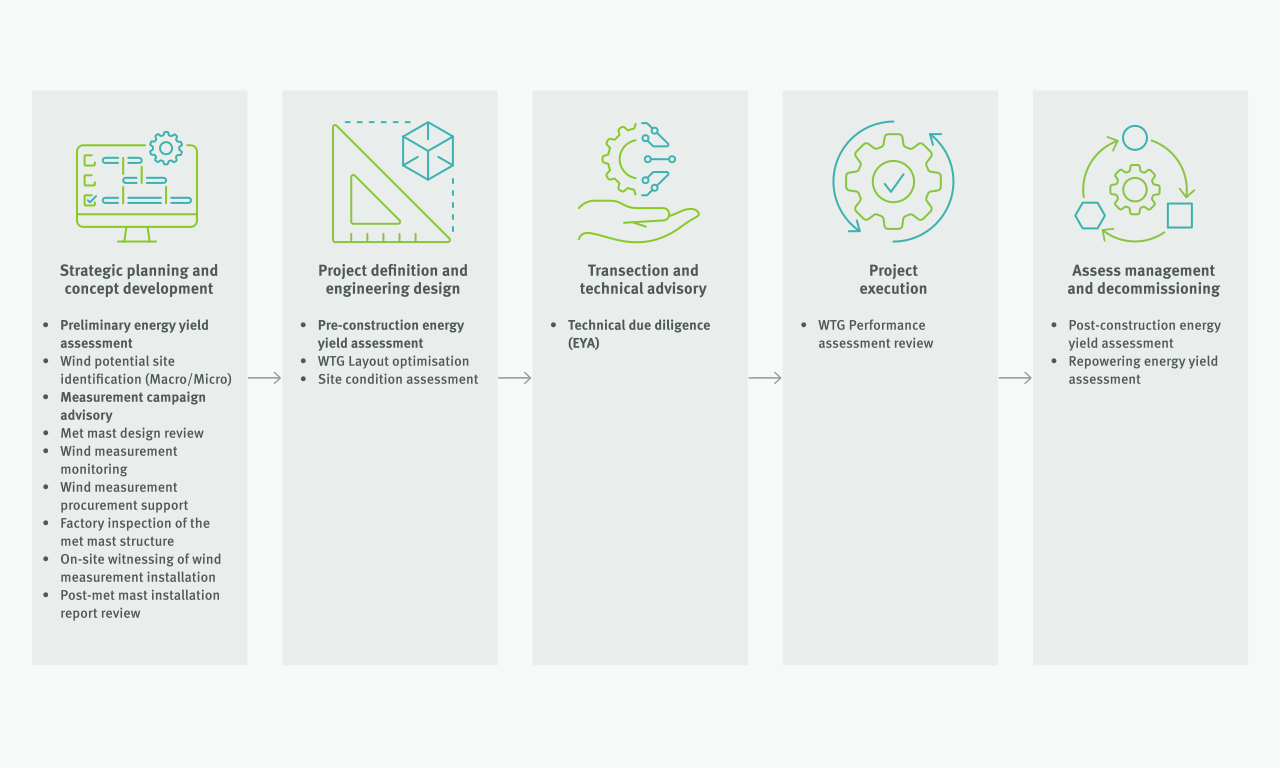
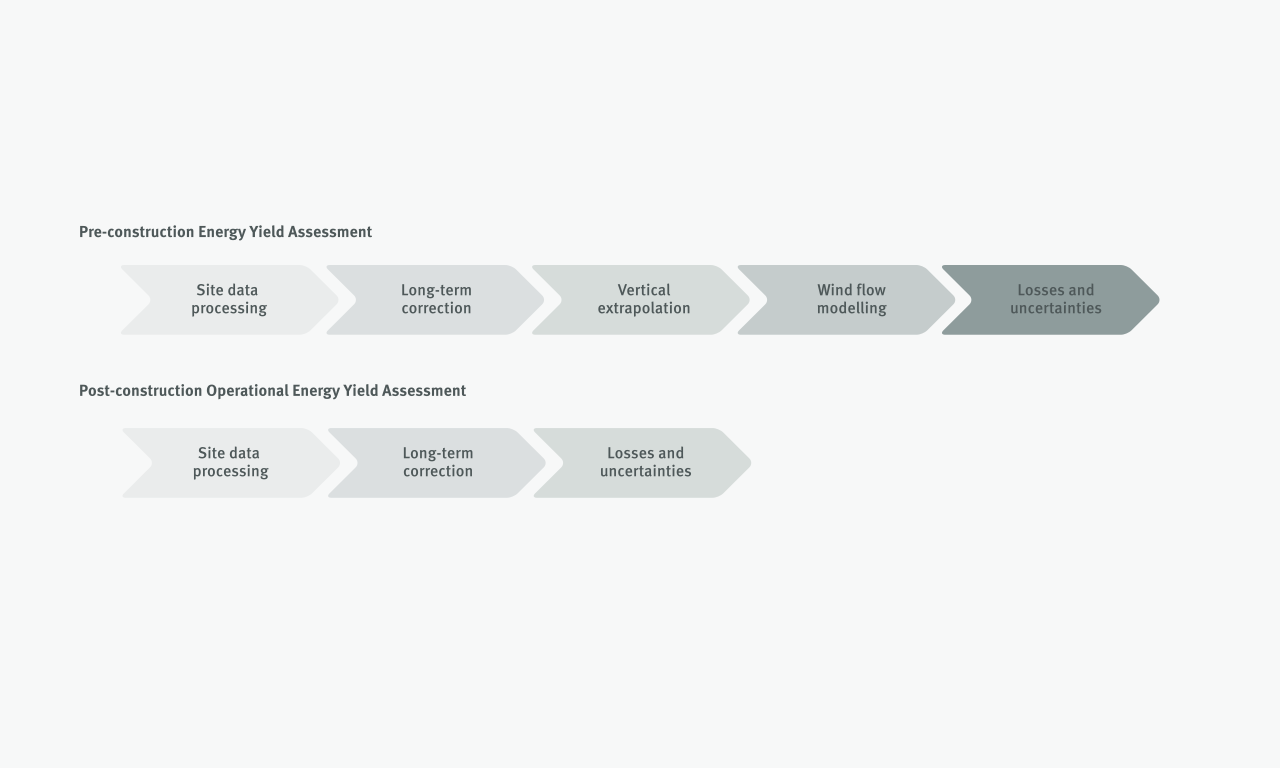
Figure 2 above illustrates pre-construction and post-construction energy yield assessments. This highlights how actual operational data refines the assessment process, allowing for more accurate energy yield predictions and improved project performance evaluation once the wind farm is operational.
P50 and P90 are probability figures, critical to energy output forecasting and business planning assumptions. They provide the net yield of a project to minimise the risk associated with variability of the wind resource.
The use of P50 and P90 calculations aid in managing risks and setting realistic expectations by estimating costs, recognising that the cost of investment proposals are uncertain. P90 represents the estimate of costs such that there is a 90 per cent probability of the project being delivered within that cost estimate. P50 represents the estimate of costs such that there is a 50 per cent probability of the project being delivered within that cost estimate.
The risk model developed digitally in the P50 and P90 calculation contains inputs into possible variance of the quantities; rates of items known as planned risk and unplanned risk events from a risk register. The plotting of data is represented as a cumulative distribution graph and the 50th and 90th percentile values are read off the cumulative distribution graph. Statistically, this represents the confidence level of a cost not being exceeded (at 50 per cent, and 90 per cent).
The data inputs to the risk model are measured at the meteorological mast (on-site) over a short-term period (greater than one year) and extrapolated to the future in combination with historical weather data. This data is provided by land-based stations or mesoscale models. The wind distribution issued from the long-term correction process is then extrapolated to the future wind turbine locations using numerical models. Finally, the wind resource at each turbine location is converted into production via the theoretical power curve of the selected turbine model.
The result from this whole process is gross yield. In order to provide wind farm developers and investors with accurate generation scenarios, net yield is devised by accounting for:
Like all scenario planning, energy yield analysis is just one component of a comprehensive project evaluation process. It should be combined with other assessments that provide whole-of-project analysis in line with a project’s development objectives, as well as the developing agency’s long-term investment strategy.
But, by understanding potential energy yields, developers and investors have a bank of data that can be used to inform investment decisions, optimise wind farm project designs, and manage risks associated with large-scale renewable energy infrastructure. Due to the diverse climatic conditions and variable wind conditions experienced across countries in Asia, energy yield analysis is particularly relevant to inform decision making.
[1] IEA50, October 2019, Southeast Asia Energy Outlook 2019, accessed 17 July 2024.
Contributing authors & reviewers: Lorenzo Claveri and Marcel Ivison.

Associate, Renewable Energy & Project Management – Southeast Asia Energy
Asia’s transport networks must evolve to deliver sustainable, connected mobility. Learn how Aurecon is shaping Asia with innovative infrastructure solutions.
Numerical modelling enables coastal cities such as Singapore to develop targeted mitigation strategies for sustainable, climate-resilient coastal infrastructure.
Exploring how floating solar technology offers Southeast Asia a viable solution for meeting renewable energy targets despite land constraints.