Having significantly contributed to Australia’s and New Zealand’s economic prosperity for many decades, the resources and industrial markets now face a significant challenge to continue to do so as both countries focus on decarbonising in alignment with net-zero commitments.
It is transforming the operating landscape for both markets as, worldwide, the energy transition is gaining momentum. This is placing pressure on organisations to progress carbon emissions reductions beyond solely setting targets.
This is in addition to pressures from customers, investors and supply chain participants to deliver clear pathways to net-zero with transparent reporting on action.
To successfully decarbonise, organisations must rebalance commercial objectives with mastering the science of achieving emission reductions of their operations along the value chain. This process should also incorporate the wider principles of environmental, social, governance (ESG), and align operations to a sustainable future for employees, communities and the planet.
The sustainable future has commenced
Current rates of change linked to climate mitigation mean that the cycles of innovation, reform and stakeholder expectations are becoming increasingly tight with little time between successive increases in expectations for climate action.
Barristers Noel Hutley SC and Sebastian Hartford Davis, known internationally for their legal opinion on climate-related challenges for boards and businesses, noted this factor in their 2021 opinion piece on climate change and Directors’ duties. They note: "It is no longer safe to assume that directors adequately discharge their duties simply by considering and disclosing climate-related trends and risks. In relevant sectors, directors of listed companies must also take reasonable steps to see that positive action is being taken"[1]
"It is no longer safe to assume that directors adequately discharge their duties simply by considering and disclosing climate-related trends and risks."
Noel Hutley SC and Sebastian Hartford Davis
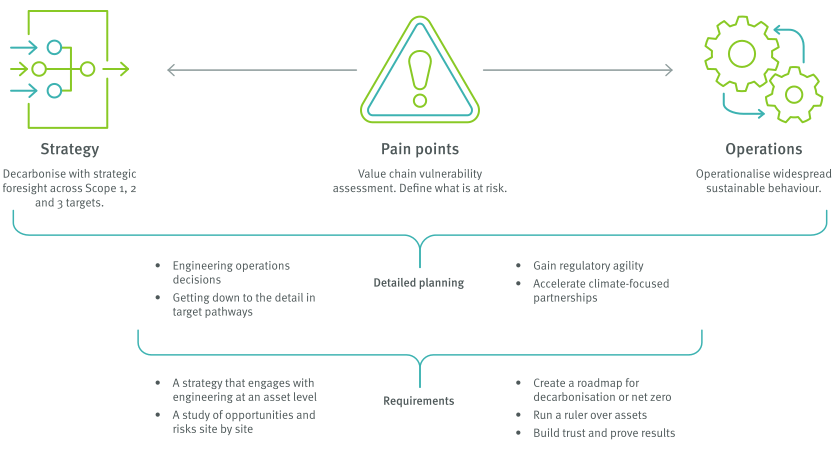
The challenge hurtling towards the leaders of resources and industrial market organisations is how to strategically navigate the pain points between maintaining business continuity and introducing initiatives that meaningfully decarbonise operations (Figure 1). Whether their operations are global or local, it is one of their biggest dilemmas.
Figure 1: Decarbonisation flow strategy for operations.
An organisation's net-zero commitment impacts all areas from strategy to physical operations. It’s a factor in every decision across their value chain.
The question when connecting strategy and operations is how to address the risks that come with supply chain vulnerabilities, and then convert those risks into opportunity; at an asset level, site level, company-wide level, and global marketplace level?
Has your organisation tailored its strategy to consider the transitional impacts of climate change with specific planning to manage emissions reform and operations?