From compliance to commitment: rethinking biodiversity in project planning
How engineering and construction projects are evolving to champion biodiversity, through early planning, advanced technologies, and ecosystem stewardship.


Change your location to view content tailored for you.
Far from invisible is the blue and green so inherent with our natural surroundings. The water, soil, biodiverse ecosystems and buffers of green landscape – the real economy that supports life on this planet.
However, as built form has been superimposed over this landscape over time, the blue and green found in nature has, in the past, been sidelined in terms of the value it provides. Now, blue and green – as a class of infrastructure – is becoming more valued as integral to the urban balance sheet.
Natural capital such as waterways, gardens, rainwater capture systems, stormwater reuse initiatives and wind directional flow for cooling are rebalancing the way urban settings are designed and managed.
They are delivering multiple co-benefits for communities. These span from flood risk management and stormwater capture and reuse, to reducing urban heat island effect and water use.
In this insights paper, we explore blue green infrastructure and why it is important for society to value natural assets and invest in these like any other asset base.
Blue green infrastructure contributes to urban settings that become nature positive, focused on restoring and regenerating rather than declining natural capital. They can help to mitigate the impacts of flooding and stormwater runoff by using natural systems such as wetlands and permeable pavements. They can also help to reduce the urban heat island effect through trees and green spaces.
Additionally, blue green infrastructure enhances urban biodiversity and provides habitat for wildlife, which can help to support the health of ecosystems and contribute to improved quality of life for people.
The tendency to undervalue natural capital in urban settings in the past is changing. It is due to society’s increasing understanding of how natural systems can not only play an important role in urban resilience, but also deliver valuable cost and resource returns. It is now up to communities, city planners and designers to develop places and spaces that recognise the value of natural capital, and the first step is understanding our relationship with nature… the impacts, dependencies and consequent value.
Many people view nature as simply places to play and relax, rather than essential components of the ecosystem of an urban setting.
Acknowledgement of natural capital as assets to be maintained is critical: fostering naturally-originated water and nature cycles, aligning built form and blue green infrastructure master planning, and putting management plans in place like how roads and railways are governed.
In a 2021 global environmental report from ScienceDirect [1], it was identified that by 2050, annual engineering expenditure for water infrastructure is predicted to be US$2.3 trillion globally. In contrast, the report found that preserving natural capital to suppress the threat of water crisis represents a potential US$3 trillion in avoided replacement costs by mid-century.
This shows that society pays a premium when natural capital is lost, as the engineering costs to achieve equivalent threat management are, on average, twice as expensive.
Engineering solutions are routinely applied to install substantial water and nature resource infrastructure to reduce the attendant risks.
What if we could break this cycle and balance
natural systems with infrastructure needs?
This is blending nature-based solutions (blue green) with engineered solutions (infrastructure) to provide safe drinking water, water for irrigation and cooling, air flow for heat reduction, and ground works for erosion control.
Looking ahead, transformational change for urban settings will require the application of four principles:
Achieving urban amenity, flood resilience and healthy ecosystems requires a transformative change to how urban settings are planned, designed and built.
When designed first, blue green infrastructure provides a different lens on natural capital ecosystems and water sensitive management. Some major city councils are already thinking this way, planting additional trees (with city-wide tree canopy percentage targets) and increasing pedestrian movement by giving active transport priority over the car.
There are also newly constructed urban developments that use vegetation-lined channels, known as bioretention swales, to capture, treat and infiltrate stormwater runoff before it is lost to natural waterways.
This provides circuit breakers to shocks such as climate change, diminishing water supply and increased urbanisation (Figure 1).


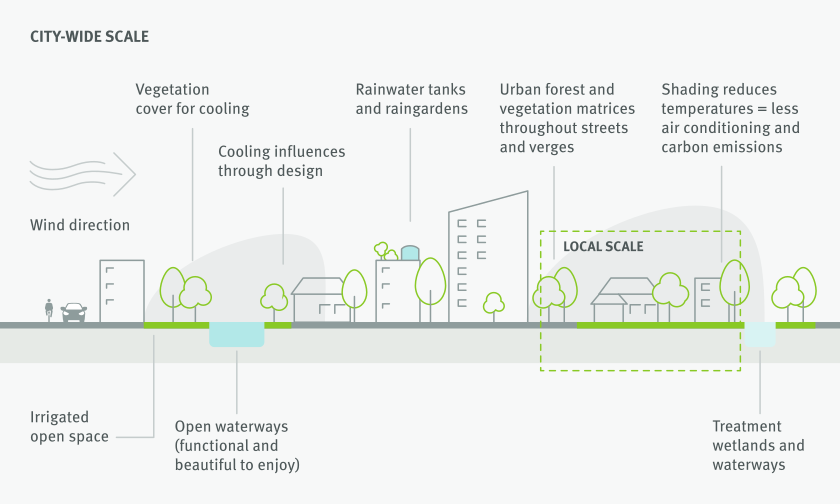
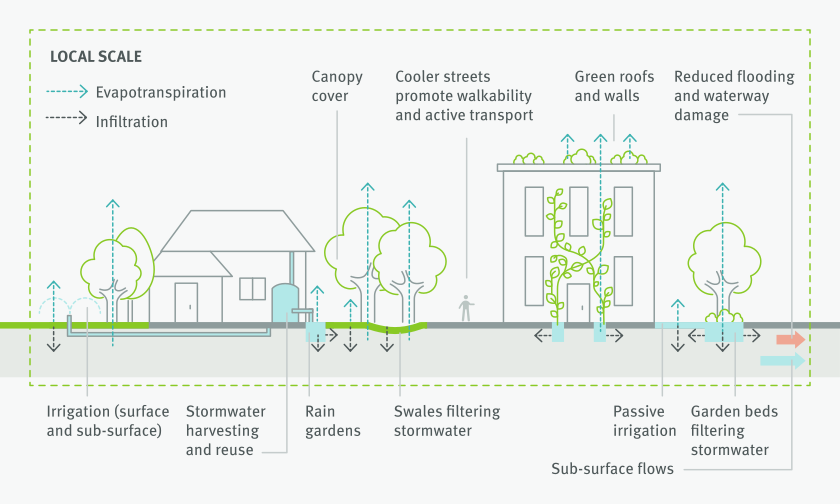
Just as financial banks hold notes and coins which are valued by society, consider natural capital as banks that also hold their own value – both economically and environmentally.
A single healthy tree can have the cooling power of 10 average household air conditioners. They absorb carbon dioxide,
reduce floods, boost biodiversity, filter air pollution,
and improve public health.
To be able to assign value to natural capital and manage it, collaboration is essential; relevant policy and legislation must be developed, partnerships developed across supply chains, and action plans enacted to install and manage long-term assets.
One significant mindset change that is required is when assets change hands. For instance, in a greenfield development, green spaces are passed from the developer usually to the local council, or power wholesaler, to manage long-term.
When the planning and design of developments considers early integration of blue green infrastructure, it rebalances the urban balance sheet by considering benefits and ongoing maintenance requirements.
The co-benefits they bring to developments include a reduction in air conditioning loads (for residents or businesses) because the street air is cooler, and reliance on fresh water to irrigate green spaces is reduced because stormwater is captured and reused. These are just two of the many examples of how urban settings can benefit from blue green infrastructure.
Traditional asset management practices have not typically been applied to the natural assets, which makes it challenging to assess investment decisions around the required levels of protection for these assets.
To overcome this, tests for prudency and efficiency; return on investment; asset valuation; and risk evaluation require a common framework. Some of the confounding factors include avoided replacement costs, land ownership, climate risk, inter-generational equity, third-party impacts and benefits, spatial and temporal boundaries, and long-term horizons, when long-term natural capital assets are compared with short-term built assets.
To illustrate, bushfires in water catchment areas are a direct threat to long-term water supply yield, therefore alternative water sources are required, such as desalination. The consequence of a bushfire in terms of infrastructure is something that can be estimated in financial investment terms. However, the financial evaluation of replacing diminishing water yield and blue green infrastructure that protects catchments is much harder to determine in monetary terms.
For example, a water utility might invest millions of dollars on catchment management and bushfire risk management, however, after a bushfire, the financial consequence of replacing lost water supply yield could be billions of dollars.
By using systems thinking, circular economy principles and multi-capital investments, rather than just discrete built-asset projects alone, society can create and sustain greater overall value than the sum of its parts. It begins with natural capital valuation to enable blended blue green infrastructure solutions to be funded and delivered.
More than 85 per cent of humankind relies on freshwater source areas that are moderately to severely threatened as a by-product of development. It is hard to imagine how society will be able to sustain ongoing water demand, which the Organisation for Economic Co-operation and Development (OECD) predicts will increase by up to 55 per cent by 2050[2].
Part of the transformational changed required is seeing water cycle management as a system (from the catchment to the ocean), rather than seeing infrastructure first and planning water management around it. This requires systems thinking to be able to reflect on infrastructure that augments and provides a nature positive outcome.
When both supply and demand are in flux, holistic water cycle management meets the needs of growing populations, together with augmenting ageing infrastructure.
Much attention is therefore paid to reducing water use, which we quite often see during droughts. What if we flipped this way of thinking?
Instead, have a framework that integrates economic and environmental data to provide a more comprehensive and multipurpose view of the relationship between built form and natural capital, changes in stocks of assets, and the benefits they bring to humanity.
The system recognises contributions of ecosystems expressed in monetary terms so that contributions to society’s well-being can be more easily compared to other goods and services we are more familiar with (Figure 2).
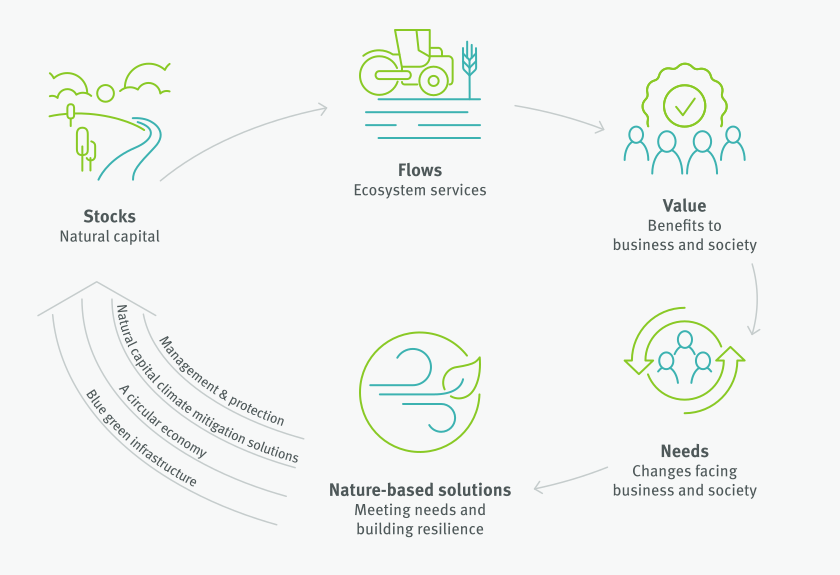

Figure 2: Natural capital stocks and flows and how they interrelate to society needs and nature-based solutions.
These systems should be applied to the policies and decision-making processes for project and sustaining capital programs for blue green infrastructure investment and delivery.
In terms of water management, the solutions lie in an integrated approach to rehydrating landscapes, building soil carbon and functioning soil biomes, and creating surface biodiversity. Destruction of natural land functionality through vegetation clearing has vastly altered rainfall runoff characteristics in catchments. Landscapes have to be built back up for our natural systems and ecosystems to be resilient in the future.
Communities have multiple co-benefits they want from places and spaces, such as greener neighbourhoods, access to transport and leisure activities, and residential dwellings that attract low water and energy usage.
The response to these pressures is a major opportunity for proactive planning and delivery of blue green infrastructure so that urban settings can rebalance the synergies of ’systems’ of water management and urban greening, with the creation of attractive and successful communities.
When planned and designed in balance, blue green infrastructure reduces the energy, water and maintenance burdens for local authorities as well as residents. They create co-benefits over full lifecycles – what we call ’the total value of ownership’.
This is a key dimension to the resilience of human-nature systems and an important reason why nature is important in places; and just as importantly, to the urban balance sheet.
A core pillar for climate resilience and improved liveability is that our natural capital in the form of blue green infrastructure is valued. We’ve reached a time in society that it’s not a ‘nice to have’ ambition but a necessary strategy to preserve the planet for future generations.
[1] 2021 Global Environmental Report from ScienceDirect.
[2] OECD Environmental Outlook to 2050: The Consequences of Inaction – Key Facts and Figures.
[3] Charles J. Vörösmartya, C.J., Stewart-Kosterb, B., Greenj, P.A., Boonec, E.L., Flörked, M., Fischere, G., Wibergf, D.A., Bunnb, S.E., Bhadurib, A., McIntyreg, P.B., Sadoffh, C., Liui, H., Stifelfet, D., 2021. A green-gray path to global water security and sustainable infrastructure. www.elsevier.com/locate/gloenvcha.
Contributing authors & reviewers: Colm Molloy, Abel Immaraj and Richard Savage.

Director, Environment & Planning – Australia
How engineering and construction projects are evolving to champion biodiversity, through early planning, advanced technologies, and ecosystem stewardship.
Aurecon shares insights on how the 2032 Brisbane Games can deliver legacy infrastructure and lasting economic, environmental and community value.
This fact sheet compares the community and environmental impacts of wind farm projects, and how ecologically sensitive design can deliver better outcomes.