
Creating sustainable asset value – balancing priorities in times of transformation
Understanding how to transform existing assets, and how sustaining capital can create and protect, value, is critical for organisations of the future.


Change your location to view content tailored for you.
For most organisations, the days of steady, predictable revenue and earnings growth are long gone. Volatility and uncertainty are more prevalent as organisations contend with a long list of disruptive factors such as digitalisation, intensifying competition, global trade uncertainty and climate change.
It is in these times of change that investing in existing asset portfolios is so crucial, and digital and data insights are helping organisations pivot and adapt at short notice whilst still tracking towards long-term objectives.
Rebalancing sustaining capital priorities with digital and data insights is becoming central to making better decisions more quickly, transparently and consistently. Aurecon’s deep understanding of asset types means that we are uniquely positioned to value digital and data insights as powerful tools for business leaders.
In this thinking paper, we explore how digital and data insights rebalance sustaining capital priorities to help business leaders improve risk management, make informed capital investment decisions, protect asset portfolios and deliver productivity outcomes.
Today, an organisation’s assets typically generate large volumes of data. This data, however, has little value on its own. It needs to be extracted, organised and analysed so that it can be used to inform business decisions.
Having visibility of, and understanding how to interpret, data, is the foundation to rebalancing sustaining capital programmes with more control and predictability, therefore minimising risk and reducing conflicts and cost.
Organisations must start with the end in mind by determining 'What decision is to be made?' This is in the context of their decision ecosystem. It might be increasing mine output by 10 per cent, achieving carbon neutrality across an asset portfolio by a set year, or prioritising the renewal of assets based on required usage stats.
This is where an organisation’s data journey begins. What follows is the digital strategy that sets the process for capturing and connecting the data to inform the decision, and then the tools required to extract the data and use it in a meaningful way (Figure 1).
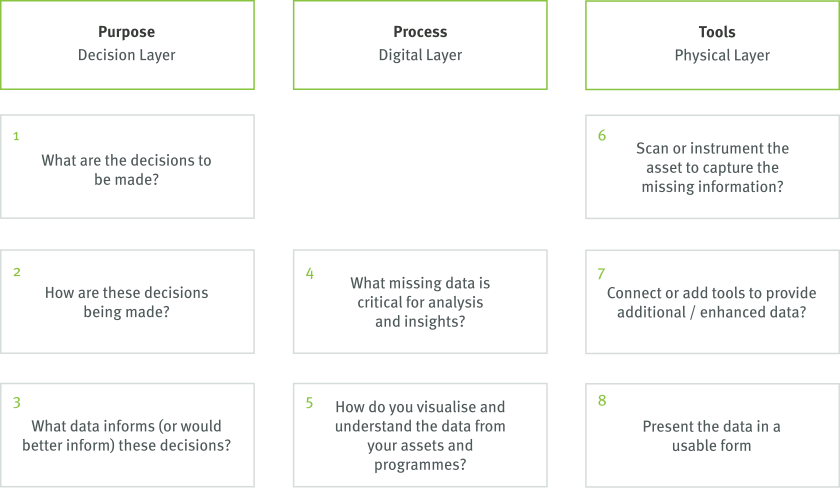
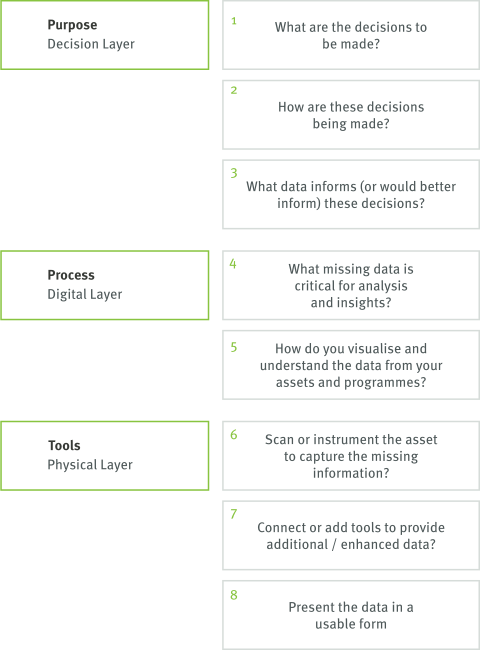
Figure 1. The methodology filters decisions according to their value, cost and return on investment and results in prioritising sustaining capital programmes across all levels and divisions of an organisation according to performance and value.
Asset intensive organisations rely on their assets. They generate revenue and provide critical business operation and services to customers.
Not surprisingly, strategic investments are heavily scrutinised. To remain viable, efficient and competitive, organisations want to create and protect asset value.
By leveraging technologies with the oversight of a digital strategy and digitally-enabled insights, risks to the business are reduced, productivity efficiencies are gained, and return on asset investment maximised. The resulting gain points emerge for business leaders across different functions (Figure 2).
Hover over the graphic to explore these gain points.
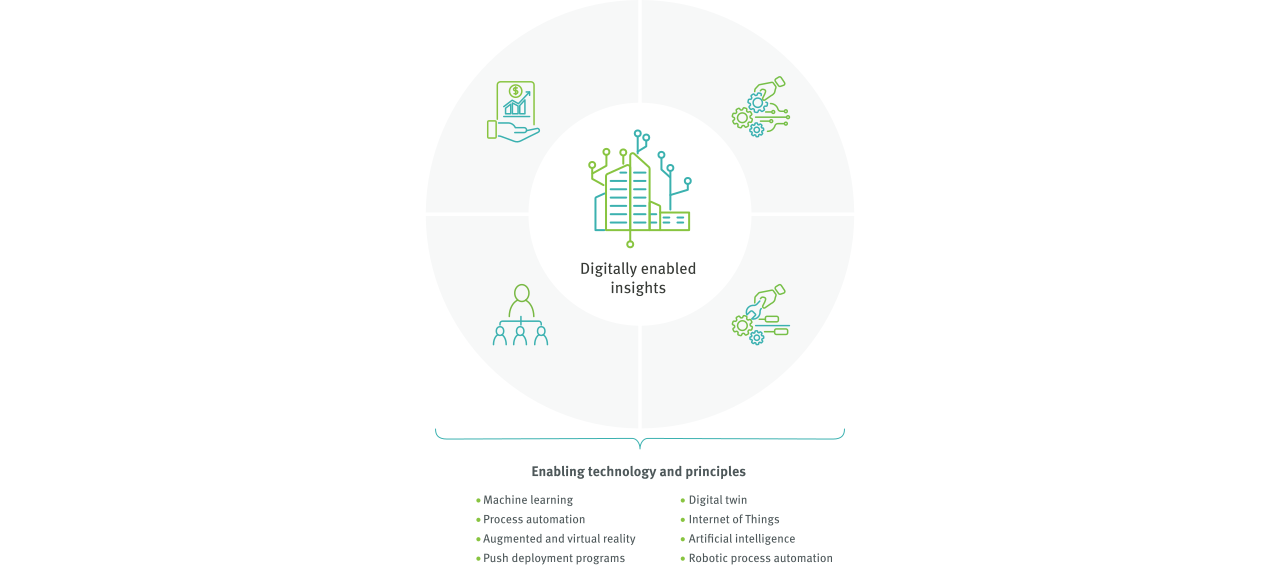
Figure 2. The benefits of digital and data enablement for department leaders in asset intensive organisations.





Figure 2. The benefits of digital and data enablement for department leaders in asset intensive organisations.
In this section, we describe four scenarios for business leaders to apply digital and data enablement initiatives to benefit asset portfolios.
Under the sponsorship of the COO, a major water utility could be looking to drive operational value through a digital asset transformation programme. While led from an asset-driven perspective, key areas could include:
Division managers are under pressure to increase the value of their decisions by understanding and analysing a range of possible scenarios.
For an organisation operating in the resources sector, the development of a digital twin for some of their large machines and fixed assets would streamline inspection regimes and establish a system to identify faults accurately and in a timely manner.
Different scenarios regarding the impact of loading events on the machines, modelled and tested using the digital twin, in the future would assist managers to identify the investment choices most likely to lower costs, improve productivity, have the least amount of downtime, and deliver the best performance overall.
A generalised example of types of twins and use cases is featured in Figure 3.
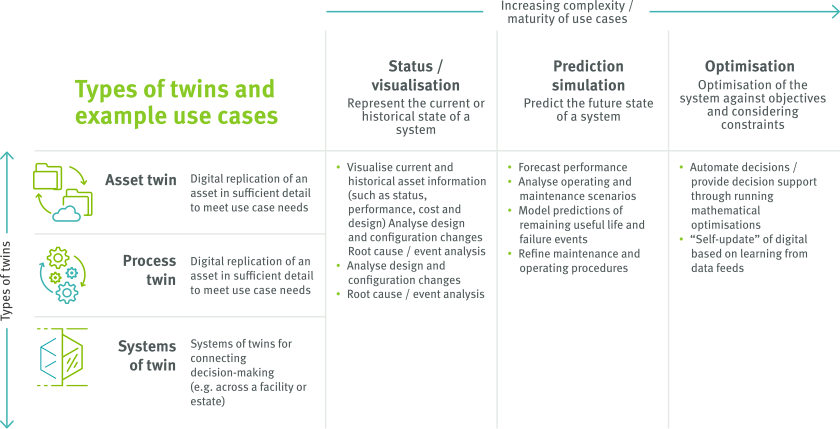
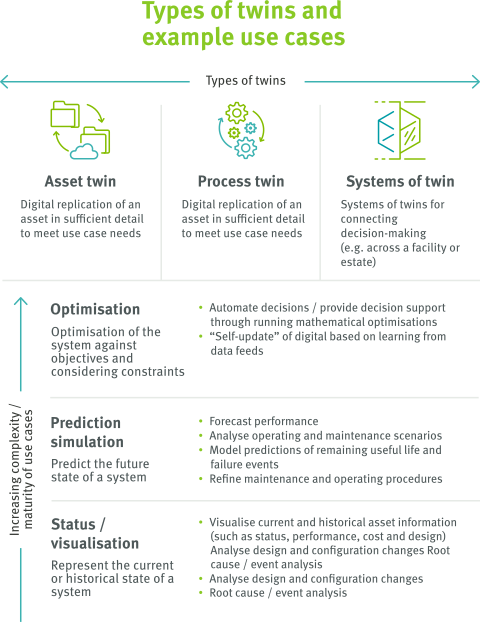
Figure 3. Types of digital twins and example use cases
In this scenario, the Head of Asset Management Performance was tasked with managing assets and making investment decisions. The focus was on understanding the performance of existing assets to ensure reliable reporting and the correct upgrade, or repair, of investments.
A data-driven approach using geospatial analysis would provide deep insights into the status and reliability of assets in very short timeframes. Development of a sophisticated digital model to provide meaningful and accurate asset predictive analysis would help prioritise repair and replacement works, and maximise value for the organisation, customers, communities and the environment.
In response, significant KPI improvements across reliability (forecasting based on performance and profile), sustainability (productivity) and affordability (alignment to implications for customer billing) would be realised.
One of the most significant sustaining capital challenges for engineering or asset managers is to understand the performance of existing assets to balance service levels, asset performance, risk and safety.
Developing a digital framework to drive portfolio-level value through more effective data governance and management should be a key strategy for an asset-intensive organisation. In this scenario, a large public organisation may have identified that the risk of not proceeding with such a strategy would have been a decline in data quality, loss of confidence in the accuracy of the data, and an inability to meet reporting requirements.
A value-led approach to data governance and management could be created de-risking the organisation’s portfolio by introducing a fit-for-purpose management system with accompanying data warehouse and training support for project officers.
This type of data integration and analysis would provide a centralised repository for asset-related data, and improve collaboration between different departments. Operational and maintenance leaders could then quickly analyse data to identify trends, devise scheduling, and highlight areas for improvement.
Since the industrial revolution and the invention of machines to build, move, transport and transfer critical products and services, data on the health and performance of assets has predominantly existed in the minds of their operators. As corporations modernised, asset insights moved to such applications on online dashboards, Excel spreadsheets and information management systems.
We’re now in the midst of a data revolution where the risks associated with human minds holding asset information is greatly reduced as technologies now track complex information, and digital applications analyse, interpret and report on a myriad of factors.
Not all these tools are necessarily new; for instance, building information modelling (BIM) has been around for decades, however, its use has grown exponentially in relevance and impact in the last five years.
What’s driving their rapid adoption today? Continuing pressure on organisations to make the right asset investment decisions, and develop and execute the right projects at the right time.
With augmented and virtual reality technologies, organisations can see assets in 3D or 4D to understand complex information in a more intuitive way. Digital twins mean organisations can create a digital replica of the built environment. The power these applications offer is the real-time asset data for leaders to make asset investment and optimisation, preventative maintenance, and operational and productivity improvement decisions. This not only makes decision-making more reliably informed, but it also enhances collaboration and communication with stakeholders and customers.
While most organisations consider data critical to future success, some are faring better than others at harnessing its power. Those experiencing less success seem to be missing the link between the value of data and answering the fundamental question, ‘What decision is to be made?’
Deriving value from digitalisation requires a collaborative approach to not only gathering and connecting data, but to understanding its true value and having the right strategy to tie asset and business optimisation together.
Good data, and rigorous analysis, yield valuable insights by removing subjectivity and inconsistency from decision-making and asset management.
Digital and data insights will improve the overall efficiency of operations. By automating certain processes, such as portfolio management, the amount of time and resources required to manage investments is reduced. In addition, digital tools streamline communication and collaboration between different teams, helping leaders make more effective asset investment decisions.
Rebalancing sustaining capital priorities with data and digital enablement represents a shift in traditional operations for many organisations. The world of work is changing, and those organisations with the greatest success will set aside the idea that data is incidental to sustaining capital. They will treat data as an asset to be actively managed across entire portfolios for maximum returns, in order to remain viable, efficient and competitive.
Contributing authors & reviewers: Kevin Miller and Dr Kane Usher.
Understanding how to transform existing assets, and how sustaining capital can create and protect, value, is critical for organisations of the future.
Facing accelerated economic and climate change pressures, businesses today require a whole new skill set to close, reimagine and transition their assets.
Aurecon shares insights on how the 2032 Brisbane Games can deliver legacy infrastructure and lasting economic, environmental and community value.