
Creating sustainable asset value – balancing priorities in times of transformation
Understanding how to transform existing assets, and how sustaining capital can create and protect, value, is critical for organisations of the future.


Change your location to view content tailored for you.
In past decades, a core measure of success for organisations has been constructing new infrastructure and equipment assets; invaluable for business operations and service to customers.
Fast forward to today, and on one hand, asset-intensive organisations now face the hurdle of sustaining these existing assets. Macro environmental forces are demanding this approach: volatility of demand and price investment signals; natural resource depletion; population growth; sustainability and climate change response; and regulatory requirements for a license to operate.
On the other hand, they have opportunities to realise the significant business value that exists within an asset base; value that can be created and protected through strategic thinking about sustaining capital investment.
In this thinking paper, Aurecon presents the ‘why’ and ‘how’ of a sustaining capital framework that successfully manages the four key operating priorities for asset-intensive businesses – operations, asset re-investment, license to operate and risk reduction.
Beyond any immediate repair and upgrade requirements to keep assets operating, ageing assets over time reduce in performance, productivity and value. Sustaining capital is the effective investment in existing assets to achieve an organisation’s strategic objectives and business value requirements.
Quite distinct from routine maintenance, sustaining capital is the continuous deployment of capital necessary for an organisation to create and protect business value to retain productivity and competitiveness. This includes replacing and refurbishing assets which have deteriorated, as well as programmes of work to support strategic goals and produce capital returns. These drivers are unique to each organisation, and may include improving productivity, planning for asset transformation or closure, reducing cost or maintaining assets in accordance with stated sustainability goals.
Contributing to the continued quality of road transport infrastructure (including bridges) in a major Australian city, Aurecon is working with this client to develop and implement a sustaining capital programme of existing assets.
Analysing and digitally categorising performance benefits for road and associated infrastructure maintenance is followed by programmes of capital works based on time, cost, risk, performance and sustainability factors. It’s enabling maintenance to be delivered at-scale and completed with consistency across the city’s portfolio, putting road users at the heart of every asset re-investment decision.
Defining value is often the first step in establishing a benefits realisation process for any organisation. Once value is understood, organisations can setup a process to track it. As projects progress from initiation to close-out, potential value can become realised (Figure 1). Put simply, projects that are poorly defined in their early stages do not fully realise their potential value.

Figure 1: As projects progress from initiation to close-out, potential value can become realised over time.


Organisations are striving to obtain a more balanced capital investment portfolio which combines essential sustaining capital spend with selected growth projects to meet value and return on investment objectives.
One of the key levers for deciding where to invest available capital is the effective deployment of a sustaining capital framework to maximise value and align capital programmes and asset performance to business strategy and outcomes.
Aurecon’s sustaining capital framework has been developed in collaboration with clients and through applying our design, engineering and advisory skills to major sustaining capital programmes that anticipate the impact of market forces and draw on a deep understanding of our clients’ assets and their strategic business drivers.
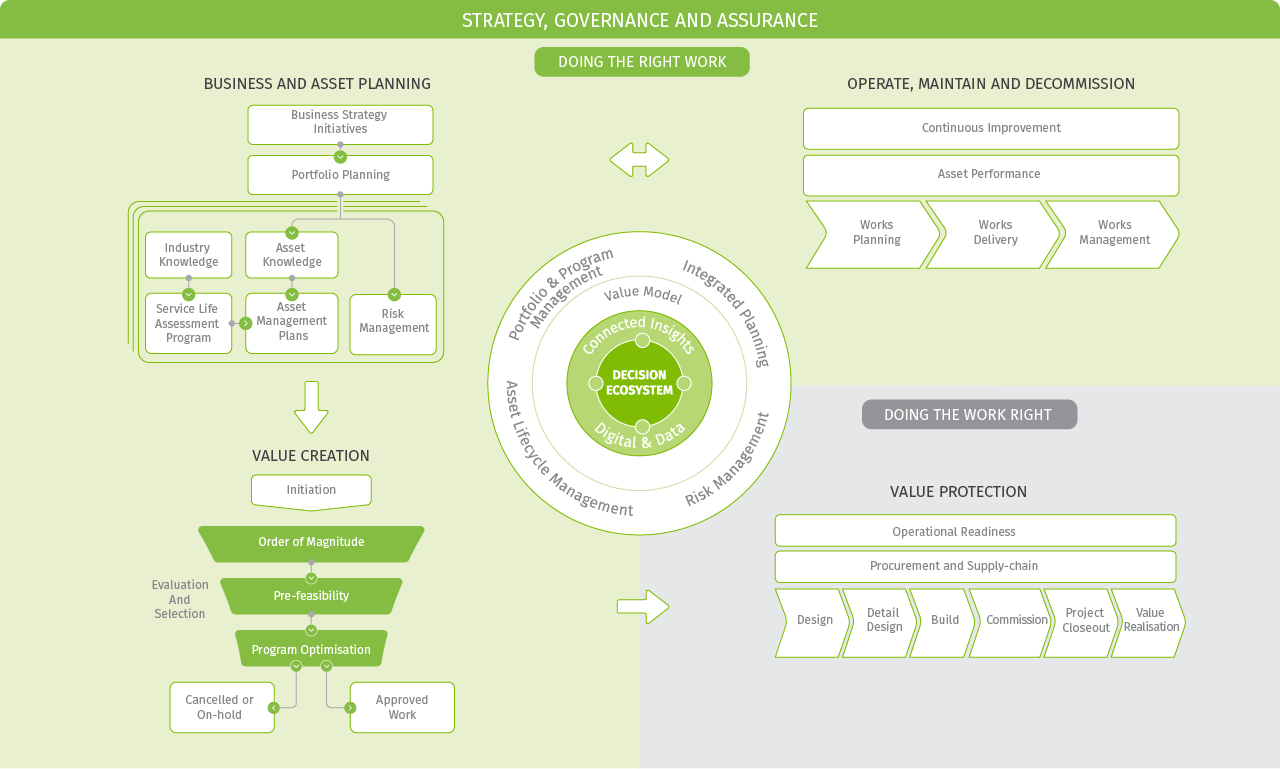
This framework steps out a comprehensive set of decision-making points across the entire asset lifecycle that aligns strategy to execution by thinking differently about the problems to be solved (Figure 2).


The key to continually delivering value for an organisation is designing, integrating and maintaining asset portfolios to operate at their optimal level, and de-risk operations, for organisations and their customers.
Application of the sustaining capital framework delivers five core benefits for organisations:
Shaping and funnelling asset-based investment decisions cannot be a siloed effort. Introducing once-off asset investments, or efficiency initiatives, in separate units won’t have significant network-wide impact. We find that organisations which build value and achieve optimal productivity and efficiency outcomes, and compelling customer experiences, commit to rebalancing and optimising portfolios together with sustainability and climate change commitments.
The framework guides the planning, shaping, development, implementation and maintenance of asset re-investment strategies and programmes.
The full impact of this is the ability to align programmes and projects to organisational strategies, portfolio targets and sustainability objectives. It’s a step change enabling organisations to continuously improve efforts around supply chain integration, long-term asset performance, and integrated approaches and capabilities.
This global miner was optimising the performance and operational resilience of ageing assets at one of the world’s most efficient export centres. Aurecon was engaged to maximise the benefits of the necessary sustaining capital investment for this programme of work.
This drove the transformation of port marine structures to be adaptable to future technology, process and environmental changes, whilst remaining adaptable to support export supply and demand.
Our team used digital analysis and modelling techniques to rapidly assess structural designs and identify safety improvements. We then developed a fully integrated, data-rich, digital model with asset information, enabling the miner to introduce maintenance and operational efficiencies over the next 50 years.
By shifting from individual projects to programmes of network-wide asset improvements, this opens opportunities to develop collaborative commitments with stakeholders and suppliers along the supply chain, as well as long-term partnerships with consultants and contractors.
These partnerships generate greater value for all parties over a longer period of time and build trust between asset owners and the organisations they partner with, allowing the development of joint and repeatable operating models and long-term skills deployment.
In an environment of high growth, evolving policy, increasing project complexity and interdependencies, water utilities are choosing to enter into partnerships with industry to enable innovation and best practice in long-term water planning.
Working with a water utility in Australia, Aurecon’s advice on sustaining capital investment is bringing agility and flexibility to the water utility’s capital pipeline of major asset renewals and augmentations. This is delivering outcomes that matter; long-term efficiency, setting the programme up for strong return on investment, caring for people and the environment, and leaving a legacy for future communities and customers.
With limited budgets for sustaining capital, the framework prioritises the process to ensure that funds are applied to the projects with the greatest return on investment, leading to a more efficient use of resources and greater extraction of value from assets.
Continuing our partnerships in the water sector, Aurecon is assisting another water utility in Australia to extend the life of its assets and plan the economical ways to invest in new capital, or renew existing infrastructure, for the benefit of customers.
At the programme’s first six-month milestone, it had already delivered market-ready documentation for infrastructure upgrades that deferred more than AUD 20 million of new capital investment.
Complex programmes and assets are often managed by different functions within an organisation, which can lead to missed opportunities and unintentional communication breakdowns.
The benefit of advanced analytics-driven decision-making is being able to inform investment decisions to increasingly deliver total strategic value across an entire organisation and its portfolio of assets.
That said, analytics-driven decision-making is not simply having a host of smart systems, it’s being able to connect data to integrated planning, engineering, operations and maintenance to support knowledge transfer and informed decision-making.
Aurecon’s collaboration with a global mining company delivers a breakthrough in the development and implementation of autonomous longwall technology and remote operations.
The application of this provides the client with the ability to remove its people from more hazardous areas, to instead be located on the surface in the new purpose-built remote operations centres. The remote operations centre ultimately minimises downtime which has impacts on overall production targets, together with helping the operations team focus on the right work at the right time.
Assessing data to identify how to create and protect value from existing assets enables a faster response to rapidly changing conditions and improves asset performance. Aurecon applied this combination of asset performance expertise and lifecycle extension to design a sophisticated sustaining capital programme for a world leader in ore refining to extend the facility’s assets and prioritise the timing of capital investments to free up significant investment cash flow.
Looking forward, data knowledge from the performance and operation of existing assets will also inform how future assets should be designed and constructed. By designing with the end in mind, organisations have the flexibility to adapt assets to changing business needs and use the lever of sustaining capital to detect physical issues sooner, predict outcomes more accurately, and drive greater value through assets now and in the future.
Using this approach, Aurecon has been able to work with a water utility in Victoria, Australia, to build a cutting-edge investment prioritisation model. It’s a model through which consistency and repeatability in decision-making governance is achieved with cross-business review and endorsement. Documenting and tracking early intervention can be undertaken and feedback is captured from projects to inform the design and implementation of other projects in the future.
A balanced capital investment portfolio which includes essential sustaining capital works will deliver value across networks of asset portfolios. Achieving this will take programmes of work underpinning by the sustainable capital framework to support the full asset lifecycle, from early phase asset management and front-end studies, through to project execution, and operational readiness and optimisation.
Inherent to this is safety, supply chain optimisation, sustainability and climate change adaptation, energy awareness and response to regulation and market changes to balance priorities in times of transformation.
For asset-intensive organisations, sustaining capital is one of the largest sources of untapped value. Through improved sustaining capital investment, organisations can ensure that assets earn their keep and deliver continuous improvement, no matter what the business cycle, to deliver and support sustainable growth and value creation, now and into the future.

Principal, Sustaining Capital – APAC
Understanding how to transform existing assets, and how sustaining capital can create and protect, value, is critical for organisations of the future.
Aurecon shares insights on how the 2032 Brisbane Games can deliver legacy infrastructure and lasting economic, environmental and community value.
How engineering and construction projects are evolving to champion biodiversity, through early planning, advanced technologies, and ecosystem stewardship.