

Maria Rampa: Hi, I’m Maria Rampa, and welcome to the 2025 season finale of Aurecon’s Engineering Reimagined podcast.
Over the course of this season, we’ve covered a lot of diverse terrain. Including the power of systems thinking, the human side of engineering leadership, the ethics of technology, the digital transformation era, and the drive toward sustainable, resilient, efficient design and delivery.
With each special guest on the podcast reminding us that engineering isn’t simply about making things work – it’s about focusing our expertise and efforts on the things that matter.
In this special episode, we'll look back on some of our favourite episodes of the year that all have one thing in common: the evolving technologies that affect or impact three critical areas of interest, including decision-making in the age of distraction, the energy transition and data centres.
Let’s get into it!
In Episode 76, we tackled a problem almost all of us have from time to time: why we can’t focus and how to fix it.
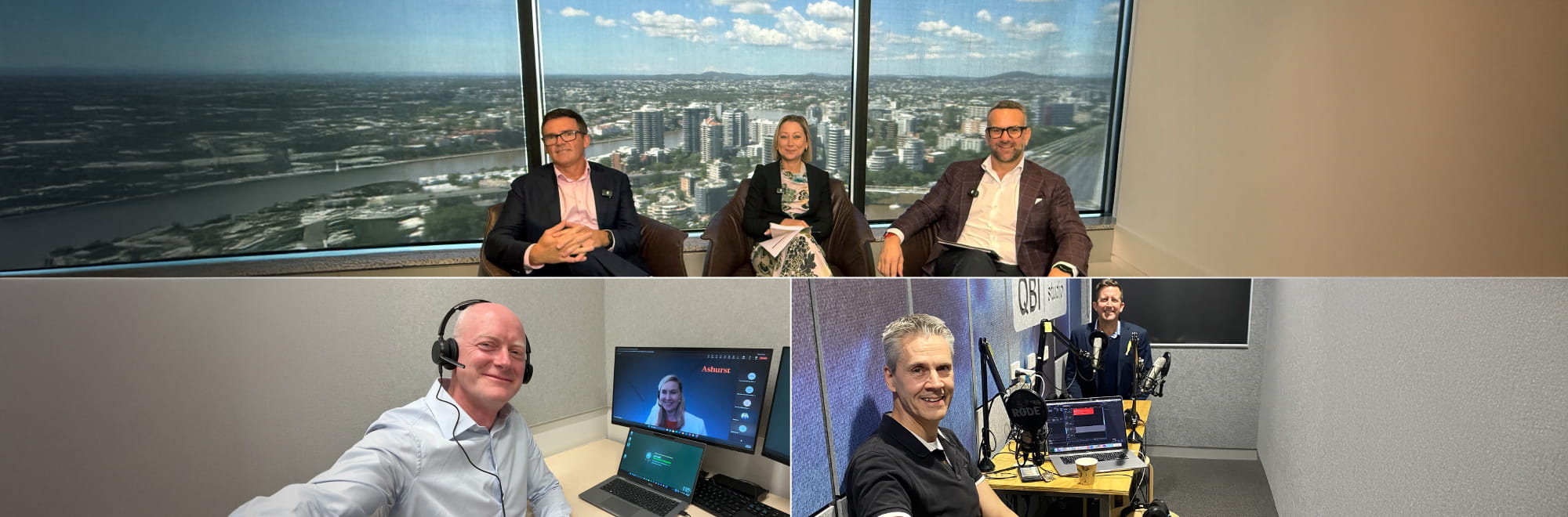
Aurecon’s Chief Executive – Australia, Todd Battley, sat down with Professor Jason Mattingley from the Queensland Brain Institute to chat about the brain, technology and how we make decisions in an increasingly distracted world.
Episode 76 - Our distracted minds: why we can’t focus and how to fix it
Todd Battley: We've certainly entered the age of AI in the mainstream, and you can't have a conversation with someone in a professional setting or even in a social setting where it doesn't come up. One of the things I've noticed in myself is, I feel like I'm much more easily distracted than I perhaps once was. I see that all the time. I occasionally sit down for a movie and a three hour movie feels like a commitment, whereas maybe it didn't once. Have you observed something similar? How are we adapting to all the distractions in our life, and is that having an impact on our ability to concentrate and focus?
Jason Mattingley: I think it is. I think the science suggests that it is, and you're right. I went to the movies on the weekend, Mission: Impossible. Fantastic movie, but it is a big time commitment, and I found the same thing, two or three times during the movie, went for my phone, and I was thinking, why am I turning my phone on? And it was to see if an email or a message had arrived. I didn't need to be doing that. It was nine o'clock on a Sunday night. That's an experience we can probably all relate to. And it's very much a technology-driven thing that we expect more of ourselves. We expect to be able to do multitasking, be able to have three or four plates spinning at the same time. And depending on the jobs we do, sometimes we have to have those plates spinning at the same time. But that does come at a cost. It means we're rapidly switching between one set of rules and another set of rules or one set of behaviours and another set. And the science tells us that when we have to switch between tasks like that, when we have to apply a new rule set to what we're doing, there's a cost involved.
The brain doesn't just switch from one to another automatically. That's effortful, and it's distracting to have to do. That task you've switched to, there's a bit of a slowness and it takes time to catch up with what you should be doing. And if you're then doing that five or six or seven times in an hour, and that might be I'm supposed to be, interacting with this spreadsheet or writing some code, but meanwhile I'm checking my Instagram, that's going to exert a cost. And why do we do it? Why do we get into the habit of checking these things? Because the algorithms that drive them are tailored to reward you with more of what you expect. So if you've been looking at footy scores or tracking rugby or whatever it happens to be, it'll feed you more of that stuff. And it's very passive, it's very easy. You just let it wash over you, there's no real challenge involved. And real work does require some degree of effort. Humans, it's probably true of all animals, we like to conserve effort. And so, we do things that are rewarding and they often are things that just distract us from the core business of getting on with what we should be doing.
Todd Battley: I have a university-age son who's actually developed a bit of a technique for himself when he's trying to study. He's quite a good student, he cares about his grades, and he'll go and put his phone somewhere else in the house, which sometimes causes another issue because you can't find the phone at the end of it. But nevertheless, it's not with him in the study and he sort of disappears into his work and comes up a few hours later and he feels good about it. Is that the kind of thing we need to be thinking about more, being deliberate?
Jason Mattingley: I think so. I use the term mindful, but just being deliberate, having a strategy, not reacting to the world as it happens to you but saying, you know, I'm an active agent in the world, I get to determine how I spend my time. We often talk about, when you're trying to do a challenging problem, using counterfactual reasoning. So, these are the sort of what-if type questions. So you see something in front of you, you're trying to evaluate something. It's always good to say, well, I think this, but what if that or what if that, you know, exploring alternatives. And if you're constantly being distracted by the phone or whatever it is. You just don't have an opportunity to get into that sort of cycle of counterfactual, active reasoning, hypothesis testing. And if you're distracted too often, you never really get to that deep level.
Todd Battley: I'm keen to dig into this counterfactual thinking because that's something I think probably go to the heart of innovation and other things. It takes us out of what we've always done to what might be. Can you explain what is happening in your brain when that's going on?
Jason Mattingley: Yeah, absolutely. So I mentioned hypothesis testing before, and I think counterfactual reasoning is that. It's saying, the future has different possible paths. The work I'm doing at the moment has a particular goal. But what if I make the wrong decision now? Or what if the evidence I've got in front of me is biased or inaccurate in some way? And it's making that explicit, rather than just saying, well, let's see how it works out. You actively create the future scenarios. So, one is the goal, it's success. Another one is near success, not quite. And then there is the disaster scenarios where things go right off the rails. And counterfactual reasoning is explicitly entertaining all of those possibilities, one at a time and asking, what would happen if this was the outcome? What might've led to that outcome? What are the decision points or the forks in the road leading to that? And being very explicit about how you would deal with each of those beforehand. And actually, we were talking about AI before. I think this is one place where AI can have a real role to play in helping structure people's thinking around counterfactual reasoning.
So, you can give a system, a trained system, different scenarios, different possible goals, and get it to tell you, what are the risks in getting to the goal that you're looking for, what are the possible branching off or falling off points, where might things go wrong? So it's a nice way of running simulations of the future, and see what those possible outcomes might look like.
Todd Battley: I'm interested in the human part to start with, is there anything that we can do to give that exploration a better chance for us to be a little more innovative, be creative, to entertain an alternate future, anything that you've come across in your work, where you've seen that be really effective?
Jason Mattingley: If you're looking at any kind of goal you're trying to achieve. It's good initially to just look at all of the factors that are at play, all of the evidence that's going to help you make the right kind of decision, and looking at outcomes with maybe the emotional factors taken out, at least initially. I'm not saying we want to become robots, robotic in the way that we make decisions, because emotions are there for a reason. They help us judge, sort of moral rights and wrongs, those kinds of things. But initially, maybe it is good to think a little bit like a robot initially and say, these are the outcomes of a possible future and now when I look at those outcomes, which ones are actually acceptable to me, based on my principles, the principles of the company, the good of society, the profit bottom line, whatever it happens to be. This is what an AI system won't give you, is those moral values or the emotional elements that we still bring uniquely as humans.
Maria Rampa: In Episode 74, we looked at data centres, the always relied on but rarely seen engines behind everything from your morning emails to late-night streaming. As their use expands rapidly around the globe, so too does their demand for energy and water.
In this episode, Bree Miechel, Partner in Projects and Energy Transition at Ashurst, joined Aurecon’s Industry Director for Digital Infrastructure, Simon McFadden, to discuss one of today's critical engineering challenges, balancing renewable energy with the expanding demands of the digitally engaged public.
Episode 74 - Data centres in the AI age: Power, Place and Cooling
Bree Miechel: Data centres are often described as the factories of the digital age. Can you shed some light on why their energy consumption is escalating so rapidly?
Simon McFadden: I like this analogy. I suppose there are two points in it. Firstly, are they factories? And secondly, why are they using more electricity? So on the first point, the analogy of a factory is probably a helpful one in that the large language models, which most people mean when they're using, when they're talking about artificial intelligence now, those large language models produce tokens or just bits of words or small words. And the AI data centre's function is to produce tokens. People have often compared this to intelligence. So, the production of tokens is the same as producing artificial intelligence. And if you want more of that artificial intelligence product, you need more tokens. And if need more tokens, you need more processing, and therefore you need electricity to produce them.
Bree Miechel: Is the need to develop data centres at scale though being overestimated globally?
Simon McFadden: The answer is, it depends. There are a few things to consider here. Firstly, are the data centres being used right now? So the existing ones, are they being used? And then secondly, how much AI will be used over time and what will the market structure be? I know that data centres have been built and are leased and in some cases are not using their full allocated power. Sometimes a fraction of this, right? But on the other hand, if AI turns out to be as powerful as people think, we'll be using it all the time for everything. So we're probably not building anywhere near enough data centres right now. And if you take account of the market structure, for example, some organisations are building data centres for them to use themselves or a large cloud provider building it for themselves to use.
But others are building data centres to rent, which you know is similar to property development really. I think that in practice there's an overlap between this demand, meaning that there will be some duplication there in terms of the sites that are planned, permitted, and so on but I would hope that the bulk of the sites that actually go through and are constructed are used. I would say if I summarise everything, I think there's more development to come.
Bree Miechel: In our powering change survey, 77 per cent of respondents viewed renewable energy investment as essential to their strategic growth, underscoring the commitment of organisations to drive forward lower carbon intensity business operations. Can you explain how this has extended to the data centre sector?
Simon McFadden: If you think globally, some of the most progressive firms that we see on renewable energy and carbon emissions would be American hyperscalers like Microsoft, Google, and Amazon. They require their teams to focus on the use of renewable energy. They all have hard targets that they've either achieved or are close to achieving for 100 per cent renewable energy by certain dates. And they're often involved with the development of renewable projects or sometimes they lead them to source that energy. We have organised power purchase agreements and attest to their desire for renewable energy. They all want it. The challenge is that it's not available 24/7. And so often this energy is not time matched. But in terms of total megawatt hours going in and coming out, they have it covered. I think over time, as we see more storage, that balance will improve.
Bree Miechel: With the intermittent nature of renewable sources and the need to ensure a stable power supply, are data centre operators turning to utility scale battery storage solutions?
Simon McFadden: Pretty much all data centres have batteries as part of their design to ensure they don't go offline. But these batteries are typically, their capacity really just covers short periods until the generators can be started and come online. We've looked at battery storage for data centres as part larger developments of campuses with renewable energy development. The challenge that the developers have is to have energy on all the time. But as you add more battery capacity, obviously the capital expenditure for that increases.
Bree Miechel: But power's not the only challenge in the design and siting of a data centre. Let's also talk about water. Data centres require significant amounts of energy and water for cooling. In regions where water scarcity is a concern, how are data centres managing this resource?
Simon McFadden: It's become more and more relevant in the last few years. I do reflect as an engineer, we have plenty of water around Australia. And most people are living near the coast. We've plenty of solar energy available to turn it into drinking water. So, you could argue it's a cost and movement issue in the long run. On the whole, the data centres need to get rid of heat. You can do that simply though to the air using free cooling or air cooling, or you can use liquids. And there's really a trade-off between how much electricity you use and how much water you use. It's interesting that we're seeing some clients that are considering water that is treated but not to potable or drinking water levels. And this can be more economic and isn't taking supply from drinking water. When considering the water supply, we consult with local water authorities and understand whether water is needed for drinking water and they consider that when giving permits out for water and so on.
Maria Rampa: Finally, today in Episode 73, Aurecon’s Managing Director, Energy, Paul Gleeson, spoke with Ashurst Risk Advisory Partner, Elena Lambros, and Ashurst Partner and Global Co-Chair of Energy Industry, Dan Brown. Together, Paul, Elena and Dan discussed the progress and trajectory of the energy transition, energy mix options and the economic choices stakeholders are making to secure Australia’s energy future.
Ep 73 - Energy infrastructure: trends shaping a surge in investment and development
Dan Brown: Paul, there is so much happening in the energy space at the moment. What's your gut feel on where we’re at from your perspective?
Paul Gleeson: I really like to remind people whenever I can that the energy transition is not a hypothetical. We're actually doing it. We are actually in it right now. For those not in the sector, particularly if you're just following mainstream media and you could be forgiven for thinking that we're still wondering, will we or won't we do this thing and is there clear pathway? And the reality is if you're in the industry, you're well aware we're doing this thing, right? There are parts of it to be figured out as we go, but there are substantial capital flows into the energy transition and have been for a number of years now. So I just think it's really important for everyone to realise that and that there are certain asset classes that are eminently bankable, investable. Our collective task is to help people, entities in that space, to deploy those projects because that's what's going to ultimately keep the lights on and then the conversations about what might the last final five or ten per cent look like, sure. We could discuss that, but right now we can't lose sight of the fact that we're in the middle of the biggest capital deployment that the sector has ever seen, and probably the country.
Elana Lambros: I like that point around bankability and projects that are really getting off the ground and forming in. Can you talk about, to the extent that you can, some of the projects you're referring to or what you see as working well?
Paul Gleeson: When I look at, having been in the sector for 27 years now, you see the different generation technologies in particular that have each reached different points of competitiveness in the wholesale market and therefore the waves of rolling out each of those. Obviously we started in Australia with a coal fired generation fleet. And then we had a period of building gas fire generators and then really since then has been the wave of wind and solar or variable renewables or VRE as we call them.
And so, from an equity and debt perspective, wind and solar as a generation technology are extremely safe ground. There's obviously risks to be managed around each site, each development, costs, stakeholders, counterparties, all that stuff, but the actual technology, the asset class itself is very bankable. That's where we see a lot of the capital flowing. But probably the biggest surge of activity we've seen in the last 18 months has actually been in the battery space. So not surprisingly, as you start to build a system predominantly on wind and solar, you create an arbitrage opportunity, right, for moving all that high-volume, relatively low-cost wind and solar energy into when and where you need it. So battery projects, absolutely surging. The scale of them now is quite mind-blowing to me. Dan, I remember you and I working on one that was ground-breaking when it was five megawatts. We've now got some that are many hundreds of megawatts, maybe not too far off a gigawatt project coming. That's driven by the volume of wind and solar that we need to move around in terms of time and location. It’s also driven by the collapsing cost, the capital cost of battery modules. That's the current wave and then once that's there that will unlock another wave of VRE and then that's on the generation side. And we can have another chat about how we move it around, the transmission projects.
Elana Lambros: We're also getting to the point where we're talking some other technology that might need a bit more support, so just wondering what your thoughts are on how we're going to get to some of those tricky things, you know, hydrogen is something that people talk about, is that ever going to get going, those sorts of things. I don’t know if you've got some observations, I'm sure you do.
Paul Gleeson: Yes, you're right, I do.
Paul Gleeson: I like to talk about the different phases of the energy transition. The national electricity market is now north of 40 per cent variable renewable energy on an annualised basis.
Elana Lambros: It's huge actually.
Paul Gleeson: Most people have no idea, most people think we're still wondering about, we might have a crack and build the odd solar farm, but actually we're already at 40 per cent. And just as a side note, in less than five years you've gone from 20 per cent to 40 per cent, you start to realise what's possible. So those are the things that make economic sense which is decarbonising the national electricity market by predominantly building out renewables and storage. But then after we've decarbonised our electricity system, what else has to be decarbonised in the national economy? And you've got huge sectors like transport and a heavy industry, agriculture eventually. So that's where there's still a gap. Where there's things that we need to do that are not yet economic.
When I'm talking about hydrogen these days, I like bang up a slide that has something called the hype curve on it, which you can Google but there's a bunch of these curves. I think Gartner might have done the first one and it looks at, pretty much all technologies, not just an energy-related conversation, that goes through this thing of rapidly building expectations to sort of like peak hype, peak expectations, and then as you go from this hypothetical into actually starting to deploy it, you come racing down into what's often called the valley of despair, where you find out what it really costs to build these things. And I think that hydrogen is close to the bottom of that valley at the moment, right. We've done all this work over the last, say, six or so years trying to develop projects. The numbers are still out. Other things have happened in the meantime that have also pushed those project economics out. Hydrogen is now, there's a big reality check around, okay, if that's really the economics of it, it's about accepting the reality that it's probably not going to be a globally traded seaborne commodity in its own right. Where instead, where we're still working on it, is where it's the, like the foundation green molecule for something else.
And so, what we're looking at with a number of players is, where are the industries where substitution of that green molecule, for a fossil fuel one, doesn't have much impact on the final product cost? So green iron, green steel are two really, really key ones. And also other parts of that supply chain. So if you looked at replacing it as, using it in rail to move iron ore from the mine to the port. You can barely see it and that's an industry that's committed to decarbonisation, whereas, if you said I'm just going to try and compete in the market, try and sell it up against diesel or something like that, it's just not going to happen. So it's about understanding the projects we're going to do in the next few years are those ones where it really has the least impact on the final cost of production and also trying to align it with which are the industries that have made big decarb commitments, because you need those two things combined really.
Maria Rampa: And that’s a wrap for our 2025 season of Engineering Reimagined. Whether you’re tuning in for the first time or you’ve followed us through every episode, we hope you’ve enjoyed what we’ve had to share.
Until then, I’m Maria Rampa, and from myself and all of the team here at Aurecon, we wish you all the best for a safe and happy festive season.
Lessons learned from Season 7 of Engineering Reimagined
As we close out the 2025 season of Engineering Reimagined, host Maria Rampa takes you on a journey through some of the most powerful moments and conversations from this year.
With each special guest on the podcast reminding us that engineering isn’t simply about making things work – it’s about focusing our expertise and efforts on the things that matter.
In this special episode, we'll look back on some of our favourite episodes of the year that all have one thing in common – the evolving technologies that affect or impact three critical areas of interest.
First, we tackle a problem almost all of us have from time to time: why we can’t focus and how to fix it.
Next, we look at rapid rise of data centres and their and their demand for energy and water.
Finally, we explore the progress and trajectory of the energy transition, energy mix options and the economic choices stakeholders are making to secure Australia’s energy future.
Let’s get into it.
Additional resources
- Queensland Brain Institute | University of Queensland
- How to stop scrolling and focus at work
- Ashurst Aurecon Alliance | Aurecon News
- Powering Change: A New Era for the Energy Transition
- Chilling out with liquid cooling in data centres | Aurecon Insights
- Clean Energy Council Energy Fact Check
- Energy transition & Decarbonisation | Aurecon Expertise
Disclaimer
The views and opinions expressed in this podcast are those of the individual speakers and do not necessarily reflect the views of the host, the organisation, or any affiliated entities.