
Beyond bricks and mortar: designing resilient high-containment facilities
Learn how adaptable, sustainable building design for complex research and high-containment facilities enhances public health outcomes and disease preparedness.


Change your location to view content tailored for you.
The Taskforce on Nature-related Financial Disclosures (TNFD) has published its final framework designed to address corporate disclosures on nature-related risks and impacts.
TNFD’s 14 disclosure recommendations have been developed in consultation with the market during the past two years. The accompanying framework is now ready for voluntary use by companies. This signals significant changes ahead for financial flows and asset allocation to achieve better nature positive outcomes from investments.
By adopting the framework, company leaders make a step-change in acknowledging that nature risk is financial risk. It provides guidance for companies to identify, assess and disclose their exposure to nature-related issues in a manner consistent with climate-related reporting.
"If your organisation manages infrastructure, energy or land assets, nature risk is already impacting your balance sheet."
Colm Molloy, Principal, Environment and Planning, Aurecon
Nature loss, and the associated nature risk, endangers the world economy with more than half of global gross domestic product (GDP) now reliant on ‘at-risk’ natural systems, as reported by the World Economic Forum[1]. In addition, more than 400 major global companies and financial institutions signed the ‘Make it Mandatory’ declaration on mandatory disclosures on nature at the 2022 United Nations Biodiversity Conference (COP15) in Montreal, Canada[2].
Every company relies on nature for resources and ecosystem services, water, material inputs, soil growth, pollination, minerals and energy. They are also being expected to act on nature and biodiversity, facing pressure from stakeholders, investors and customers to decarbonise, and mitigate and manage nature-related risks.
Given these factors, it is important for companies to understand, disclose and manage nature-related risks as part of prudent corporate risk management processes. This is no longer framed as external to financial and corporate strategy, instead intrinsically linked.
The annual unpriced cost of nature is 13 per cent of global GDP[3]. Carbon markets are now maturing, and the world’s nature markets are valued at USD9.8 trillion[4]. The implication for companies is the need to channel investment into risk-assessed opportunities and develop corporate awareness of marketable natural opportunity and material risk management.
Already, the Australian Institute of Company Directors is offering workshops for companies on how to prepare for the emerging nature opportunity to create long-term corporate value.
Companies that value their natural assets and incorporate nature into their strategic, risk, governance and financial decision making will be leaders in the transition economy. Not only capturing their impact on natural capital but also value creation for responsible investment approaches can differentiate them amongst competitors (Figure 1). This is especially important, given the focus on economy-wide decarbonisation initiatives, such as the electrification of fleet, and energy generation.
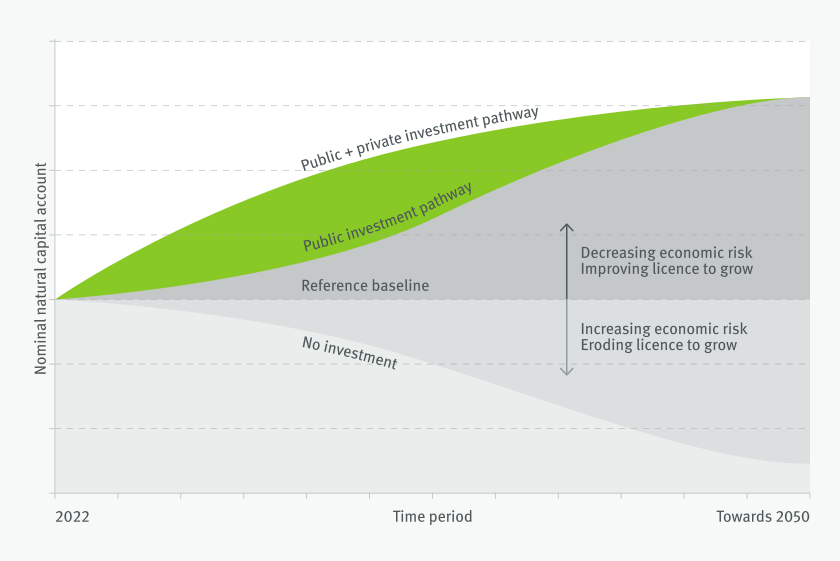
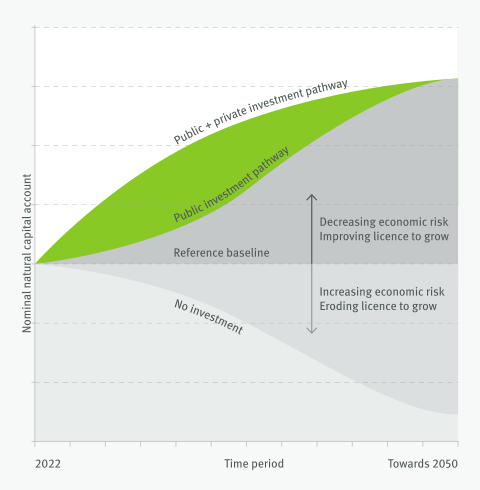
Figure 1: Recognition of the need to integrate natural capital into investment planning.
Financing (whether using debt or equity) and protecting long-term investment into natural ecosystems requires an understanding of a company’s exposure to risk. Adopting the TNFD framework can prepare them for investment in a new paradigm, where controls on greenwashing are likely to exceed those of existing financial structures.
High integrity reporting requires systems that connect nature risk with the decision-making framework. Platforms like Aurecon’s bespoke Advanced Interactive Reporting (Aurecon air®) generate evidence-based reporting to deliver market, regulator and stakeholder confidence.
The TNFD framework is an internationally recognised risk management and disclosure tool for the private sector to report and act on evolving nature-related risks. It includes 14 recommended disclosures covering nature-related dependencies, impacts, risks and opportunities, and aims to support companies in their transition to scale up action that restores the resilience of nature.
Companies adopting the framework must consider business decisions in the context of understanding the relationship their assets have with nature, and being able to account for nature value throughout their supply chain.
What this means for asset owners is that detailed guidance regarding physical, transition and systemic risks will enable them to assess, manage and disclose nature-related risks:
The global economy impacts nature and, yet, at the same time, is dependent on nature. This dependency concept does not exist in relation to climate impacts. For instance, humans depend on nature to provide fresh water, but water doesn’t rely on humans. Therefore, while modelled on the TCFD, the TNFD incorporates both these concepts equally – climate and nature.
It provides companies with guidance to begin understanding how nature-related risks impact financial performance and financial risk assessment. As with all enterprise risk, understanding risk appetite and incorporating high integrity information is the key to building systems that create and retain value.
Companies are not simply encouraged to measure their impacts. The framework compels them to set science-based targets and properly embed nature-related considerations in their strategies and systems. It does this by introducing the Locate, Evaluate, Assess and Prepare (LEAP) assessment process:



While only voluntary at this stage, it is anticipated that the TNFD framework will become adopted as part of mandatory reporting, with many companies preparing for this eventuality.
Aurecon anticipates that over time, the benefit of the framework will be more than its reporting guidelines, but rather will enable companies to develop systems that account for intangible risk, enhancement of resilience, creation of new value from green investments, and development of defensible decisions for stakeholder engagement. Identifying expanded nature-related risks and opportunities improves long-term value creation for asset portfolios.
There are many companies that own land out of necessity and may not have prioritised managing it sustainably, or, in accordance with ecologically appropriate regimes. Looking forward, there is a significant opportunity to make transformative changes to function and operation by taking high-level action on nature, creating a nature-positive world.
Understandably, there is a risk for companies in aligning with the TNFD’s recommendations. Full supply chain collaboration (upstream and downstream) will require most companies to now introduce complete traceability. In addition, depleting resources are still a concern together with financial risks associated with transition risk, regulatory changes, and shifting consumer preferences.
Given that the TNFD framework is anticipated to have widespread adoption, companies may want to start making preparations to combine their climate and nature-related reporting.
These preparations might include:
Through providing companies with the ability to assess and disclose their impacts and dependencies on nature, the TNFD recommendations are aligned with the Global Biodiversity Framework (particularly Target 15).
The TNFD framework is a significant milestone in providing guidance for companies and investors that intend to assess and mitigate their exposure to nature-related risks.
Overall, the framework offers compelling opportunities to take action, create new value and make a real difference for people, places and the planet.
[1] World Economic Forum, 19 January 2020, GDP Moderately or Highly Dependent on Nature, accessed 1 April 2023.
[2] Business for Nature, Make it Mandatory Nature Disclosure, accessed 26 April 2023.
[3] Earth Track, February 2022, Protecting Nature by Reforming Environmentally Harmful Subsidies: The Role of Business, accessed 10 May 2023.
[4] Taskforce on Nature Markets, March 2022, The Future of Nature Markets, accessed 20 September 2023.
Contributing author & reviewer: Colm Molloy
Learn how adaptable, sustainable building design for complex research and high-containment facilities enhances public health outcomes and disease preparedness.
Aurecon’s ecology and biodiversity expert shares how to achieve timely project approvals, what regulators want, and how to navigate regulatory changes.
Aurecon shares insights on how renewable project delivery models are evolving to better manage risk and deliver long-term value through project partnerships.