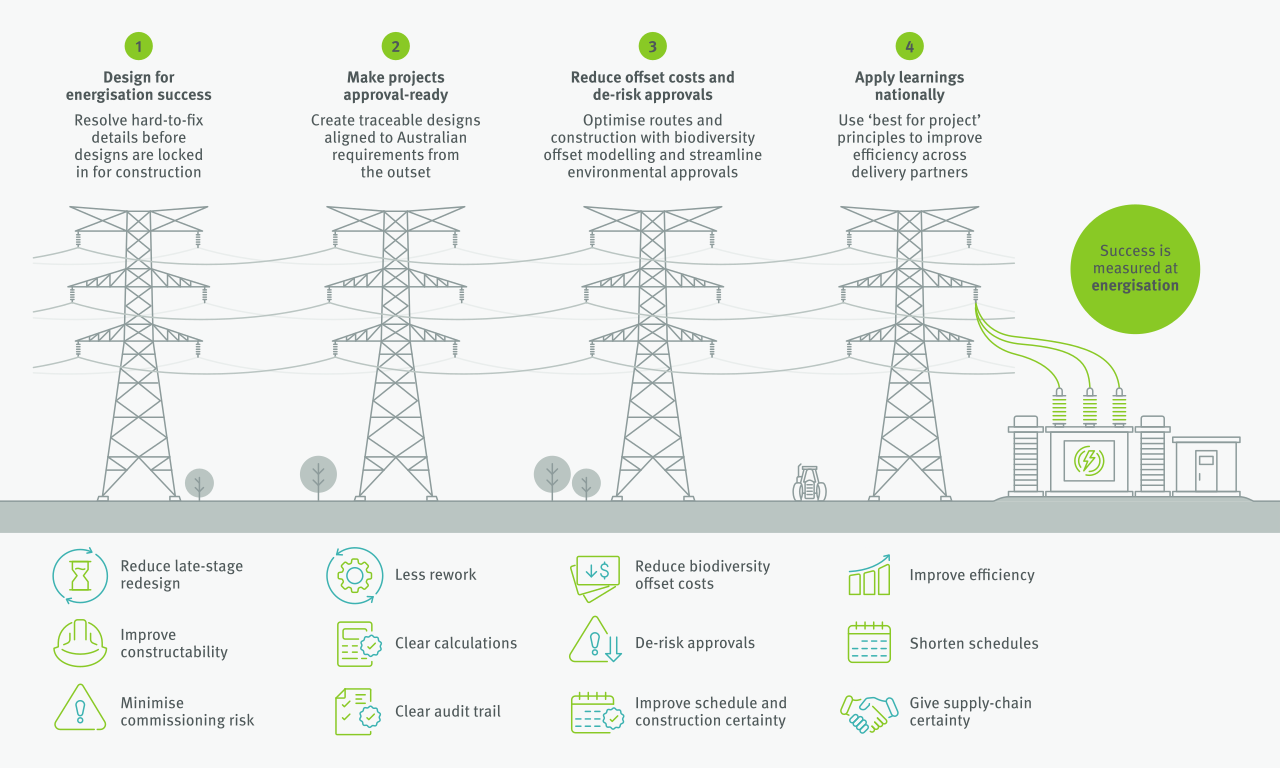
1. Design for energisation success
The biggest cost and schedule outcomes are determined at the outset. Rushing front-end decisions to meet design milestones creates risk of delays and cost escalations once projects move into construction and commissioning.
Global research into major infrastructure delivery by Flyvbjerg and Gardner (2023)1 argues for a ‘plan slow and act fast’ approach. This means investing time upfront to resolve details that will reduce construction time as well as rework and commissioning risk.
Once procurement starts and costly on-site teams mobilise, this front-end decision-making helps deliver efficiently, to budget and to schedule.
2. Make projects approval-ready
In Australia, design approval gates, approvals pathways, workforce capacity and climate resilience regularly become key drivers of schedule and cost. With approvals, landholder engagement and design often progressing in parallel, teams also need to design for Australian regulatory and design gate expectations, so decisions are approval-ready and traceable from the outset. This reduces churn and avoids ‘stop-start’ delivery – it also protects investor confidence.
3. Reduce offset costs and de-risk approvals
Biodiversity offsets can materially shape route selection, CapEx, and investor confidence and approval timelines. Teams can avoid redesign, reduce contestability and improve certainty for investors, regulators and communities when offset implications are understood early. Treating offsets as a strategic design input, with visibility of ground and land values and escalation factors (labour, commodities and land), supports approvals and investment decisions. Analytics and geospatial modelling can significantly reduce offset requirements while at the same time streamlining approvals and reducing project risk.
4. Apply learnings nationally
Transmission delivery is as much a commercial and behavioural challenge as it is a technical one. Incentives that are aligned around shared outcomes encourage teams to surface issues sooner as well as solve problems faster and protect schedule certainty. That makes it more likely cost forecasts will hold and lessons learned can be transferred from one project to the next. A national approach is one way to make collaboration real through transparency and incentives that reward collaboration, reduce duplication, manage sequencing impacts and sustain industry capability.
In this video, Aurecon's Renene Windsor shares four ways to improve cost and schedule outcomes for major energy transmission projects.