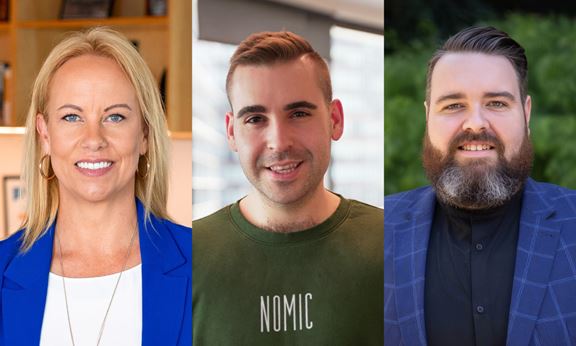
Aurecon invests in Nomic to shape AI-enabled engineering
Aurecon's strategic investment in Nomic builds on a four-year working partnership to scale industry-specific AI capabilities across Aurecon's workforce.


Change your location to view content tailored for you.
Never before has the facade industry been as challenged to innovate as it is now. Aurecon’s Steve Daniels, Global Facade Leader, and Greg Borman, Facade Engineer, discuss the changing face of facade design, the latest in facade technology and the future of this evolving industry.
"Facades are to a building what first impressions are to people," says Daniels. "A building’s character is determined by its architectural facade and is therefore a crucial design and construction element responsible for setting the 'tone' of a building."


He goes on to say that, over the past decade, there have been significant changes in terms of what is required of building facades.
Facades have, essentially, moved on from simply keeping the weather out, with today’s clients demanding that they work a lot harder than they have in the past.
"Our clients are facing manifold challenges unique to today’s business environment: increasing energy prices, climate change and pressure to ensure buildings reflect sustainable building practices. As a result, it’s become critically important to ensure building skin technology has both aesthetic and functional appeal."
Facade design has evolved into a building science with its own sophisticated tools for responding to increasingly challenging client demands.
Borman confirms this: "Dynamic modelling has become standard practice in industry. Using sophisticated programmes, we are able to model an entire building’s performance, from occupant comfort levels and possible cost-savings to be realised from different material choices, to how the building’s facade will affect the performance of other technologies within a building. This allows engineers to ‘prove’ the impact of good design measures."
What’s more, trend-setting companies are increasingly viewing their building’s facade as a way of making a bold statement.
"They want their building to represent who they are, and, as a result, end-users are becoming intricately involved in the design of their buildings, including the specification of materials," explains Borman.
He goes on to report: "Just the other day, Aurecon assisted a client in the selection of a high performance glass which, at the same time, delivered the appropriate degree of transparency. The client wanted the glass to reflect the company’s 'transparency' and stance against corruption in industry, and, as a result, was closely involved in the glass selection process."
Aesthetically, glass and aluminium still reigns supreme, but how we use those two materials is evolving rapidly.
"Over and above performance, architects are coming up with increasingly complex facade designs and better engineering is required to realise these designs," believes Daniels.
Architectural tools have become more sophisticated and are enabling engineers to achieve more and more complex 3D designs and forcing them to stay ahead of this technology to ensure the designs can be realised.
"Importantly, this isn’t only an international trend," comments Borman.
The tendency toward creative facades is starting to enter the South African market, too, and we’re seeing curves and angles we would never have been asked to create some years back.
He adds that in the past, add-ins such as photovoltaic and 'living' panels (panels which include flora) were included 'for show', but in future he believes these will become part and parcel of good design.
"What’s more, we’ll soon see the cost of integrating cutting-edge technology, such as energy harvesting, drastically reduced."
There is significant research and data which shows that people are more productive when they work in more comfortable spaces.
"Just one of the benefits of smart facades includes increased staff comfort, and as a direct result, improved productivity," says Daniels.
He goes on to say that building owners are increasingly seeing the business sense in investing in facades.
"Forward thinking developers understand that occupancy rates and demand are higher for buildings with high-tech facades and are increasingly investing in this aspect of their buildings in order to secure future paybacks."
Borman concludes by saying that the future of this evolving industry is best captured by curious architects and developers asking: "What’s really possible?" and "We now have the technology to respond: ‘almost anything, really!’"

Group Director, Brand, Marketing & Communications
Aurecon's strategic investment in Nomic builds on a four-year working partnership to scale industry-specific AI capabilities across Aurecon's workforce.
Aurecon appoints seven new Design Directors to help clients deliver complex, high-risk projects across Asia Pacific in energy, infrastructure and digitisation.
Aurecon has announced 31 new owners across Australia, New Zealand and Asia, who will play a critical role in helping the company grow alongside our clients.