


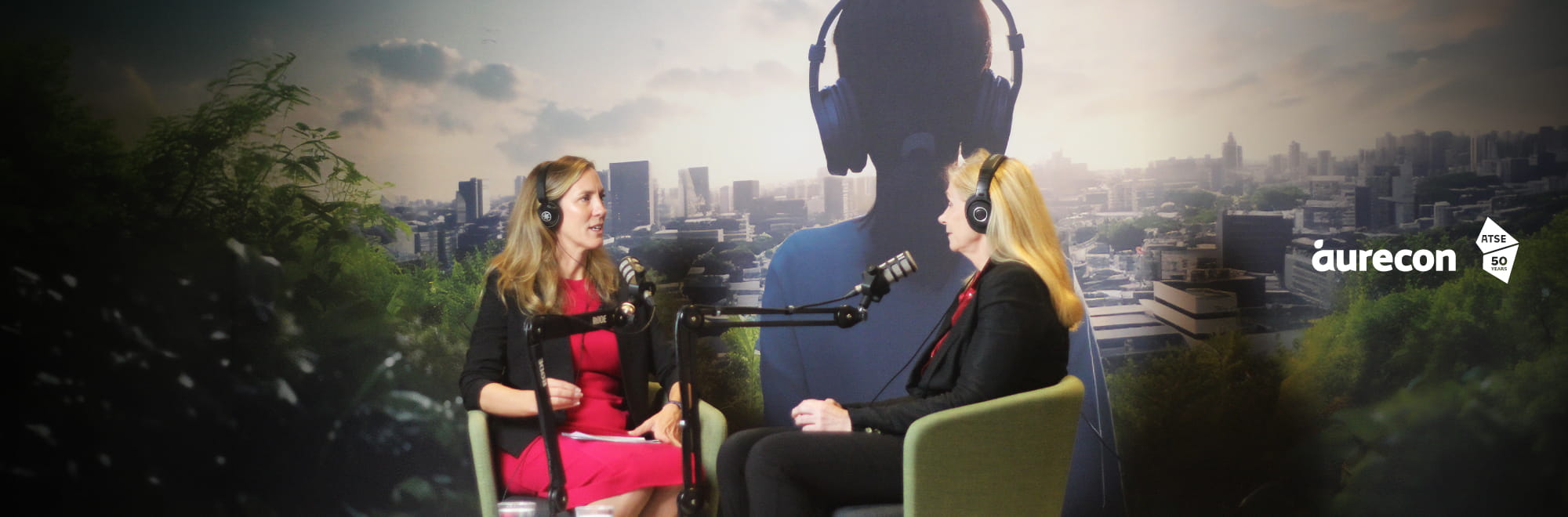


Maria Rampa: Hi, I’m Maria Rampa, and welcome to this episode of Engineering Reimagined recorded live at the 2025 CAETS Conference.
What does it take to reimagine the future in a world shaped by rapid technological change? And what role can human skills such as creativity, judgment, and connection play?
In this episode, Aurecon's Chief Engineering, Eminence and Innovation Officer Tanya de Hoog sits down with robotics expert and former geochemist Sue Keay to explore the unexpected pathways that lead to emerging technologies and how they are impacting our planet—from mining and manufacturing to construction and climate change. Sue shares her unconventional journey from isotope geochemistry into robotics, highlighting the value of transferable skills and “T-shaped” expertise.
Together, they unpack how technology and human ingenuity can scale solutions to some of our biggest challenges.
Let’s get into the conversation.
+++++
Tanya de Hoog: Welcome Sue.
Sue Keay: Thank you.
Tanya de Hoog: It's great to meet you. Now to start off Sue, you're a research scientist in isotope geochemistry with a PhD in Earth Sciences. I'm fascinated to know, how did you get into robotics?
Sue Keay: Well, it's my sister's fault. So, she did a master's with the Australian Centre for Field Robotics, focused more on the social side of robotics, and moved over to the US and became the managing director of Silicon Valley Robotics. Which is an organisation that was set up by the early successful robotics companies over there to help support the new up and coming robotics companies. And so she was always telling the family that robotics was the way of the future, blah, blah. She's my older sister, so it was kind of my duty to ignore everything she said. I'd moved out of research science more into research management and commercialisation across a whole range of things, including water recycling. And an opportunity come up to help set up a new research centre focused on bringing computer vision and robotics together. I didn't really know much about either of those two things. But I contacted my sister and I said, well, there's this opportunity and she told me I'd be crazy to miss out. And then that was really quite transformative because it gave me the opportunity to be walking into a robotics lab every day and seeing what they were doing. However, sadly, I knew that my sister often was the recipient of a lot of the talent and technologies that we were developing in Australia because she sees so many Australian companies just bypass our shores really and set up over in the US to pursue developing robotics technologies further. So, it kind of left me with a real deep interest in what is it that we need to do here in Australia to make sure that we're making the most use of that talent and those technologies and developing an environment around robotics that would help it to flourish.
Tanya de Hoog: So tell me from that sort of beginnings in research, did that give you an edge in robotics? Were there things that perhaps you came in with different or unconstrained thinking?
Sue Keay: The most important thing was that I wasn't afraid of big words, and so even when people were speaking about technical things that were not my area of specialty, I had confidence that I could figure it out, and I think that does give you an advantage over people who potentially don't have scientific training at all, because then I think that the whole jargon that is involved in a discipline can be very off-putting. However, I do think it gave me that outsider perspective of where there might be potential gaps or areas where people were maybe not seeing the problem.
Tanya de Hoog: I'm just going to dig into that confidence to figure it out because I have heard at this conference over the last two days, a lot of conversation that maybe is based in sort of fear or missed opportunity or challenges around climate change being such a big problem that it's almost overwhelming even with emerging technologies. But when I hear from you this idea that we can figure it out if we have a deep understanding in one area that actually you can apply that and transfer that into these big problems, I find that really inspiring. If you were a young scientist or a young engineer coming into our vocations now, what advice might you give somebody in that context?
Sue Keay: It is really about following your passion and finding where you can have the most impact and that won't necessarily be in the area that you initially trained in. But that initial training is important. One of the other things we've heard a lot about today is what people call the T, where it's very valuable for people to have very deep understanding in one particular area but then also balance that with a very thorough general knowledge. If you have those two things, then you can apply that deep expertise in ways that might be a bit unexpected, but also give you the confidence that there are a lot of problems that you can contribute to solving, even if it isn't in the discipline that you specialised in.
Tanya de Hoog: There's been a lot of advancements in robotics, but certainly a lot impact that we can learn from. I'm specifically interested in how we might learn from the advancements in robotics to take some of those innovations and impact at scale our built environment.
Sue Keay: That is certainly an area where it would be great to see some impact at scale. And I wouldn't say that robotics is there yet, but there have been a number of, as you say, advances in the field that mean that robots are far more capable than they've ever been in the past. And that has only been accelerated by a lot of the advancements in artificial intelligence. And now that we're seeing big investments in areas like humanoid robotics, that trend is going to continue. Because even if we don't end up with useful humanoid robotics, what happened when we saw big investments in self-driving cars were that it reduced the costs of a lot of the components that go into making self-driving cars, such as sensors. They reduced the price point, which meant that you could make advances in a lot of areas surrounding that field.
Tanya de Hoog: It's so interesting.
Sue Keay: And the same thing is going to happen with humanoid robots. So I think we'll see a lot more development in things like tactile sensing. The main trend that we've seen is a move away from those static industrial robot arms that most people imagine when they think of robots that operate on the factory floor but in general remain in place, they don't move around, to robots that are far more mobile and can operate in unstructured environments, which then make them very suitable for applications in the built environment. So robotics in construction is something that I'm quite interested in because construction has been an area that has been quite resistant to innovation and I think there are a number of reasons for that. However, I think that Australia is getting to a point where we will have to look at how these technologies can be applied because we have a housing crisis. The government has promised to build, I think, 1.2 million new homes, at the same time, we are seeing probably upwards of $50 billion worth of investment into the development of data centres and also we have a number of special projects happening such as the Brisbane Olympics in 2032 and all of these things are going to be putting enormous pressure on the construction industry and on the built environment more generally, for us to come up with solutions that are not gonna require the level of resourcing that we are currently using. And the main way that you can address that issue is through robotics.
Tanya de Hoog: Which is really exciting and if we layer onto that, future forced climate migration in highly populated areas and particularly in South East Asia, the amount of growth and the amount of construction that's required for people living in cities in the future just far outweighs what would be possible from a resource perspective. So in that sense, tell me a little bit about what we can learn, if we know that this is coming in the future, and we know that robotics potentially will augment and sometimes replace what we might do, how can we learn from that? Rather than being fearful of these big, really wicked problems that we framed earlier, what can we learn from the work that's been done, particularly in the mining sector and manufacturing with robotics, that we might take as an optimistic view on what's possible for the future?
Sue Keay: The main use case for robotics in both manufacturing and mining in the first instance has been safety and we know that construction is still a dangerous industry for people to work in and although we haven't completely automated processes in mining, the opportunity in areas like that is to get to the point where you might employ people on a mine, but they don't actually have to be at the mine site. And this is particularly important for things like underground mining, where we're still typically sending hundreds of people underground every day and if we could come up with technological solutions that were reliable enough to operate in those challenging environments, then we're looking at a future where we can still maintain production and be developing materials, but without having to put people in harm's way. That is the sort of thing that we need to be looking at for the built environment, but the other opportunity that it opens up is that a lot of the benefits of applying robotics in mining, for example, ended up being unanticipated. So there's sometimes not a straightforward, obvious business case for deploying robots, but what they found when they first developed the autonomous load haulage vehicles that are now commonplace in Australian iron ore mines, was that there were a whole range of flow-on benefits, such as reduced maintenance costs, reduced fuel consumption. There were just things that were not anticipated. And the other thing that has been important is how you can look at redeveloping processes so that they're more suitable for robots than for the way that we currently do things. So it opens up a whole range of possibilities. But I have to say, we're still really not good at unpicking our processes and figuring out how things can be done in different ways. People get very attached to there being a certain way of doing things. And it seems to be very challenging to unpick that. But if we want to take advantage of technologies and we need to recognise that these technologies are not replacements for humans, they have very different strengths. You really need to be able to play towards those strengths to get the most benefit out of them. Robots are a really good example of that because you can't just, for example, put robots on a conveyor belt where you might have had humans doing a particular task and expect the robot to just replace a human worker because they're not humans. They operate in a different way and so you often have to look at how you can set up the environment to suit the robot rather than the other way around. Where robots will have the most impact in the built environment will be in areas where you can prefabricate. So in areas which I guess are the most like manufacturing, those aspects of construction.
Tanya de Hoog: Why do you think that's the biggest area to leverage in the built environment? Is it because we are able to design the process to suit robots?
Sue Keay: Yes. You also have less variables in prefab. Whereas, if you can imagine trying to apply building 1.2 million custom homes versus a thousand warehouses that all have the same footprint, it's much easier to automate the thing that is very regular and has to be reproduced in the same way each time.
Tanya de Hoog: That's one of the things I'm passionate about in engineering is having impact of scale but doing it by designing things that are repeatable as opposed to trying to come up with that really big solution that's going to scale across the world and it just becomes this almost too big, too complex, unknown problem but when we think about what can I do that is innovative or innovating in a way that we can share that knowledge and that can actually be repeated all over the world, suddenly you can start to see how that has a really big positive potential impact.
Sue Keay: I think people should take some comfort in the fact that actually what it's showing is that a lot of these technologies and robots aren't very competent. You really have to give them the most simple, reproducible tasks to be successful, whereas you still need humans to do the much more complex, complicated tasks that really, we're actually very good at.
Tanya de Hoog: One of the other things I've heard a lot about in recent days and conversations about emerging technology is the human element. And I am really interested in, as engineers and as scientists, what our future might look like and what to lean into now to prepare for that, not just as an individual but as a profession. How do we maintain the human aspects of who we are and what we do? Where might our value lie in the future when we are going to augment what we do now with emerging technology and potentially, you know, robotics and the way we build things? Is it our deep expertise that we lean into? Is it really broadening our T-shaped professional? What are your thoughts on that?
Sue Keay: Well, I think it's the deep expertise, but also married with sociability because, although, there's often some talk about robots as counsellors and friends, it's not the same thing and robots don't have emotions, they can only pretend to have emotions. And for that real human connection, you need humans. There will always be a place for people in people facing roles and to be able to get that trust with other humans. But also, the deep expertise side of things and the ability to put a whole different lot of tasks and experiences together is something that's very hard to reproduce by a robot. Also, you know as humans, we get to choose how we use these technologies, and people shouldn't lose sight of that. And we need to make sure that we are using our agency and that these technologies are used in ways that we feel comfortable with. If we do that and keep that in mind, then the real opportunity is that technologies like robotics are really providing an extra set of hands or multiple extra sets of hands to help us as humans solve problems that we have not been able to solve as humans alone. Because I think the real power of robotics and AI is the scale at which they can be deployed. And we have to be the ultimate architects of how they're deployed.
Tanya de Hoog: So to wrap up, if you were to think of one large opportunity where that combination of the human deep expertise, combination of people coming together and sharing knowledge with robotics and emerging technology, what challenge or opportunity would you advise young people to say this is the biggest thing, the biggest opportunity if you want to change the world? I believe that engineering is the place to do it. I'm sure that scientists believe that there's equally as much opportunity. Where would you focus that energy and impact to solve those big, kind of wicked problems of the future?
Sue Keay: Looking at sustainability and how we can continue to make sure that everyone has a reasonable standard of living and quality of life while also preserving our environment. And I think that's a message that resonates with everyone really, because no one wants to live on a planet where we are not doing the most that we can to try and alleviate the impacts of climate change and so any contributions that people are making to be able to balance those demands of an ever-increasing human population and all of its requirements with preserving our planet is certainly going to be very impactful.
Tanya de Hoog: That's wonderful, thank you. Well, it's just been a pleasure to talk to you and thank you so much for your insights.
Sue Keay: Yes, thank you very much, Tanya.
Maria Rampa: That brings us to the end of this episode of Engineering Reimagined.
What a fascinating conversation with both Tanya and Sue sharing their thoughts on curiosity, adaptability, and why the future is as much about people as it is about technology.
If you enjoyed this episode, hit subscribe on Apple or Spotify and don’t forget to follow Aurecon on your favourite social media platform to stay up to date and join the conversation.
Until next time, I’m Maria Rampa. Thanks for listening.
Why creativity and human ingenuity remain essential
In this episode recorded live at the 2025 CAETS conference, Tanya de Hoog, Aurecon's Chief Engineering, Eminence and Innovation Officer, speaks with robotics expert and former geochemist Sue Keay about the intersection of robotics, human ingenuity, and the future of our planet.
Sue shares her unconventional journey from isotope geochemistry into robotics, highlighting the value of transferable skills and “T-shaped” expertise.
They also discuss lessons from mining and manufacturing, where robotics has improved safety and unlocked unexpected efficiencies, and how these insights can be applied to construction.
“Where robots will have the most impact in the built environment will be in areas where you can prefabricate,” said Sue Keay.
Tanya and Sue emphasise the enduring value of human skills: creativity, judgment, and connection, reminding us that rather than replacing people, robotics offers the potential to augment human capability at scale – if we choose to deploy it thoughtfully.
Additional resources
- UNSW AI Institute
- Humanoid home robots are on the market – but do we really want them?
- Automation: how smart tools are reshaping Australian mining
- Aurecon reimagines mass timber construction with robotics technology
- ATSE
- CAETS 2025
- Seven global leaders join Aurecon and ATSE on podcast | Aurecon news
Disclaimer
The views and opinions expressed in this podcast are those of the individual speakers and do not necessarily reflect the views of the host, the organisation, or any affiliated entities.