



Courtney Lock: Hi, I'm Courtney Lock, and welcome to the latest episode of Engineering Reimagined.
In March 2024, the Groote Eylandt Mining Company (GEMCO) Milner Bay Wharf was severely damaged during a cyclone which immediately halted global exports of manganese ore, used in steelmaking and rechargeable batteries. As the world’s largest exporter of manganese ore, responsible for 10-15% of global supply, expediting the wharf’s recovery was an urgent priority.
The wharf is also critical for its fuel import to Groote Eylandt, home to more than 2,000 people. Fuel that’s used for all vehicles, plant, and electricity generation – adding to the imperative to return it to operation as rapidly as possible.
Today, Aurecon CEO Louise Adams and Perenti CEO and Managing Director Vanessa Torres speak about how they connected over their shared passion for the role of optimism and the role it specifically played in transforming the GEMCO wharf from catastrophe to rebuilt and operational in 14 months – a process that could have taken three to five years. Optimism inspired a completely different approach to delivering this critical infrastructure project, one that the essence of time was at the absolute forefront of.
Let's get into it.
+++++
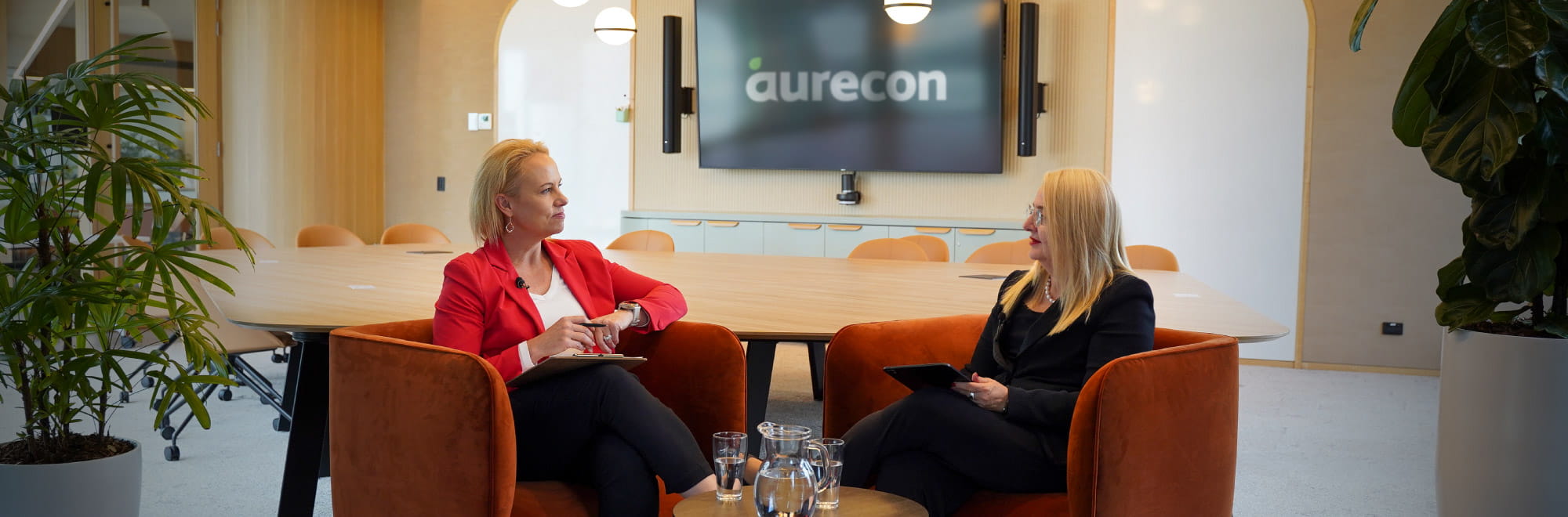
Louise Adams: Hi, I’m Louise Adams, and welcome to this episode of Aurecon's Engineering Reimagined podcast. And I'm delighted today to be joined by Vanessa Torres, who's the Chief Executive Officer at Perenti. We're going to be talking around leadership, partnership and impact, particularly across the mining and resources sector. So thanks, Vanessa for joining me. I'm looking forward to reflecting with you on broad leadership lessons that you've picked up through your career, how they continue to shape your approach to your role and also perhaps a little bit of reflecting on the GEMCO Milner Bay Wharf recovery from your time at South 32.
Vanessa Torres: Always a pleasure to be here.
Louise Adams: You've led through some really complex operational and recovery environments across the resources sector in your time. Looking back, what experiences most shaped how you think, particularly about partnerships and why has that lesson stayed with you as a leader?
Vanessa Torres: I think what comes to mind first was the experience of leading the overall recovery of the GEMCO Manganese mine in 2024 after the wharf and all the major infrastructure at the island was destroyed by Cyclone Megan. We had to rebuild in a year a wharf that would normally take three years to develop and as well as a major bridge and dewater the mine. So, we achieved that very successfully and in every dimension. And the lesson that stayed with me as a leader is the value of engagement and the value of trust.
Louise Adams: And when we first met, I had done a keynote and I was talking about Aurecon's choice of optimism as a strategic choice. And you came up to me, and you said it had really resonated and you talked about the GEMCO recovery project where we'd worked with you and supported that. You said you had a passion for optimism and the role it plays in both engineering and leadership. Do you want to talk a little bit about that and how that plays out in your life and in your career?
Vanessa Torres: I believe I was born as an optimist, but the first time that I really thought about optimism as a strategic choice was when I was introduced to the concept of Positive Psychology by Martin Seligman, and that was through my mother, who was a psychologist. So I was still in my early 30s, and I was starting my leadership career. And what I learned from the book and then conversations with her after, is the power of fostering that environment where leaders role model optimism and a growth mindset. It was very powerful to see that I could actually influence my whole team to be optimistic like I was.
Louise Adams: It’s not about having rose-coloured glasses and thinking everything's fine and everything's great. It's really, and this is why I think it resonates so well with engineering, about being realistic about the challenges that you're facing, but knowing that you can find a pathway forward. Is that what you've found?
Vanessa Torres: Yes, and it's like that belief in the capability to go through things and to solve problems. And if you think about what an engineer do, whether it's a chemical engineer or civil engineer, it's about solving problems. If you don't think you're going to get a solution, you have no chance. So that optimism, I think, is very important.
Louise Adams: We just touched on engineers as problem solvers. What's that role look like for you in a client consultant sort of partnership?
Vanessa Torres: I think it is very important to have that shared belief and the trust that you can actually achieve the vision. So I worked most of my career actually in the client side and the best partnerships was actually when we had a team that worked together. In the beginning, you really don't know exactly what the solution would look like, but you trust that you actually have the skills. And you go through that journey together.
Louise Adams: And in the world that you work in, you're often balancing safety, operability, needing to keep these assets, keeping on working and the continuity of supply, all of these things in tension and there's a lot at stake. How do you as a leader balance needing to work at pace and get things done alongside risk and then this idea of continuing to build long-term value? So how do you balance that in your decision-making in that environment?
Vanessa Torres: When it comes to making decisions I believe it’s important to balance the fast and slow thinking, like Daniel Kahneman, so I read all the psychologists, sorry, but it is that thing about, you need to make today better, and at the same time, you have to have an eye on how you're going to transform tomorrow, and whether that is leading the front line and making sure that the teams on the ground are actually you know or when you're actually making a big investment decision. It comes to the same thing, the short-term and a long-term at the same time. You cannot choose. You actually have to go and work in that spectrum if you want to be successful.
Louise Adams: I'm quite fascinated at how you bake in innovation and new ways of doing things and moving away from perhaps traditional, deeply understood and often repeated approaches to things. So what does that look like in that highly complex, high-risk environment where you've got lots of stakeholders, a real clear idea of the successful outcome you want? How do you create an environment where people can move away from the traditional approach?
Vanessa Torres: At the end of the day, for me, it boils on culture, so it is important that you actually have the culture where people feel included and also they feel they can share their ideas very openly. And culture always have to come first in operating environments because the first thing is that it's essential to guarantee everyone goes home safe and well. Operations are risky by nature, so you actually have to have the right controls, but also that mindset of what I call the safety guarantee. Once you get that, I think you also need to foster that positive culture and thinking culture as strategic, because it can become the superpower of an organisation if you get it right. No matter if you're doing mining resources or delivering projects or providing services. All organisations are about people. Building that kind of culture, I consider my number one job now that I'm leading Perenti.
Louise Adams: And so if you think you put safety as the foundation and you put that up as the pinnacle, as you say, the safety guarantee, I really like that language, and then you can ebb and flow your culture around that. So everybody knows where the line is, but they're not stuck to conformance, they're not stuck to doing things the same way, but that's the guarantee that they have to be able to do that.
Vanessa Torres: And it's balancing understanding where we cannot take risks in safety. So that's why we get the safety guarantee. But once you actually have that, you know, that guarantee about safety, you know, work in their environment, then you actually need to be creative. And sometimes take risks, do things a little bit different or invest in things that perhaps you haven't thought you should invest in the past. So it's that balancing again about what's the immediate outcome, but also the vision, what we can create.
Louise Adams: Thinking about your time when you were the Chief Operating Officer at South 32 and you talked a little bit about the GEMCO Milner Wharf Recovery Project, which was quite outside the box really and something certainly for our Aurecon team we reflect really positively on what we all collectively managed to achieve. So can you talk us through that project and the challenges the organisation was navigating at the time to get that done?
Vanessa Torres: 16 March 2024, I'll never forget that date, Cyclone Megan came and destroyed the wharf, the major bridge that connected the mine to the plant, and it flooded all the mine pits. It was an unprecedented event. So within 24 hours, it rained 700 millimetres. That's equivalent to the annual precipitation of Perth in Western Australia where I live, just in terms of a comparison. I went to the island as soon as it was accessible, quickly engaged with the team. The first was to really help them with the sense of loss, some of them have lived and worked for more than two decades. So hearing them, making sure that we actually took the time to take it in, but then how we could focus the organisation into response, recovery and rebuild. And we needed to get the operation back and running in 12 to 18 months maximum. The key challenge was really to rebuild the wharf. As you know, Aurecon have built many wharfs. Usually, from concept to delivery, it takes two, three years. We needed to do that in less than 12 months. That was the target. So we assembled a team with some of our key people at the organisation there, Aurecon as our engineering partner, and the construction contractor. And it was that team that turned that vision into a plan. And with a solution inside, then I needed to demonstrate the business case. Engage with our CEO and our board, build confidence in them, get consent from our JV partners. And so it was a lot of stakeholder engagement, but within the month from the disaster, a mandate was approved. We also engaged with government, with the community to make sure we could proceed to do the work. And while the operations were interrupted and we have a thousand people working there, we took the opportunity to retrain people in safety fundamentals.
Louise Adams: Yeah.
Vanessa Torres: So we could actually keep them engaged and motivated. In the end of the day, we have achieved that, and we kept the workforce engaged, we delivered the wharf on time, and we even got the insurance reimbursement, which meant no material loss to our shareholders.
Louise Adams: And what fascinates me, almost everything you've talked about there is the people or human element of it, not necessarily the technical solutions of how we might design or the processes. In the context of that challenge, what was it when that challenge was in front of you and you had to find an engineering partner, what was it that stood out for you?
Vanessa Torres: A number of things. First, I knew well one of your employees, Annette Woods. We worked together at BHP when we were both working on projects. As soon as the disaster happened, Annette reached out and said she heard about the cyclone and offered her support. My VP Projects at the time, Marco Pires also have worked with Aurecon in previous projects. I just connected with Annette and say, Annette, I need your team flying to the Groote Eylandt next week. Can you do it? That week, then we had your team on the island. There was no contract, nothing. And we actually took it through the issues. We also, at the same time, took another engineering company there. And when we look at the concept, but in particular the partnership and the way the process, working together, Aurecon was the clear choice because it has both the human element, that partnership, that thing about, yeah, we're going to work together, there was a commitment to work seven days a week if possible, because it's going to be a very, very unconventional project. The design solution was also very, very clever. Your team basically were able to find a solution where they replaced 200 piles by 28. The way the wharf components were assembled in different parts of Australia. It was like putting together a Lego or Playmobil piece. So it had that human partnership, trust element, but also was actually very, very clever design. And at the end of the day, that saved us a lot of time.
Louise Adams: And so you get the wharf back and running, you've achieved the recovery that you're after. What impact did that have?
Vanessa Torres: We restarted the mine three months after the cyclone, the concentrator within six months, and the wharf restarted operations exactly 12 months from the start of the demolition activities. What that enabled is, one, to keep a thousand people in the workforce engaged, and also to keep supporting that community. The operation today, because it took the time to train people on safety, has half of the total injury rate than it had before. So when you actually go and visit Groote Eylandt, the only economic activity that we have is actually the manganese mine there. And without that, a community of 2,000 people wouldn't have the royalties, wouldn't have all the community programmes that we provide and support people there. And when we opened the wharf, we actually had the traditional owners opening the wharf together with me because that was important for them as much as it was for us.
Louise Adams: Well, and I love that reflection, though, in and amongst all of that about how, whilst you had the time, you've made that focus on safety and, therefore, you were able to get a little bit of a consequential uplift in that performance, which is not directly associated with the recovery of the wharf, but just the very smart use of the time that you had available.
Vanessa Torres: What we are able to do is to actually train a thousand people workforce within two months because then what we set as a target was that we're not going to even start operating the mine until we actually have that workforce all trained. So that actually gave a lot of sense of purpose, not only for the workforce, but for the people who are conducting the training and everyone else.
Louise Adams: And a very optimistic way to approach something.
Vanessa Torres: Yeah, because also that gave the workforce the confidence that we would be restarting.
Louise Adams: Yeah. So if we look at the broader resources sector as it continues to navigate complexity and change, what do you think strong partnerships need to do differently to deliver outcomes that truly matter in this sector moving forward?
Vanessa Torres: I think when we look at the scale and complexity of the resource industry today and the challenge to deliver critical minerals and accelerate production, no one organisation have all the answers. So the only way is to actually work together. And I just made the move from a resources company to a mining services company, Perenti, and at Perenti we talk about smarter together. That means none of us are as smart as all of us. And I think that's really, really powerful. So, to deliver those outcomes that matter, it is about choosing the right partners, developing that trust, and being very, very open about the outcomes. The more you align the outcomes and the vision and the drivers of success for the teams, the better it is for both. The mining industry today as compared to 20-30 years ago, we have a much more resilient system of work because it's about an ecosystem where everyone has a different skill and bring those skills to actually deliver those outcomes.
Louise Adams: And I think also in my experience, that sort of mindset better positions you to deal with the unforeseen challenges that might get in the way of those outcomes. When they hit, you're more likely to come around together with your partners to resolve them fast rather than perhaps a more traditional mindset which would see you revert to your corners and sort of put up the hands and say, not my problem.
Vanessa Torres: And even like is that, I think it's a lot to do with technology and AI as well, because what we have today is an access to innovation that is actually at a much faster pace as well. So I think that connection, you know, you don't need to actually have systems that are designed to work together because, you know, AI now connects those systems. So that complements also the people connection of people working together.
Louise Adams: It certainly makes that human connection and that human judgement a lot more valuable. You are passionate about positively contributing to the communities in which you operate and this shows up specifically through your work as a co-founder and financial supporter of the Beehive Project, which is a not-for-profit organisation in Brazil, which is your home country, that has provided free personal and professional development activities to an average of 100 students per year over 20 years. I mean, it really is an amazing story.
Vanessa Torres: It completely shaped my leadership style, because for me, leadership is building a vision, connecting people, and giving back. And I learned that working with my family in the development of that community centre. So my mother imagined a place near our farm there where kids could develop to their full potential instead of being dragged into drugs and crime. My sister, she was just finishing her architecture course. So she designed that place. My father, he tapped into his retirement savings and he was an engineer as well, so he built it. And I project-managed that project that we call the Beehive Project. And I supported that and we all started supporting with part of my salary. So my parents, they were not rich, but they were able to leave a real legacy because of all the impact the centre has and continue to have in terms of developing children. Some of the children, they are today engineers and they are lawyers and they are psychologists and they're teachers that 20-25 years ago were kids looking for a place to spend time after school. And that experience working with the kids taught me the power of connection. The importance of generosity and also taking people through the journey, because you might get to the top of Everest only by yourself, but if you don't take people with you, there'll be no meaning at the top. You'll be very lonely.
Louise Adams: That story is particularly about, you've built something and you've created over a period of time a more resilient community because it's built capability and skills and given those young children a future that they might not have necessarily had. So if we think about it in the context of the mining and resources sector, where these big organisations have these critical assets in communities, what's your view about the relationship between that asset and creating a resilient asset that is sustainable and long lasting and the ultimate link to the community resilience?
Vanessa Torres: I think in Australia, we probably don't see that very clearly sometimes because we have a mining industry here for the last 50 years. But when you actually go to the developing world, that's actually where we see that playing out much deeply. And when you're actually there, your role is not only to run a mining business, but also to develop the community. You end up training a lot of people. Some people, they'll have the first job of working in the mine. That first job will enable them to provide an education to their children, will enable their children to have healthcare.
Louise Adams: And Perenti's obviously got a large footprint, but you're from Western Australia. You know that area really well. So what do you see as opportunities and the overall outlook that's evolving in Western Australia and the market in general over there, particularly across the mining and resources, infrastructure and energy markets?
Vanessa Torres: So I think that what we have today globally, which is the need of critical minerals for decarbonisation, is a trend that probably started a decade ago and is going to play out for the next few decades. What that can bring to Western Australia is the diversification of the mining sector itself. In previous decades and the previous mining boom in the early 2000s was a lot about iron ore for China. And now it's about lithium, almost half of the periodic table that exists in Western Australia. And I think that's what makes quite exciting. We have a lot of deposits and a lot of opportunities that won't be mega operations, but collectively, I think they can generate a lot of development and a lot of development on the technical space as well, because you need different solutions.
Louise Adams: Well, thanks so much for joining us today and I think it's been really powerful to hear about how you have navigated your leadership journey and the impact that you've had and no doubt you're going to have a great impact at Perenti moving forward. And so really appreciate your views on clients and how the Aurecon Way has in your experience delivered great outcomes for you and your team in your previous job and we look forward to continuing working with you in the future.
Vanessa Torres: Thank you.
Courtney Lock: Vanessa’s personal experience is a powerful reminder of what's possible when partnership, trust and an optimistic mindset come together under pressure.
If you enjoyed this episode, please subscribe to us on Apple or Spotify and share it with a colleague or a friend on LinkedIn.
Until next time on Engineering Reimagined, I'm Courtney Lock and thanks for listening.
Rebuilding critical infrastructure with trust, collaboration and optimism
In March 2024, the Groote Eylandt Mining Company (GEMCO) Milner Bay Wharf was severely damaged, halting global exports of manganese ore, used in steelmaking and rechargeable batteries. As the world’s largest exporter of manganese ore, responsible for 10-15% of global supply, expediting the recovery of the wharf was an urgent priority.
The wharf is also critical for its fuel import to Groote Eylandt that is home to more than 2000 people. Fuel that is used for all vehicles, plant, and electricity generation – adding to the imperative to return it to operation as rapidly as possible.
Today, Aurecon CEO Louise Adams and Perenti CEO and Managing Director Vanessa Torres speak about how they connected over their shared passion for the role of optimism and the role it specifically played in transforming the GEMCO wharf from catastrophe to rebuilt and operational in 14 months – a process that could have taken three to five years.
Together, they discuss how optimism inspired a completely different approach to delivering a critical infrastructure project, one that the essence of time was at the absolute forefront of.
Aurecon collaborated to develop cost-effective design solutions aligned with the client’s brief to minimise schedule and ensure efficient, rapid delivery within site constraints.
A technically complex project, the team’s initial priority was making the site safe: stabilising what could be saved, planning how to safely demolish what couldn’t and determining the fastest path to restore operability. Smart build strategies reduced labour hours and allowed work to continue flexibly and responsively – even as designs evolved daily – to rebuild the global supply chain link in record time.
Additional resources
Disclaimer
The views and opinions expressed in this podcast are those of the individual speakers and do not necessarily reflect the views of the host, the organisation, or any affiliated entities.