Brisbane 2032: Creating lasting impact through transformative infrastructure
Aurecon shares insights on how the 2032 Brisbane Games can deliver legacy infrastructure and lasting economic, environmental and community value.


Change your location to view content tailored for you.
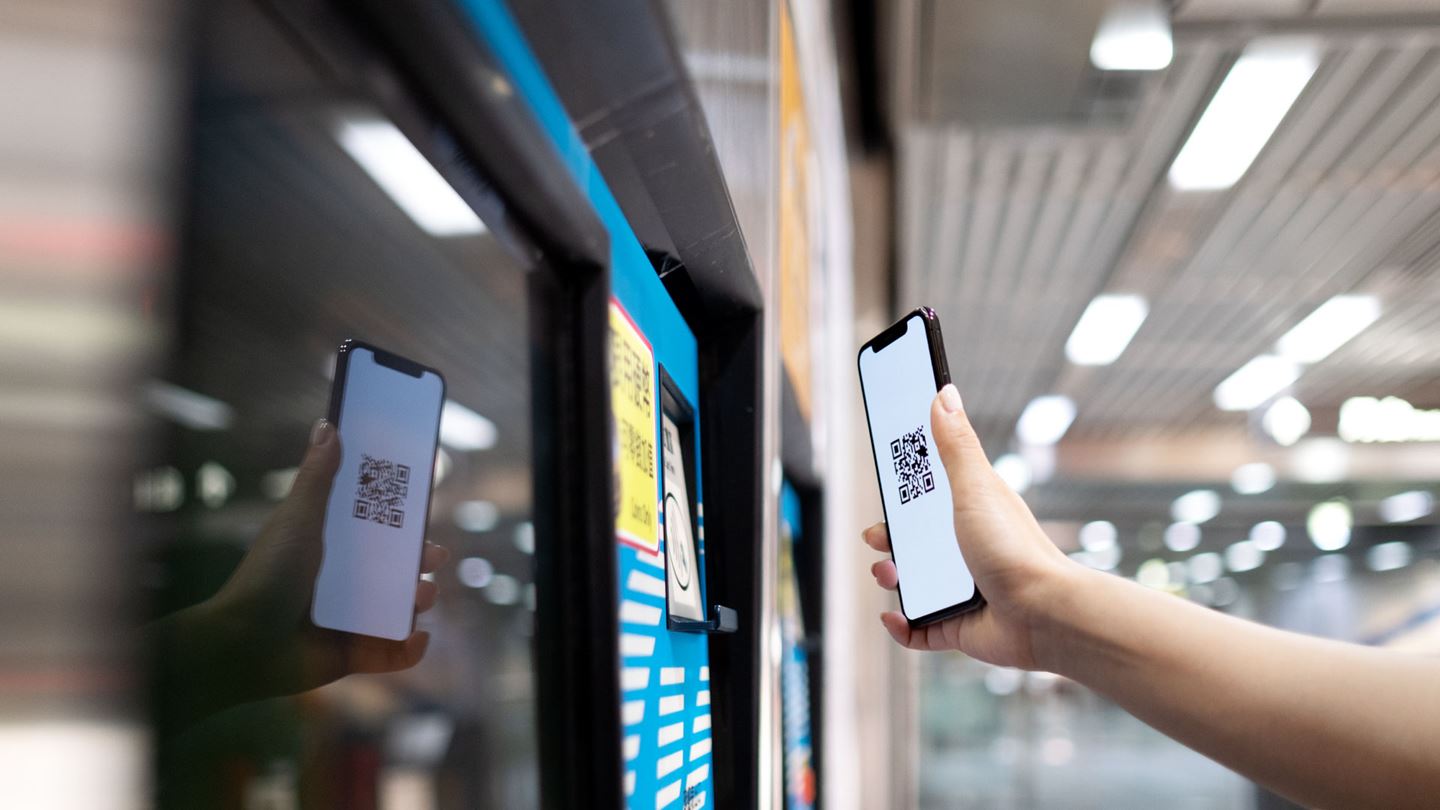
For rail customers, digitisation of ticketing with contactless payments enables self-service fare choices to meet individual needs, the safe storage of tickets digitally, skipping queues to save time, and receiving personalised journey notifications.
For network operators, new systems to manage passenger flow, improve wayfinding, ensure revenue and improve security can enhance the experience of rail travel, helping to attract customers.
As with most markets, there is an ongoing push for greater efficiencies and the rail and mass transit sector is no stranger to the quest for streamlining operations. Digital technologies are being used increasingly for rail network information displays and ticketing – the latter being important when it comes to attracting customers and enabling them to personalise their journeys.
"Rail station design needs to be designed to meet the requirements of a changing society…. and the next generation"
Yet, while the technology is available, the redesign of the physical to complement the digital is currently underway. The design, construction or redevelopment of physical architecture takes time to pivot and adapt when key changes include structural layouts that have been in place for a long time, sometimes decades.
In this paper, Aurecon explores the future of rail station design and layouts to this new avenue for contactless transport payments.
Much attention has been paid to the rapid advancements in smart device technology as contactless payments have become a popular transaction method. It is convenient and secure.
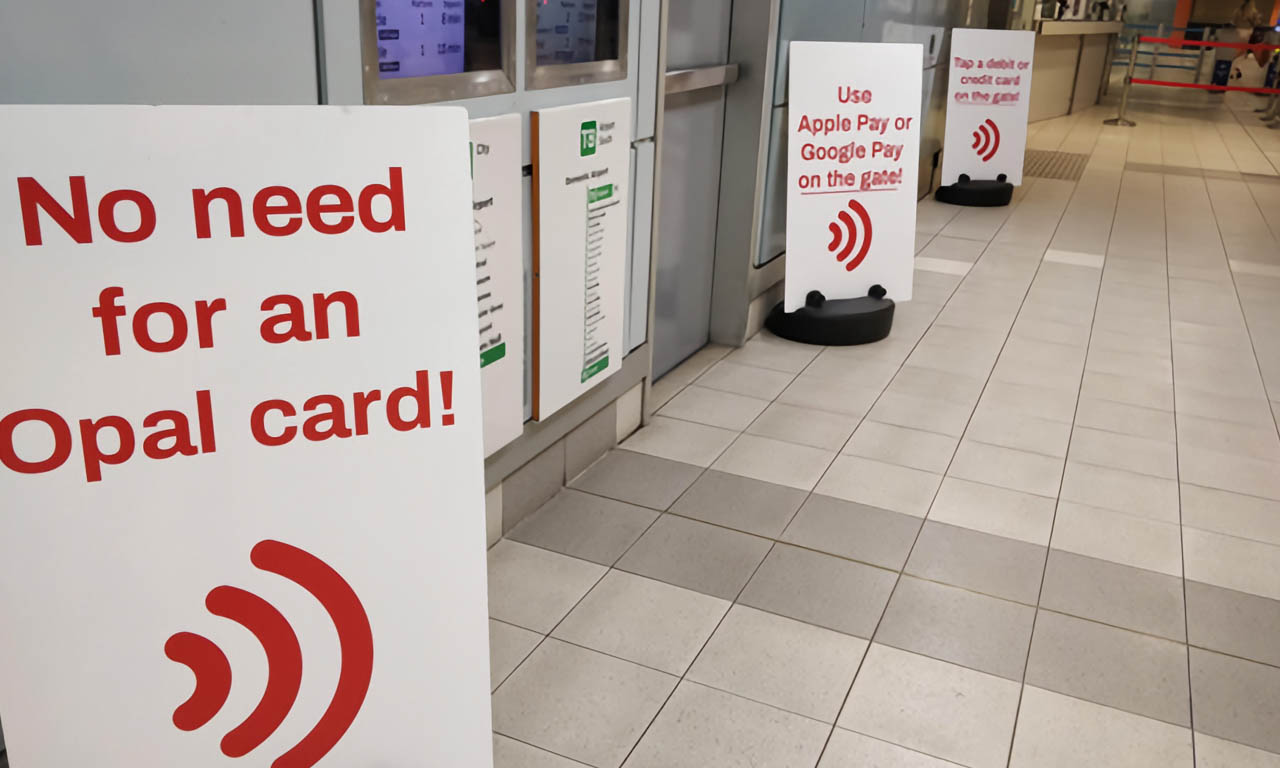
An example of how far contactless payments have progressed for public transport can be seen around the world. Transport for London has calculated that in 2021, approximately 75 per cent of public transport customers in London used contactless payments. In the same year in Singapore, 22 per cent of monthly adult trips made on public transport were contributed by SimplyGo (the contactless payment platform), and in Sydney, that figure was 30 per cent (Figure 1).
It’s important to note that this high uptake of contactless payments by rail passengers indicates their preference for how they want to travel – with interconnectivity, speed, convenience and ease. The challenge of many rail stations today is that they were designed a long time ago, sometimes more than 100 years, long before digital enablement was a consideration.


Rail operators and asset developers will need to go with the flow in the future as different customer needs and digital technologies continue to disrupt traditional operational processes.
To capitalise on these changes, rail station designs and layouts should also evolve in keeping with the growing purchase and display of tickets via a smart device. For instance, ticketing, information and platform entry points could be more condensed in its space requirement, freeing up pedestrian circulation networks inside the station building.
Other examples of how rail station design and layouts may change to integrate new forms of contactless ticketing payments are described in Figure 2. These elements consider how digital technology and architecture can integrate to create a completely informational environment within a rail station.
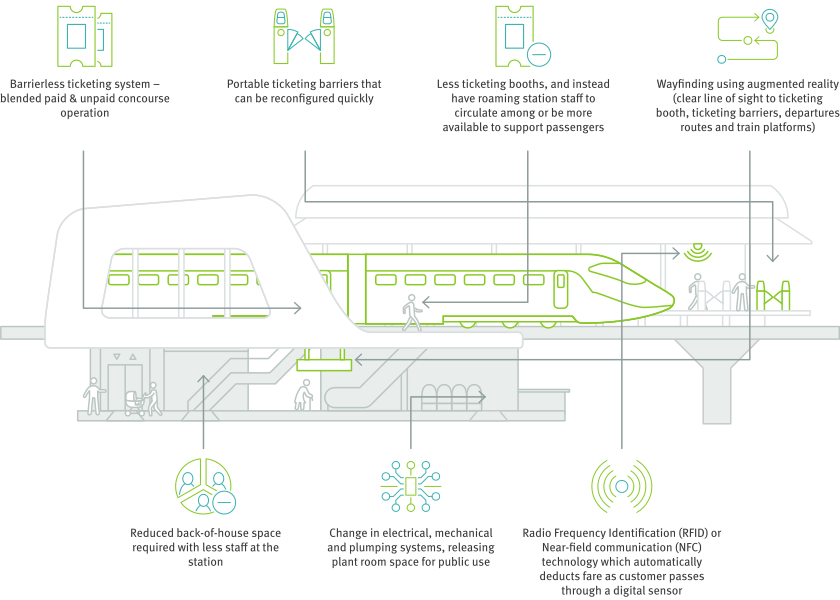
Figure 2: Some of the many ways that contactless ticketing may change physical rail station architecture in the future.
The challenge for designers is to anticipate and align to the direction of change to accommodate the future of digitisation, while still retaining the civic quality and character of stations. Another challenge is the important metering function that gatelines currently serve. Without them, station operators need to think about how to slow down and regulate flow rates and directions so that increasing queuing or congestion doesn’t occur.
The benefit of digital engineering techniques is that they can model bespoke station architecture scenarios to guide decisions on the best layout that accommodates not only contactless ticketing, but future movements of customers. In addition, the modelling of assumed operating – or ticketing – can be undertaken to determine how the station layout could adapt to change.
The introduction of a digital twin may bring to life longer-term efficiencies and assets which are fit for purpose, safe and durable – or maintainable – to operate. The digital twin combines data on different assets in one place. Centralised and visual asset data allows easy utilisation and helps ensure the data is always available to all relevant stakeholders of the asset.
A digital twin can potentially unlock real-time passenger movement analysis, provide a more accurate crowd performance information under the exiting condition, and highlight the real bottleneck for future design improvement.
Technological change will influence the way customers move through station spaces to turn them into interactive spaces that become responsive to user moods and requirements via smart device applications.
There are a number of trials underway globally that mean customers accessing stations have no, or minimal, contact with control gates.
For example in England, customers travelling on train services can make contactless fare payments with their debit or credit card at more than 700 railway stations across the North and Midlands. This operates similar to New South Wales’ Opal card system where ticket gates all remain in the station. The benefit is to reduce the needs of the ticket vending machines and ticket offices, not the ticket gates (in this case). The UK government has plans to extend this system to buses and trams.
A global rail tech firm successfully trialled sensor ticketing in Italy in 2021 to replace ticketing barriers with sensors installed on train carriages, capable of detecting an app on a customer’s phone. Via the app, the customer is automatically charged the correct fare dependent on their journey.
Using these technologies provides a good argument for the removal of some ticket gates and ticket booths to provide additional capacity in the station to improve the customer experience, as well as reducing operating costs in the station.
One limitation to these changes is that ticket barriers are used by rail network operators for more than solely ticketing, they also act as security and safety barriers. Therefore, in the future, operators may consider retaining some form of physical barrier for safety and security purposes.
All the current hands-free ticket gate trials (in Singapore and Korea) keep the physical ticket gates in the station, with additional equipment to achieve Bluetooth access or facial recognition access. It’s worth noting that it seems that operators are still wanting to have ways (in some form of physical barrier) to stop people accessing the station where required.
Effective wayfinding will remain critical both inside and outside the station, particularly considering the future where station layouts may look very different to the past. The most challenging aspects of this are ensuring that signage is highly visible, and not obscured, as wall and floor surfaces are often concealed by passenger traffic, especially in peak periods.
The reality of seamless integration of digital technologies into rail station design is here and now. Looking forward, passengers can access the station with or even without a smart device in their hands. People may no longer need to worry about ‘the balance in my tickets’ when catching the train service, or have to join a long ticket purchasing queue when visiting a different city.
Dynamic pedestrian modelling can be used to test future station layouts and multiple scenarios for rail station development, or reconfiguration in existing stations, to accommodate changes in ticket issuing and checking facilities. It can also optimise both infrastructure and operations, providing more visual and relatable information to enhance customer experiences and show interfaces with the systems of other stakeholders.
Its benefits are highlighted as:
To develop the assumptions behind ticket issuing facilities, a chart is used to identify passengers in local or non-local categories, followed by choice in ticketing systems, then by the different percentages across ticketing activities such as top-up and purchasing a travel pass (Figure 3).
For customers choosing to pay with a contactless bank card or smart device, they can directly access the station without holding a physical travel pass, therefore skipping the ticketing issuing facilities. The remainder of customers, using the media-based ticketing system, still go through the same ticketing activities, however, their total is less which doesn’t require as many ticket issuing facilities.
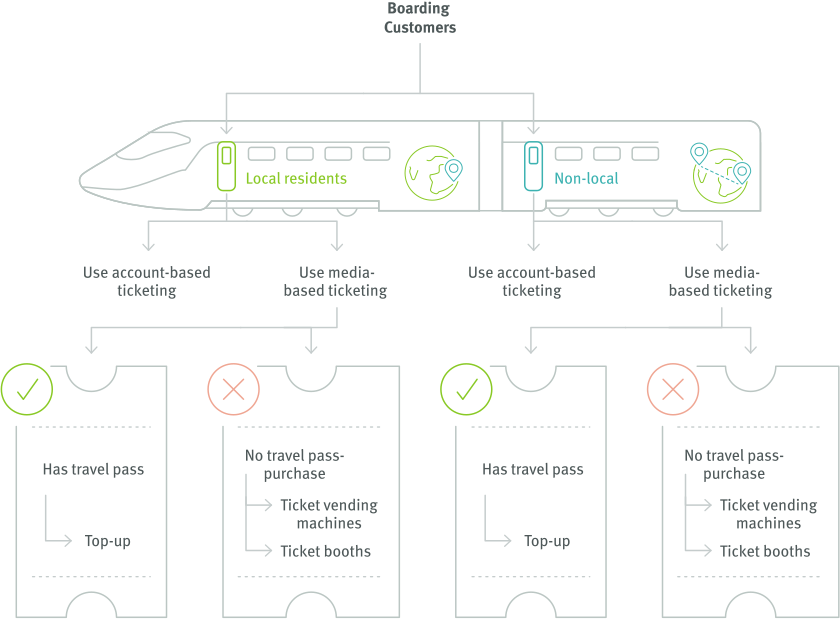
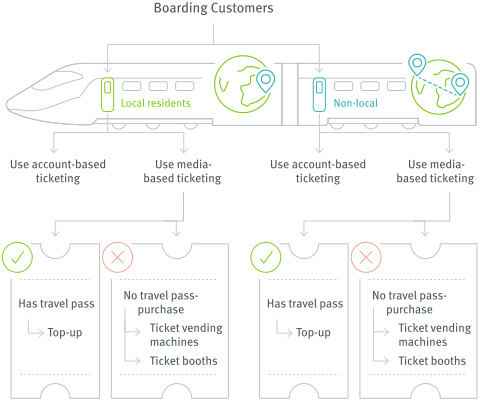
Figure 3: Ticket issuing facilities usage – introducing smart ticketing.
Of course, what must be realised is that some customers don’t have this type of smart device technology. More conventional systems can’t be excluded as some user groups don’t have access to smart device technology. Some others may be averse to using digital ticketing technology, or have accessibility or inclusivity needs that require face-to-face connection. A customer should be able to use the payment system that suits them.
The reality is that customer behaviour and needs at rail stations are changing towards preferences for more contactless payments as it provides perceived security, safety and convenience. In the future, the hard demarcation between the paid and unpaid concourse might be heavily reduced if sensors and account-based systems are introduced, while asset developers or network operators might still choose to retain some form of physical barriers for safety and security purposes.
Due to these behavioural changes, the time spent in the station per customer on average in the future is likely to be lower than the past. This will make it possible for the number of ticket facilities at the station concourse to be reduced, and the way station entrances are configured and utilised is likely to change.

Lead Engineer, Integrated Transport & Mobility – Australia
Aurecon shares insights on how the 2032 Brisbane Games can deliver legacy infrastructure and lasting economic, environmental and community value.
How engineering and construction projects are evolving to champion biodiversity, through early planning, advanced technologies, and ecosystem stewardship.
AI solutions offer huge benefits for businesses, but knowing where to invest in AI matters. Aurecon's digital experts discuss where AI can make the most impact.