Delivering energy infrastructure needs people, capability, and cohesion
Australia's energy transition requires more than technical plans. Discover four ways to build the people, culture and capability to deliver infrastructure at scale.


Change your location to view content tailored for you.
Australia’s policy environment has shifted, with the Federal Government in 2022 releasing a national framework for licensing offshore wind projects in Australia.
It’s no surprise that asset developers are keen and willing to progress offshore wind projects in Australia given the country’s abundant and high-quality offshore wind resources, and its need to rapidly decarbonise.
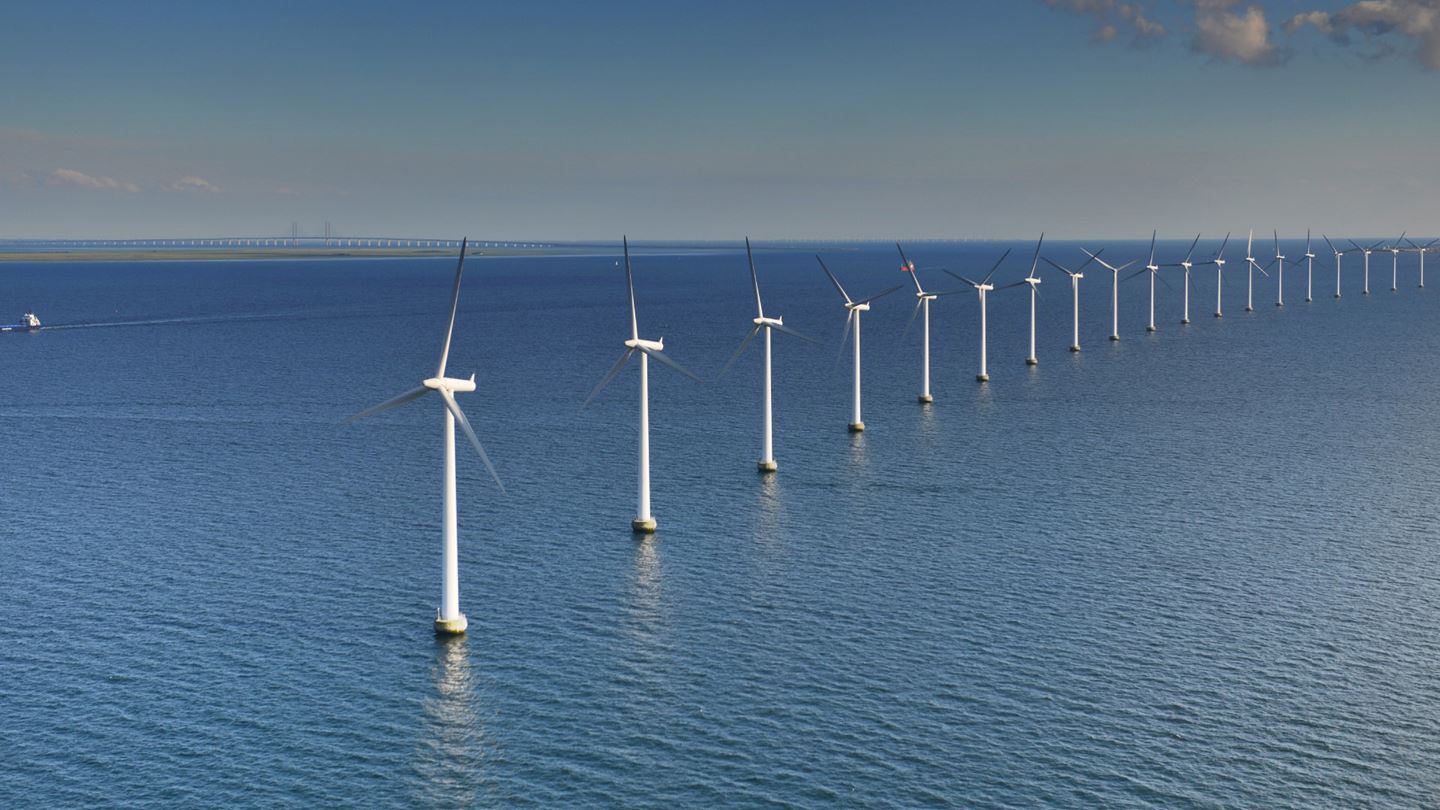
Development of an offshore wind industry will, in part, be dependent upon a centralised planning framework to bring projects online, and shared infrastructure to optimise the cost and efficiency of connecting into the grid. In this insights paper, we explore the ocean of opportunity for offshore wind around Australia.
Committed to reducing emissions by 43 per cent below 2005 levels by 2030, and fossil fueled power generators facing decommissioning, Australia is poised to transition to a greater mix of renewable energy. On 23 November 2023, the government announced an expansion of the Capacity Investment Scheme (CIS) to target 9 GW of clean dispatchable capacity and 23 GW of variable capacity nationally – for a total of 32 GW nationally[1].
The country’s vast offshore wind potential presents an ocean of opportunity both for diversified energy generation and economic advantage.
Offshore wind projects are being considered across the United States, Europe and Asia to provide utility-scale generation for major populations. For Australia, offshore wind could be the next era of wind energy supporting our energy transition, if the right regulatory and investment conditions are provided.
More than 30 individual offshore wind projects, most with around 1-2 GW of power generation capacity, have been publicly announced in Australia. Decarbonisation of the energy sector and the reduction of carbon emissions to limit climate change is at the heart of the energy transition landscape.
It was recently reported by the International Renewable Energy Agency (IRENA) that among all low-carbon technology options, accelerated deployment of wind power when coupled with deep electrification would help to reduce total global emissions by more than 25 per cent (nearly 6.3 gigatonnes of carbon dioxide (Gt CO₂) annually) by 2050[2]. This is a big role that wind energy will have in the transformation of the global energy system.
With approximately 37,000 kms of coastline and some of the world’s strongest and most consistent wind resources, at face value, offshore wind projects are a natural fit for Australia. However, connecting even a fraction of the publicly announced projects to Australia’s existing onshore transmission network presents a substantial delivery challenge in the short timeframe leading to 2050. It is a complex and sensitive issue as we work towards net zero targets at the same time as minimising the community and environmental impacts of new infrastructure.
States across Australia are seeing the benefits of REZs because the shared network investment reduces existing constraints and supports connection of new renewable energy projects. Just as REZs are supercharging transmission and grid upgrades, offshore wind farm developments may do the same.
REZs are enabling the central deployment of synchronous condensers and reactive power compensation for system support. In this same way, if there are declared zones for offshore wind projects, associated onshore and offshore transmission may be implemented at a state level to minimise environmental, social, and economic impacts.
A centralised planning and development body will help to provide assurance for investors and customers. For example, in Victoria, stewardship is being provided by VicGrid, a newly formed body within the state’s Department of Energy, Environment and Climate Action.
The concept of shared offshore assets has been employed in Europe for several years, with transmission owners installing offshore platforms for point-to-point connection of clusters of projects. The geographical spread of offshore generation zones in Australia provides both challenges and opportunities regarding offshore assets.
The better alternative would most likely be shared onshore infrastructure that distributes the energy generated from turbines to the grid. It would include interconnectors, substations, high-voltage direct current (HVDC) systems and transmission lines. When this scenario is applied – including installation and operation by regional transmission system operators – clusters of offshore wind projects have the potential to develop at-scale.
Shared onshore transmission network capacity must be considered in the early stages of planning, and a lot can be learned from markets such as Germany and our experience with onshore REZs in Australia.
How system operators and wind farm developers design and operate their infrastructure for offshore wind power installations is different around the world.
This is Aurecon’s comparison of Australia with European and Asian markets, focused on key transmission asset ownership with inferred structure in Australia. It highlights distinct differences in transmission asset ownership between different regions around the world, particularly from the associated onshore and offshore infrastructure required to connect to the national transmission network.


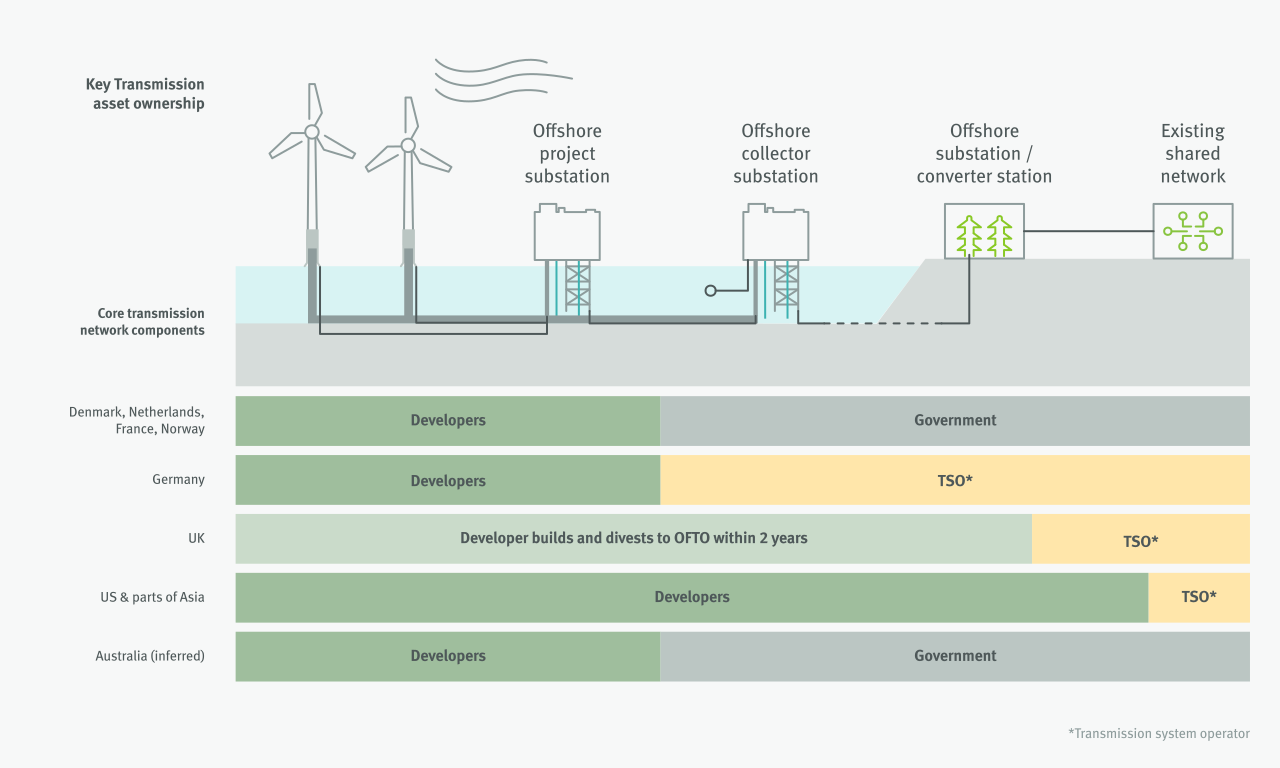
Although there will be challenges to overcome on these bold projects, investment is still very important as offshore wind brings in a new era of energy transition. It’s no surprise that asset developers are keen and willing to progress opportunities given Australia’s abundant and high-quality offshore wind resources, and the need to rapidly decarbonise. To increase the likelihood of successful delivery in each jurisdiction, an effective project planning and grid connect model should be determined, and government will need to assume stewardship.
We have the advantage of a clean slate – able to learn from other countries and optimise the planning and delivering of offshore wind farms without making the same mistakes.
As with any new (and exciting) project, Australia must also be mindful to minimise social and environmental impacts. Done effectively through cohesion and support, offshore wind could change Australia’s renewable energy landscape for the better.
Australia’s policy environment has shifted, with the Federal Government in 2022 releasing a national framework for licensing offshore wind projects in Australia. Developers and investors now have regulatory guidance to be able to progress a number of projects.
European countries have paved the way for Australia with their offshore wind capacity reaching close to 30 gigawatts from more than 5,400 grid-connected wind turbines across 12 countries3.
Lessons that these countries have learnt which can be applied in Australia:
Just as others have learnt, participation in the wind energy market is central to a country decarbonising and meeting its renewable energy targets. The contribution of wind to the task of solving the climate crisis, while simultaneously ensuring longevity and success of assets, is a crucial adjunct to the net zero pathway.
[1] Department of Climate Change, Energy, the Environment and Water, Capacity Investment Scheme, Australia, accessed 29 November 2023.
[2] IRENA (2019), Future of wind: Deployment, investment, technology, grid integration and socio-economic aspects (A Global Energy Transformation paper), International Renewable Energy Agency, Abu Dhabi, accessed 21 November 2023.
[3] Wind Europe, February 2021, ‘Offshore Wind in Europe’, accessed 6th November 2023, windeurope.org.
Contributing authors & reviewers: Chris Amos, Charlotte Guthleben and Paul Cann.

Technical Director, Energy – NSW & ACT, Australia

Principal, Power Generation
Australia's energy transition requires more than technical plans. Discover four ways to build the people, culture and capability to deliver infrastructure at scale.
Aurecon’s ecology and biodiversity expert shares how to achieve timely project approvals, what regulators want, and how to navigate regulatory changes.
Aurecon shares insights on how renewable project delivery models are evolving to better manage risk and deliver long-term value through project partnerships.