

Stormwater can drive Aotearoa's water reform
Stormwater management reflects the full complexity of water reform. From the UK's experience, five lessons Aotearoa's water sector cannot afford to overlook.


Change your location to view content tailored for you.
Time and time again our infrastructure projects are cancelled, deferred, or rescoped to fit within constrained capital allowances, which not only adds cost, but means New Zealanders are not getting what is needed out of the infrastructure system.
Asset recycling – partnering with the private sector on our existing public assets and 'recycling' capital back into the system to deliver more infrastructure New Zealand needs – presents an opportunity to add to our funding and financing toolkit to deliver more infrastructure without increasing debt.
Asset recycling allows us to deliver more infrastructure by leveraging the economic value of our existing assets, as an alternative to issuing debt.
New Zealand’s persistent underinvestment in maintaining and renewing our infrastructure has become a major long-term challenge for our economy and productivity. Our existing infrastructure assets, excluding land, were valued at $287 billion in 2022, but over the last 30 years renewal investment has not kept pace with depreciation. This means we now face a bow wave of asset renewal for existing assets that are increasingly expensive to maintain and delivering less-effective outcomes for the communities they serve.
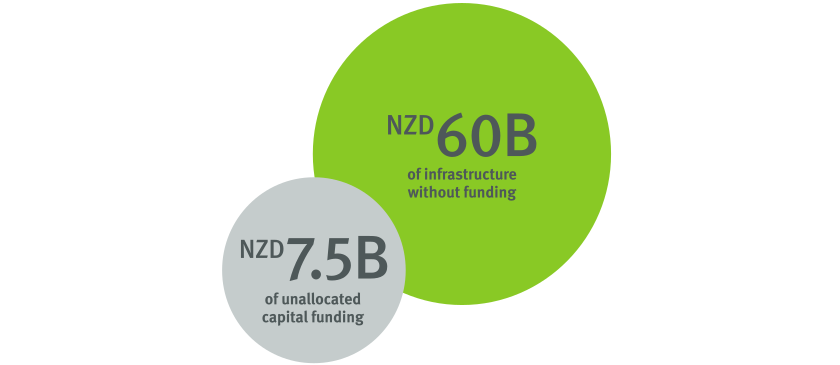
Figure 1. A yawning funding gap.
The combination of historic underinvestment, the need for new infrastructure, and the rising costs of maintaining and renewing existing assets has resulted in an infrastructure gap estimated to exceed $200 billion. Financing this infrastructure demand through government debt alone could double our Crown borrowings which is an unrealistic option given Crown debt intentions and our appetite for public debt.
Although net core crown debt is forecast to increase by $55 billion by 2028, most of this debt is already allocated to projects. With $60 billion of our $150 billion infrastructure pipeline yet to have been allocated an approved funding source, it is unlikely that public debt will be the answer for all our infrastructure needs. This demonstrates the need to consider options such as asset recycling to supplement our traditional capital financing tools.
Asset recycling provokes the public sector to question its current and future infrastructure needs. This includes examining whether such infrastructure needs are fulfilled by the existing assets they own or if something more is required to achieve desired levels of service. We should continue to question if we are still getting the best value for money from an original investment in our existing assets, and if not, could this money be used to build something more fit for purpose.
The public sector owns many valuable assets that are either underutilised, or not generating optimal returns and benefits. These include large, underutilised land holdings and roading assets failing to generate economic returns, and whole systems of poorly maintained water assets that cost more to maintain than they should for the services they deliver.
Asset recycling differs from privatisation alone as it 'recycles' capital back into higher performing infrastructure.
If an asset has a strong revenue stream attached to it, there could be private sector investment interest even if the asset itself is not achieving everything it needs to for its communities. This means rather than needing to take on more debt to upgrade or build new infrastructure, innovative commercial arrangements could be explored to access private sector investment through leveraging an existing asset, and using this influx of capital to re-invest in higher performing infrastructure. This allows for our infrastructure to meet desired outcomes for the public without the burden of additional debt.

Capital is locked in existing assets that are not delivering the best value for money.

Existing assets are monetised to release capital and recycled to better use infrastructure.

New or upgraded infrastructure delivers on public outcomes needed without raising debt.
Asset recycling differs from privatisation alone as it 'recycles' capital back into higher performing infrastructure. Reinvestment of funds into higher performing infrastructure is a critical component of asset recycling and without this reinvestment, transactions would not be included in an asset recycling definition.
Asset recycling arrangements can involve partnering with private sector companies to deliver public services. This could include direct operation of infrastructure, or commercial management of service delivery. Private sector involvement brings in profit motives and complementary capabilities that may not sit directly within public sector departments. This can drive greater efficiencies and support greater innovation.
Private sector motives also encourage accurate pricing to ensure operating costs can be more accurately recouped from users. Public services often cross subsidise costs between users and non-users, and the real cost to deliver can be obscured. Accurate pricing enables better infrastructure planning, as we work out what assets are actually worth paying for and which aren’t. It also drives open discussions and transparency around how much is being subsidised and by whom.
Asset recycling can take different forms. Some of the models for an asset recycling transaction can include:

Partial ownership – divesting a portion of an asset or public entity to the private sector, also known as the mixed-ownership model.

Temporary ownership (lease or concession) – transferring control of the asset or public entity to the private sector for a limited period.

Temporary-partial ownership – a hybrid model involving a temporary transfer of control of a partial stake in an asset or public entity to the private sector.

Full ownership (permanent monetisation) – a full sale of an asset or public entity to the private sector.
For asset recycling to be part of an effective long term infrastructure funding and financing strategy, it needs public support that transcends political cycles. A national asset recycling policy from the Government is critical to increase the uptake of asset recycling as a funding tool, and to align system settings and controls in place for those entities engaging in asset recycling across the public sector.
As well as a national policy, the following components are needed to secure the best outcomes in asset recycling transactions:
Asset recycling could play a critical role in New Zealand’s infrastructure funding and financing landscape. With increasing pressure on public debt and a high-cost infrastructure delivery pipeline and deficit, we can look to our balance sheets for existing assets that may be underutilised or underperforming.
Aurecon’s full paper exploring the topic of asset recycling, with examples from New Zealand and abroad, is available on the Infrastructure New Zealand’s website: here.
Contributing author & reviewer: Caitlin Borgfeldt

Infrastructure Advisory Practice Leader – New Zealand

Manager, Infrastructure Advisory – New Zealand
Stormwater management reflects the full complexity of water reform. From the UK's experience, five lessons Aotearoa's water sector cannot afford to overlook.
The economic case for integrated asset and investment management in New Zealand and how well-governed infrastructure delivers lasting cross-sector value.
Aurecon draws insights from Committee for Sydney’s Jeremy Gill on how we grow Auckland's tech economy through placed-based, connected innovation precincts.