
Navigating new PFAS limits: what they mean for Australia's water industry
Proposed PFAS limits in Australia pose challenges for water utilities, requiring infrastructure upgrades, increased monitoring, and adaptive management.


Change your location to view content tailored for you.
In this insights paper, Aurecon explores the transformative power of adaptive planning in guiding businesses towards effective capital investments in an uncertain future.
Traditional planning methods can often be too rigid in addressing the rapidly changing economic, technological, and environmental landscapes. This paper sheds light on how choosing an adaptive planning approach can equip businesses to make informed, flexible, and resilient decisions for future capital investments and strategic planning.
At its core, adaptive planning recognises that the future is inherently uncertain. It also:
Those involved in the water sector are being challenged to effectively manage operations in the face of droughts, floods and other natural disasters, as well as contend with rapid population growth, system disruptions and human induced global events.
With such significant effects, there is a deeper level of uncertainty emerging in the water sector today that will continue into the future, making it more vulnerable to change. To remain resilient to these changes, investing for the future needs to become increasingly flexible and robust.
Traditional planning approaches tend to be rigid and based on a prediction of the future. Adaptive planning is a new method that is more dynamic and flexible, helping businesses plan for future potential uncertainties in a transparent and robust way. It supports decision making on water policy, planning and infrastructure investment by linking strategy to future possibilities, keeping options open, and increasing flexibility to respond to trends and shocks.
Adaptive planning allows us to use what we know, to plan what we can, to deal effectively with whatever the future may bring.
It is a continual process of planning, monitoring, evaluating and revising, very similar to how our brains operate, adaptively within a framework of objectives, values and limits. In response, understanding the tipping points (when a threshold is reached) of the framework’s objectives, values and limits is critical.
When these tipping points are reached, actions are required to continue meeting long-term operational performance objectives. Adaptive planning augments business-as-usual planning based on the premise that increasing uncertainty is the new normal. It’s a whole-of-system planning approach that acknowledges and plans for future uncertainty.
The water sector faces the challenge of managing complex systems of diverse infrastructure and meeting the increasingly high expectations of customers and stakeholders. The sector must anticipate what changes could occur in the future and have plans to address them.
Even in the face of uncertainty and complexity, adaptive planning balances the need for immediate action within long-term planning, leaving room for flexibility, while incorporating resilience and adaptability.
Although technical water planning is required, that is not the whole intent. It is a holistic planning approach that provides confidence to decision makers around which investment decision to make; when the decision really needs to be made; and why a particular investment decision is aligned with business strategy. To be prepared for whichever future eventuates, all potential options remain viable until they are either implemented, delayed, modified or abandoned.
Although, there are several pain and gain points in adaptive planning, as with any planning system, businesses should consider these when applying the approach:
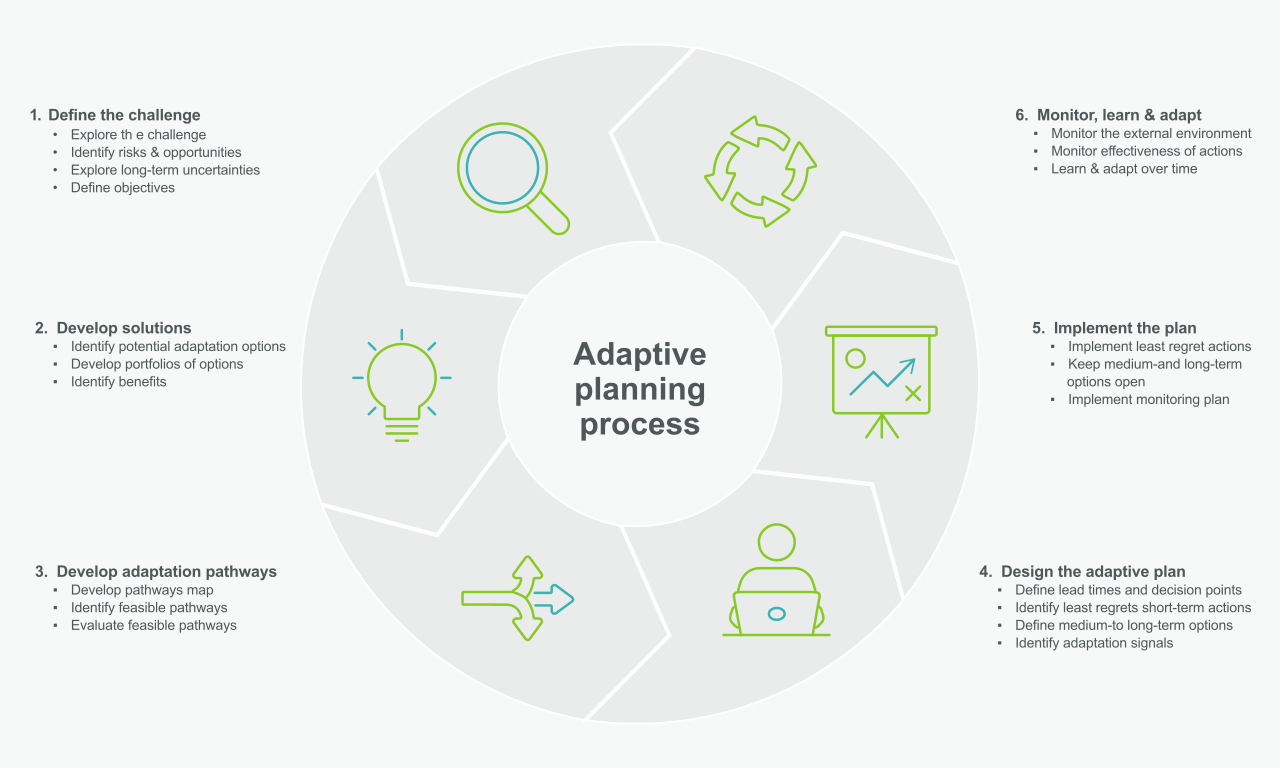
Used the right way, adaptive planning keeps infrastructure investment options open. Rather than identifying definite futures based on historical information, it identifies pathways to move from one option to another depending on how the future unfolds. A typical approach to adaptive planning is presented in Figure 1.


One example of where this approach is being applied is on Queensland’s Gold Coast. The City of Gold Coast’s 50-year vision integrates water systems, infrastructure and land-use planning to deliver multiple benefits, which are adaptive to changing circumstances.
Aurecon helped the City’s journey by developing an adaptive planning framework to respond to future uncertainty and change. Resilience was created through adaptive planning by thinking differently. Future uncertainties were taken into account, such as weather extremes, changes in the environment, and social factors, to develop an integrated and adaptive planning guideline for how Council will make investment decisions in the future.
A key component of our role was supporting the mindset change required for adaptive planning, as it’s less about new technological solutions and more about shifting traditional beliefs, values, roles, relationships, and approaches to work.
If assumptions driving future infrastructure requirements do not eventuate, this can lead to the construction of assets with too much capacity too soon, or less capacity than needed, or in the wrong location, without flexibility to change and respond to the new circumstances.
Solutions assigned to tipping points can be updated and iterated over time as a business gains a greater understanding of the future. It creates actionable implementation timeframes and monitoring plans that are robust because possible solutions are tested against multiple plausible futures.
This is not only relevant for capital investments, but also corporate, human capital and operational changes that may need to occur.
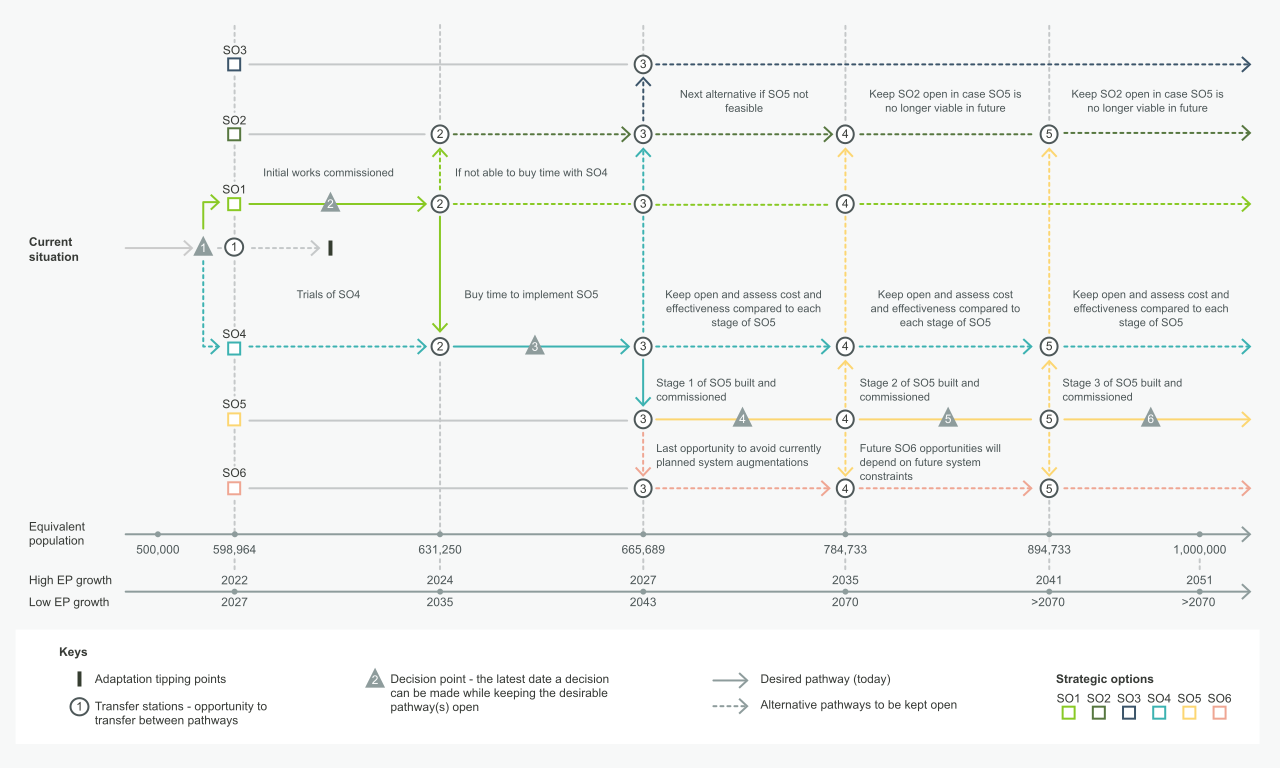
Adaptive planning informs businesses about which external influences should be monitored to understand how they may be changing as the future unfolds. The planning approach shows how those changes may affect decisions that will need to be made at adaptation tipping points.
A key feature of the technique is the adaptation pathways map (Figure 2). It is a very effective way to communicate the adaptive plan and quickly understand the alternatives and decisions that need to be made at certain tipping points. However, it is important to remember that this is only one part of an adaptive plan. Implementation and monitoring plans are also crucial to achieve objectives and targets.
As the level of uncertainty continues to increase for the water sector, utilities face the risk of investing too much too soon, or too little too late.
Many challenges are common to all entities, regardless of geography or institutional arrangements. New flexible methods of planning and implementing water infrastructure will take favour over traditional methods that are more structured in their approach.
Now is a good time to look at how adaptive planning can create value and reduce the vulnerability that comes with making asset investment decisions.
It’s worth noting that undertaking adaptive planning does require new skills and ways of operation to achieve economic returns and take advantage of opportunities. It requires businesses to make deliberate decisions on how they are coordinated internally, and collaborate with customers and community, as well as with each other and their supply chains, to ensure that infrastructure remains efficient, effective and resilient in a more dynamic future.
Nevertheless, the prize is improved resilience and intergenerational equity by better balancing the risk of over-investment, and under-investment, over the long term. This addresses the risk of unnecessarily burdening future generations with deferred investment and expensive future solutions.
By becoming comfortable with uncertainty and applying adaptive planning, the water sector will have far greater certainty as the future unfolds.

Technical Director, Water – Australia
Proposed PFAS limits in Australia pose challenges for water utilities, requiring infrastructure upgrades, increased monitoring, and adaptive management.
Water sector planning must modernise to address climate and other issues, shifting to system-wide, digital, and collaborative approaches for resilience and sustainability.
Discover strategies to future-proof Australia's water sector by modernising planning, delivery and management of water infrastructure for resilience and sustainability.