
Smart Water Fund Water Supply Options Assessment, Melbourne, Australia
Aurecon and SKM provided assessments of over 30 potential large-scale potable water supply options identified to augment Melbourne’s existing water system.


Change your location to view content tailored for you.
Adaptive planning ensure a sustainable water supply for Canberra in the event of prolonged and severe drought. The world is rapidly changing and the ability of water utilities to effectively define and optimise planning for the future needs of their communities, together with the potential effects of climate change, is becoming increasingly difficult.
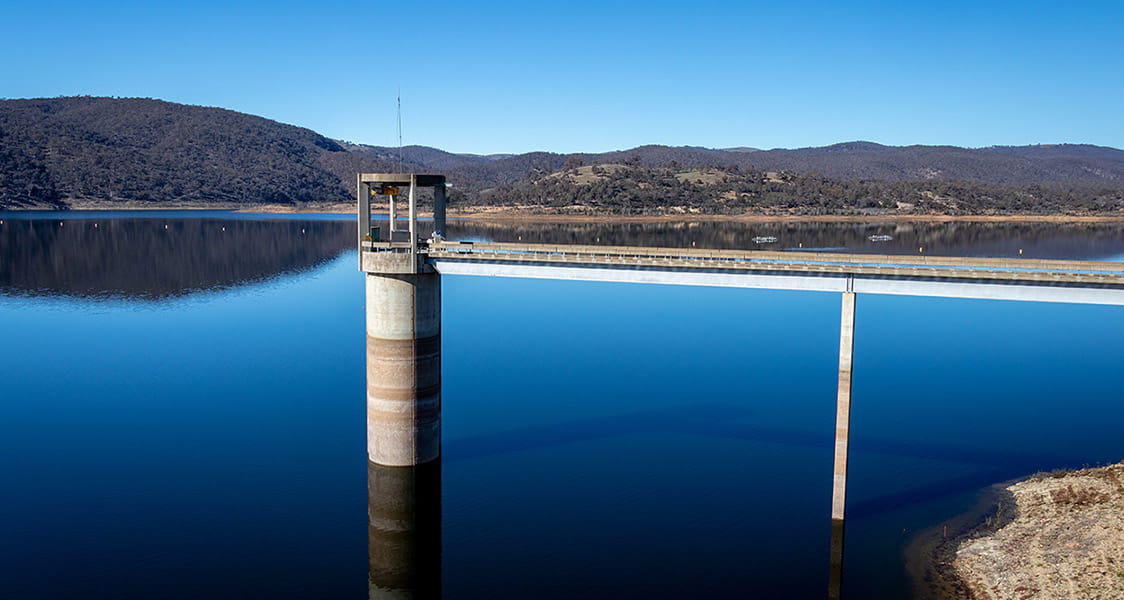
Aurecon was engaged by Icon Water to apply adaptive planning to its existing Drought Management Plan. Servicing the Canberra region and providing bulk water to New South Wales, the water utility has four dams, two water treatment hubs, two sewage treatment plants and approximately 6,500 kilometres of water and sewage pipes.
Shifting from a traditional to adaptive planning approach is helping Icon Water to better prepare for drought conditions and a warmer climate. Traditionally, planning is focused on defining a single preferred outcome that can be more rigid, or less adaptable, to change.
Adaptive planning is an innovative approach to planning that is providing Icon Water with sufficient flexibility to ensure its supply system upgrades or responses are implemented ‘just-in-time’ to withstand severe and prolonged droughts in the future.
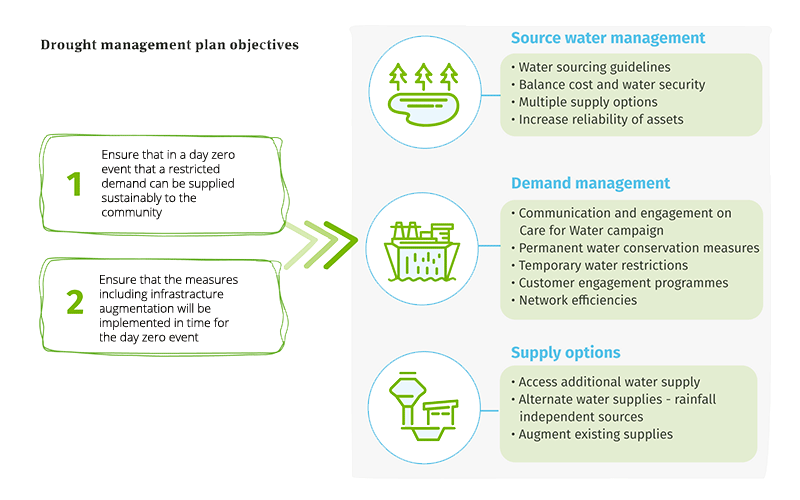
The project focused on alternative water supply options during severe drought to ensure that mitigation measures, including infrastructure augmentation, can be implemented in time to maintain a sustainable supply to the community if dam levels reach the minimum operating level.
Adaptive planning in this context was applied to enhance the water utility’s existing Drought Management Plan, and more effectively prepare Canberra’s water supply system to respond to severe drought conditions.
Instead of defining what assets need to do for the system over the short-, medium- and long-term, adaptive planning focused on the drivers, objectives and services the utility needs to provide over these time horizons.
The defining objective on this project was the need to maintain a sustainable water supply during prolonged and severe drought. The adaptive planning response was focused on the development and assessment of a suite of drought portfolios, with each portfolio consisting of alternative water supply system investments, to prevent loss of water supply.
Future uncertainty and vulnerabilities were established for each portfolio, together with actions that can help to reduce any adverse impacts on the investment planning or spread and/or reduce risks that stem from vulnerabilities.
The elements of flexibility, adaptability, and evolved learning enable the portfolios to adjust to new information as it becomes available in the future. For example, new information might reveal developments that can lead to one portfolio becoming more favourable over another, or present opportunities that should be taken advantage of.


Aurecon led the development of a portfolio assessment framework (Figure 1) to navigate the complexities of the project in a practical and effective manner, while maintaining the required level of robustness. The framework:
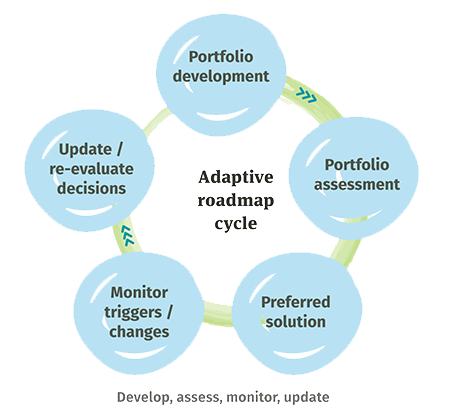
As activities are progressed and greater certainty is achieved, the portfolio assessment can be re-evaluated in the future to determine if the preferred portfolio outcome has changed. The adaptive roadmap is not static; it represents a flexible and adaptable output that is monitored, progressed and updated over time (Figure 2).
Traditionally, strategic planning implicitly assumes a ‘most likely’ plausible future. However, if the future turns out to be different from the hypothesised future(s), the plan may no longer be suitable.
The adaptive planning approach applied by Aurecon on this project was based on acknowledging, identifying and incorporating future uncertainty and vulnerabilities, and resulted in an assessment framework being established as a decision-making tool to guide future decisions and actions (Figure 3).
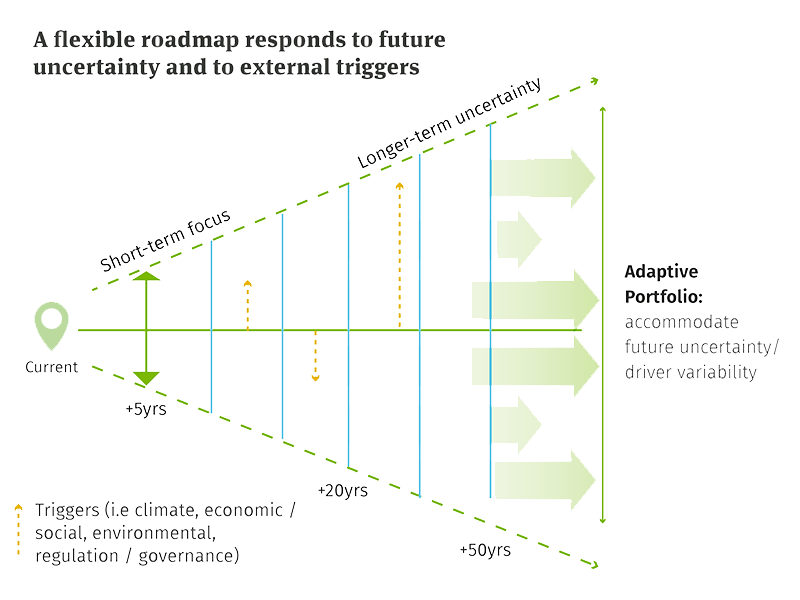
The drought portfolios embody actions and prioritisations that are explicitly designed to be adapted over time to meet changing circumstances such as climate change. This allows Icon Water to be better prepared to respond to prolonged and severe droughts at any specific point in time, in the future.
The flexibility and adaptability of the portfolios ensures the water utility has preparedness in activities that are prioritised, and this will help to avoid future disruption to its sustainable water supply.
This project has won the following award:
Aurecon and SKM provided assessments of over 30 potential large-scale potable water supply options identified to augment Melbourne’s existing water system.
A major boost to Australia’s regional water security is being delivered through a partnership providing Portfolio Delivery Management for Water Infrastructure NSW’s projects.
Aurecon is transforming Sydney Harbour, replacing dredging with TBM tunnel engineering to deliver a faster, safer and more sustainable second harbour crossing.