Change your location to view content tailored for you.
Q: What has been your most memorable entertainment experience?
Phil: When I think about my experiences in entertainment venues, the things that come to mind for me are events where it turns into a real spectacle site where we've got music performers or shows, and these venues transform into something that really creates an experience for the fans and for the viewers there on the day.
The memorable experiences for me are the likes of Taylor Swift, Coldplay, Delta Goodrem, and watching these venues transform into this full stage set in a very quick period is really incredible. If I think about the Taylor Swift concert, she had just finished performing and then they started pulling down this stage to get it to Sydney for the next night.
There wasn't a minute spared in between because there was obviously some time criticality there. But what was really interesting for me, was watching and imagining how that whole logistics might happen behind the scenes to create this show that goes for a two-hour period, there must be so much more time put into it behind the scenes than that.
Q: What opportunity does the 2032 Brisbane Games present in terms of creating iconic entertainment facilities?
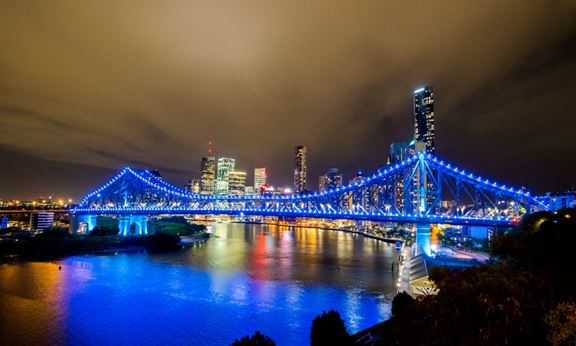
Phil: If you think about world cities, cities that sit on the world stage around the globe, and you think about places like London, Paris, New York, and you think about the skyline that those cities have and the silhouette of that skyline when the sun might be setting, they're instantly recognisable as those cities. And I would love to see Brisbane transform in that way.
I would love to have Brisbane create its own unique skyline that is immediately identifiable as being a city on the world stage. And as designers that's a really proud moment for us as well. Being able to say that we contributed to that design. I love to sit on Southbank with friends and family and point out all the buildings in the CBD or around the CBD that I've contributed something to. It's a real piece of satisfaction for me.
Q: How can designers and engineers collaborate to create this iconic infrastructure?
Phil: There's a real opportunity that we've got ahead of us, and it's one that we should respond to as an industry. So, we have really bright thinkers around our industry. And being an engineer, I believe I've got more to add to a project than just engineering support, engineering knowledge, and experience. And in my experience, when you've got those project teams that really collaborate closely, they tackle problems together. Even though those problems might sit outside the particular competency of that design in a particular way.
Having that diversity of thought around a table when tackling a problem. Having people who are familiar with the type of project that we're looking at and being able to say, I did this over here, I've done this this way before, and to bring that additional thought to the table in tackling those problems, it's a really powerful thing, that collaboration we can achieve on big projects.
Time and time again, whether it's a small project or a large project with those teams that work collaboratively, it's hands down when we get the best results.
Aurecon is not a sponsor of the Australian Olympic Committee Incorporated, the International Olympic Committee, any Summer or Winter Olympic Games, the organising committee for any Summer or Winter Olympic Games, an Australian Olympic team, a section of an Australian Olympic team, or an individual member of an Australian Olympic team. This material is not intended to suggest that Aurecon has any formal association with, or has provided any sponsorship or sponsorship-like support for, any of these parties.

Buildings Electrical Practice Leader – QLD, Australia
Aurecon shares insights on how the 2032 Brisbane Games can deliver legacy infrastructure and lasting economic, environmental and community value.
This fact sheet compares the community and environmental impacts of wind farm projects, and how ecologically sensitive design can deliver better outcomes.
How engineering and construction projects are evolving to champion biodiversity, through early planning, advanced technologies, and ecosystem stewardship.