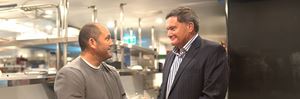



Courtney Lock: Welcome to Engineering Reimagined. My name is Courtney Lock and I’m the new host of this podcast which has now been running for an incredible eight years. Today’s episode is the final interview of our live recordings at the CAETS Conference, and features a fascinating conversation between Aurecon's Chief Engineering Eminence and Innovation Officer, Tanya de Hoog, and one of the world's leading voices on science, policy and diplomacy, Sir Peter Gluckman.
Scientists and engineers are consistently ranked among the world's most trusted professionals. Yet at a time when AI is transforming how knowledge is created, geopolitical tensions are reshaping global collaboration, and public trust in institutions is under pressure, that trust has never mattered more.
From an unexpected career journey that began in medicine and research, to advising governments and leading international scientific collaboration, Sir Peter shares insights on the power of curiosity, the importance of systems thinking, and why the biggest breakthroughs often happen when disciplines collide.
I hope you enjoy today’s episode, so let’s get into it…
+++++
Tanya de Hoog: Hello and welcome to Engineering Reimagined, recorded live at the International Council of Academies of Engineering and Technological Sciences, or CAETS conference here in Brisbane. I'm Tanya e Hoog, Aurecon's Chief Engineering Eminence and Innovation Officer. Today I'm joined by Sir Peter Gluckman, President of the International Science Council, Director of Koi Tū: Centre of Informed Futures, and Distinguished Professor Emeritus at the University of Auckland. Welcome, Sir Peter.
Sir Peter Gluckman: Thank you.
Tanya de Hoog: Sir Peter, you began your career as a paediatrician and biomedical scientist. I'd love to hear a little bit more about something within your career journey and all of your achievements that has been incredibly surprising to you when you think about where you started compared to where you are now.
Sir Peter Gluckman: Well, I never planned my career. I started off actually to go to university to do mathematics.
Tanya de Hoog: Oh, really?
Sir Peter Gluckman: And then quickly decided that mathematics wasn't my future, sorry to any engineers who's listening, and moved to medicine. When I graduated in medicine, I thought I was going to be a career clinical paediatrician, but immediately after I graduated, I was invited to go to the Himalayas with Sir Edmund Hillary and do some medical research on iodine deficiency and that led me to reflect a lot more on the value of research. And although I qualified as a paediatrician with expertise in hormonal disorders, I'd already made the decision to be in a career of developmental physiology. That is the science of fetal, neonatal, and human development. And I spent most of my career in that and then I was asked to be the first Chief Science Advisor of New Zealand and then everything's flowed from there. And so, for the last 15 to 20 years, I've been largely engaged in science policy, science diplomacy, thinking about the long-term issues and the way in which evidence can help improve the world.
Tanya de Hoog: I love that retrospective in terms of you don't necessarily plan your career.
Sir Peter Gluckman: I tell all young people that if you plan, you'll miss the opportunities when they come and I've had remarkable opportunities. I never applied to be dean of the medical school, I was asked to be dean. I was quite happy in research when I did it. I never expected to be Chief Science Advisor, I ended up as Chief Science Advisor and that shifted my career to science and policy science and diplomacy. And that's where I've stayed since.
Tanya de Hoog: You talked about, if you plan, you miss opportunity. Tell us a little bit more about that.
Sir Peter Gluckman: I think overplanning is not good. And I think that's the same as why narrow minds and science cannot be good. You've got to be aware of the unexpected. My career was built around the things that have given me the recognition, have largely come from accidental findings, having the ability to recognise something was different, something was odd, and then chasing that and understanding what it is and it's come from rather accidental discoveries. The best idea came from talking to a scientist in a quite different area at two o'clock in the morning in a pub in Germany, where we were comparing notes. And I suddenly realised that he had been doing something which would change the way I could do research and what I could study. So I think open minds are important. I think in what I do, I have to be able to listen to an engineer or listen to a social scientist, listen to a humanist or listen to a natural biologist. You have to be able to integrate across knowledge systems. Now science and engineering, which I regard as a science, are made up of people who are reductionist and they're important, they understand the details, they get into the detail, but we also need the integrators, people who can cross disciplines, integrate across disciplines, because as we know innovation and new thought and new solutions largely come when we cross disciplinary boundaries.
Tanya de Hoog: That cross-disciplinary boundaries is something that I've been an advocate for in engineering for most of my career because that thinking in much broader terms, in systems thinking, has allowed me to really bring more as an engineer to my deep discipline as well.
Sir Peter Gluckman: Well, I think systems thinking is going to be the future of so much of science, including engineering. And I think that we don't train a young scientist in systems thinking. Most of our PhD programs are narrow and focused on knowing a lot about a little, which is important. And I think all of us need to have that experience, like Charles Darwin spent eight years studying barnacles. You have to have that depth of focus, but I think all scientists need to be able to reach beyond their narrow discipline and understand the context in which they're operating and where they want to make a contribution.
Tanya de Hoog: Thinking about the future, we're seeing a lot of things that are changing around us in the world, and you might argue that that's always been the case. But particularly the way that science and engineering has evolved in the past has been about that knowledge sharing, that cross-disciplinary thought with the sort of generosity, I guess, of sharing in order to achieve progress in some way. How do you think that things might change currently, but also moving to the future with the way that we collect knowledge in AI, geopolitics, shifting funding, many different changes that are different from what we've seen in the past?
Sir Peter Gluckman: Science is a team-based and I think that one of the big shifts is, of course, science has moved to be more team-based than it was 50 or 100 years ago. But in doing that, the boundaries of science has also changed. We haven't yet mentioned social science. And to think about science without thinking about society and the human and societal dimensions of science and technology is to make a big mistake. Science has always been driven by technological developments. When Leeuwenhoek invented the microscope, it changed the whole way biology could progress. When the computer became available, it changed the whole way physics, the natural sciences, the exact sciences could be undertaken. AI is going to change scientists in knowledge production and also knowledge reporting in very dramatic ways. Dan Sarewitz, the great Scholar of Science and Science in Society in the US, wrote a brilliant essay a few years ago which was highly criticised at the time, in New Atlantis, arguing that science is actually driven, and the hypotheses that can be asked are driven by the technologies that emerge. And so, given the fundamental nature of artificial intelligence, and I'm reluctant to use one word to describe what is a range of different technologies, we can expect to have dramatic impacts on how science is done, what science has done, how science is communicated. But there comes the rub.
The rub is that there's a danger, that knowledge is automated in a way that removes the expert judgments that's needed. The changed information environment can corrupt the knowledge that's within science. We've always had bad science, but this makes the greater risk of bad science occurring. We've already seen disruption to scientific publishing in ways that are not entirely healthy. False papers, more false authorships, false citations. And we haven't worked out how to manage that because the world missed the opportunity to regulate the digital and internet world 50 years ago and we haven't worked out how to retrospectively deal with this issue which is very dramatic. And then the other factor which is very real, is science, technology, economics, and geostrategic power have always been linked. And a large proportion has said science technology has been linked to the defence and security sectors since the First World War, but they're more tightly linked than ever, and as the world splits from the pre-2016 era of globalisation into a more fractured world, the potential for science sharing to become more difficult is real. There's been a large move towards open science, and open science is very important.
Open knowledge. But at the same time, you're hearing every government using the mantra now 'Open as possible, as closed as necessary.' And while defining dual-use technologies was simple 50 years ago, now any aspect of knowledge could be used for malevolent purposes or for strategic purposes. And so, we may be at a period where we go through a real difficult period of sustaining openness in science, and it's at a time when the geographical distribution of science is changing. I think last year was the first year in which more papers were published from the broadly defined global south than from the global north.
Tanya de Hoog: Really?
Sir Peter Gluckman: The influence of China, India, and many other countries, South Africa, Brazil and so forth, has changed the distribution of where knowledge is emerging from.
Tanya de Hoog: What's the opportunity there?
Sir Peter Gluckman: The opportunities are multiple. They first start with making sure we protect science as a trustworthy endeavour and work hard to ensure that trust in science is protected by, and the issues are not so much about disinformation, although that can be a challenge. The real issues of trust in the institutions of science, how they operate, how they communicate, how society is brought into it, the quality of science education and science literacy in society, which is very variable across even the developed world in terms of the quality of science literacy. These are all issues that are important. We're now seeing around the world issues where science has been caught up in politics. So, at least in some places, not accepting science as a source of reality has become a badge of political identity. Very dangerous. For a long time, the cognitive dissonances that come because people from one side of the political spectrum don't want to accept climate change because it interferes with their more direct interests, or from the other end of the spectrum don't want to acknowledge the potential of the life sciences technologies. These are issues that are real. For a long time, politics has picked and chose what science it wants to accept and use, and that's fine, that's what societies do. But scientists must, or the system of science, that the institutions of science like the International Science Council, have a core responsibility to fundamentally protect science as a universal language.
Tanya de Hoog: What do you think the biggest opportunities are for science and applied science to really, really dig into and realise some of the solutions around problems that have been pervasive for a long period of time?
Sir Peter Gluckman: Well, I think that's the problem. We can see the opportunities and we actually know the pathways, or we think we know the pathways to solutions. So, we've got to ask the question why that's not happening. Rather, just keep on punching and punching against a policy wall or a multilateral wall, which is not making a difference. And I think the existential question for the planet, in a sense. How do we actually get longer-term thinking rather than short-term thinking? Now, I'm jealous of engineers because engineers have worked in infrastructure, or your kind of engineer has for a long time, and so they've actually worked with that aspect of society that's prepared to think on a 30, a 50, or even a 100-year time frame. We haven't achieved that on climate change. We haven't achieved that on biodiversity loss. We haven't achieved that in terms of pandemic risk, etc. We haven't achieved that in thinking about urban wellbeing. Yes, you may do a lot on transport or building design, but 70% of the world's population is soon going to be living in cities and a lot of them are not having the quality of life which they would aspire to. So there are many things here that we haven't achieved, but fundamentally, we're dealing with the problem of short-termism. And that's an issue that we have not really found a way to well address. I worry about it a lot. That's why I head a centre for informed futures. How do we actually get decision-makers to think over long term? Engineers do deal a lot with risk. I'm sure in your practice you're thinking a lot about flood zones or earthquake zones or whatever, but sometimes persuading the client to actually invest to reduce the risk can be very hard. Why should I spend money now against something that may not ever happen?
Tanya de Hoog: Or they may not have the money to spend right now.
Sir Peter Gluckman: Exactly. So these are real issues, and if we look at any of these issues, and the most obvious one is climate change, where you've seen short-termism for egregious purposes, perhaps on one hand, but you've also got short-termism because it's just too hard politically to address some of the changes that need to be made, because although the scientists have preached and yelled, the public still sees it as something in the future or something for somebody else to deal with. The fundamental challenge is how do we get the knowledge we have received by the people who can make decisions? And that's really hard. We had peak global, I wouldn't say unity, but some level of willingness to work together in 2015. We've got the Paris Accords, we've got the Sendai Framework for Disaster Risk Reduction, which is largely a science and engineering exercise, and we've got the Sustainable Development Goals. A decade later, look where we are. The world is a very different world. It's not focused on globalisation. It's focused on fracturing and nationalisation. We've got emergent techno-poles, China, Europe, Russia, India, USA are all developing different attitudes to technologies in different ways. Progress on the Sustainable Development Goals is virtually nil. Work continues on disaster risk reduction, but we've not made progress on dealing with pandemics despite the experience of COVID. We don't have progress on, real progress on an effective pandemic management treaty or anything like that. So we're still fighting to learn our lessons of the recent past. And yet at the same time, science, the world is continuing to face more and more issues, whether it's conflict, whether it's issues in space with over too many satellites up there, confronting issues of deep-sea mining, the polar regions, not to mention climate change, biodiversity, urbanisation, etc. Where the world, despite the fact that we're all individual cultures and societies, should be able to use science and technology to make far better progress. And so these are the issues that I confront all the time.
Tanya de Hoog: So what I hear from you is not necessarily having as much power and influence in science and engineering as we might like when you think of the capacity we have.
Sir Peter Gluckman: Go back to the first Cold War. 1960s, 70s and 80s. Look what science did in that period. The Soviet Union and America cooperating, over the International Space Station. You had the science community, led by my predecessor organisation, ICSU, in 1985, along with the World Meteorological Organisation, running a meeting in Villach, Austria, who said the world is going to warm at an unacceptable rate. The international community must do something about it, with the pressure from the science community that led to the formation of IPCC. Now, whether it's done well or not, it's certainly brought it to the fore politically. Look at the Montreal Accord over ozone, which came from technology developing, allowing the world to eliminate fluorocarbons because technologists and chemists have found a better way to refrigerate without fluorocarbons. 1957, the first International Geophysical Year, the second International Polar Year. When a large number of countries, including the Soviet Union and the United States, gathered together to study the Antarctic and the Van Allen Belt, which had just been discovered, controlled by the International Science Community, ICSU, my predecessor organisation, which led three years later to the Antarctic Treaty, which is seen as the highlight of science diplomacy. 1972, Kosygin and Lyndon Johnson, recognised that they had to find a way to reduce the tension. They founded AIASA and got the academies, National Academy of Sciences and the Russian Soviet Academy of Scientists to work together to form a multilateral organisation, now based in Vienna, which still provides much of the data relevant to sustainability. So the science community acting as Track 2 diplomats, that is, without the formal, has nudged the diplomatic community on more than one occasion to make progress. The National Science Council, which has been busy start moving itself and reforming itself to put an office into New York, it's going to put an office into Geneva. It is now working very closely with the UNA government and with more UN headquarters. It's working with agencies like United Nations Environment Programme, United Nations Development Programme, WMO, UNESCO, to do what we can from the science community to nudge them. We don't have to take the credit. We need to make sure the system moves forward. A secret to science advice is don't take the credit for what you achieve. Let the policymakers take the credit.
Tanya de Hoog: So focus on the progress and what's possible when you marry science with diplomacy.
Sir Peter Gluckman: I used to say when I was Chief Science Advisor, the success is nobody knows what I have done. The success is I know that the Prime Minister and Ministers have responded and claimed credit for using science to do something. And I think we have to accept that the major outcome of science will be mediated, and when we're talking in this context, the global community, through what multilateral organisations do, where they acknowledge what we do or not, as long as we're at the table and have access. And that's what I work on, humility in public, access in private, and making sure that the right knowledge gets to the people who might use it. Now, we fail a lot of the time, I'm not pretending it's easy, cause short-term interests, cognitive biases, political interests, financial interests, diplomatic interests, will always get in the way of what the scientist thinks is ideal. But we can make progress.
Tanya de Hoog: I was going to say, and yet, we do make progress.
Sir Peter Gluckman: Exactly. I mean look where the world is, it's a difficult period at the time, but in general if you look over the course of history, people are living longer, more people are out of poverty than were there before. The future for the next generation is in many ways brighter, yes, there are threats which need to be addressed, but a girl born today in Australia and New Zealand will live well into the 22nd century, probably the three numbers, a hundred and something years of age. Most of that will be in healthy life. The range of opportunities will be much broader for her than was there in the previous generation. Look at China. Look at how fast so many people have been taken out of poverty. Look at India. You're seeing the same thing there. And I think you can pick other countries where things are happening quite fast. That's the issue. I don't think our governments necessarily recognised the need to keep on driving more and more science, more and more knowledge, so that their countries can progress. There's too much belief that they've already done it. There's so much more to do.
Tanya de Hoog: So much opportunity. Well, I think we're out of time, but this was an incredibly deep and interesting conversation particularly when I think about the progress that you've reminded us of and the opportunity in science and engineering. So, thank you, and I hope our audience finds it just as inspiring as I did.
Courtney Lock: That's it for today’s episode.
It’s fascinating to hear Sir Peter’s insight on the power of curiosity, the value of embracing unexpected opportunities, and the importance of connecting disciplines to tackle complex global challenges.
If you enjoyed this episode, hit subscribe on Apple or Spotify and don’t forget to follow Aurecon on your favourite social media platform to stay up to date and join the conversation.
Until next time, I’m Courtney Lock. And thanks for listening.
The role of Science and Engineering in addressing complex global challenges
Scientists and engineers are consistently ranked among the world's most trusted professionals. Yet at a time when AI is transforming how knowledge is created, geopolitical tensions are reshaping global collaboration, and public trust in institutions is under pressure, that trust has never mattered more.
Aurecon's Chief Engineering Eminence and Innovation Officer Tanya de Hoog speaks with Sir Peter Gluckman, President of the International Science Council, about the evolving role of science and engineering in addressing the world's most complex challenges.
They discuss the value of remaining open to opportunity throughout your career, the importance of systems thinking and interdisciplinary collaboration, and how emerging technologies such as AI are reshaping the way knowledge is created and shared.
“I think all scientists need to be able to reach beyond their narrow discipline and understand the context in which they're operating and where they want to make a contribution,” said Sir Peter.
Sir Peter also explores the growing need to build trust in science, strengthen science literacy and connect scientific expertise with policymaking and public understanding.
Additional resources
Disclaimer
The views and opinions expressed in this podcast are those of the individual speakers and do not necessarily reflect the views of the host, the organisation, or any affiliated entities.