



Maria Rampa: Hi, I'm Maria Rampa, and welcome to this special episode of Aurecon's Engineering Reimagined podcast, recorded live at the CAETS conference.
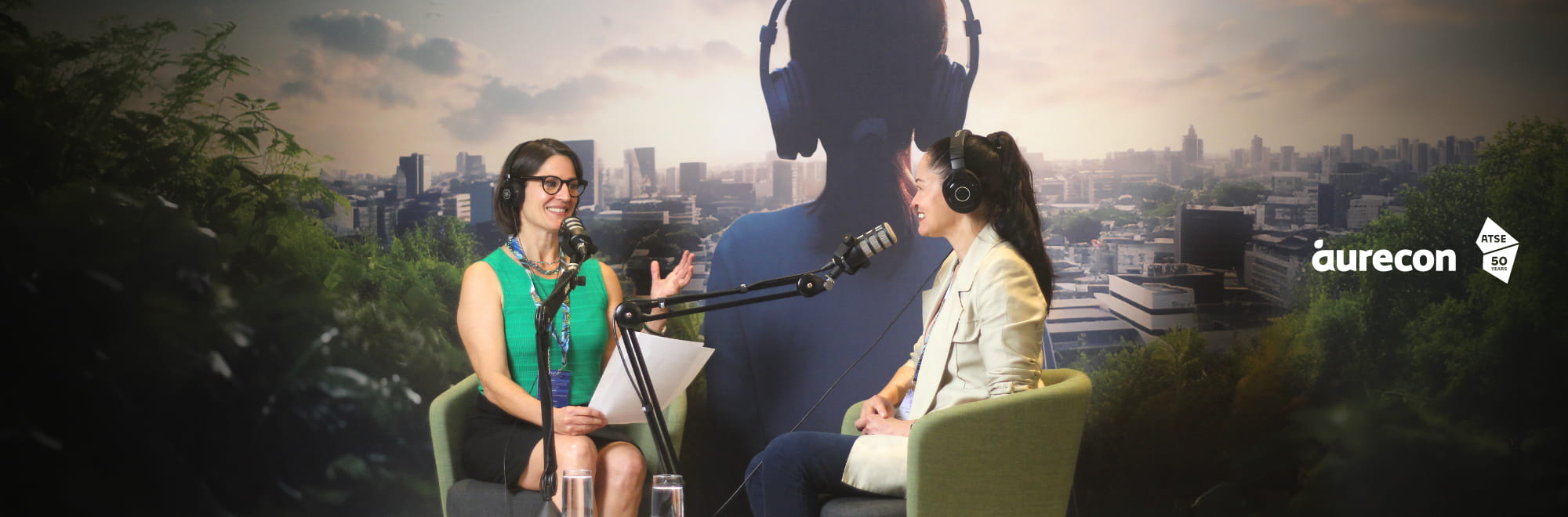
Today's conversation features Aurecon's Queensland Lead for Engagement and Change Advisory, Lorna Bishop speaking with Tanya Ha, award-winning science communicator, sustainability advocate, and Director of Engagement at Science in Public.
Over a career spanning more than 25 years, Tanya has made it her mission to translate complex science into stories that resonate with the public and inspire action.
In this episode, Lorna and Tanya explore how technology has transformed traditional approaches to communications and engagement and how STEM professionals can cut through the noise, build trust, and make their work matter to the communities they serve.
They also talk about why communication is still a skill that can be learned and why it’s important to celebrate our humanity at a time when AI threatens to take the personality out of our messaging.
I hope you enjoy today’s episode, let’s get into it…
+++++
Lorna Bishop: Hello, and welcome to Engineering Reimagined. Today, I'm lucky enough to be joined by Tanya Ha, an award-winning Science and Environmental communicator, sustainability advocate, best-selling author, broadcaster, and Director of Engagement at Science in Public. Today, Tanya and I will explore how STEM professionals can cut through the noise, build trust, and make their work matter to the communities they serve. Welcome Tanya.
Tanya Ha: I'm very pleased to be here, thank you for having me.
Lorna Bishop: Your career has ranged from science journalism to board leadership and sustainability advocacy. You have such a unique mix of skills. What triggered that shift from chemistry to a focus on science communication and engagement?
Tanya Ha: Well, I'd like to pretend that I started my career in teenage years and adulthood with a plan.
Lorna Bishop: Yes, we would all like that.
Tanya Ha: But if things went to plan, I would still be living in Adelaide and be a physiotherapist. And life just happened. I ended up doing a science degree and majored in chemistry, but very quickly during second year I could see that I had a lab partner who was brilliant. He would make a great theoretical chemist, but he would come out of lectures saying, you know that bit where we looked at the blah blah blah on the bond angle and that was at this or this and I'd be thinking did we come out at the same lecture? I mean his mind was just operating on another level. One day he will imagine and do original chemistry and make new compounds and that sort of thing. But don't get him anywhere near communicating with the broader public, he's going to need an interpreter. I knew that at high school I was good at sciences but I was also good at humanities and English and art. And so, I thought surely there's a career in there and I decided to be a science communicator. And then three weeks before my lectures finished, I had my first child. So I've only ever known working motherhood. And I kind of accidentally somehow landed working for Planet Ark Environmental Foundation and I'd found my niche.
Lorna Bishop: Fantastic.
Tanya Ha: Communicating behaviour change and sustainability to a mainstream audience. The other part of my background was that when I was at university, my part-time job was modelling. So I had media and communication skills. I wasn't too scared of microphones or cameras. But we just realised at Planet Ark that here's someone who knows stuff about recycling and she's female at a time that there were very few female voices in the environment movement. And so I had to overcome a certain shyness, but it really was understanding that there was a need there and it's a tough job, but someone has to do it, and I was ready to do it and I've loved it.
Lorna Bishop: I'm quite interested in your thoughts on what separates STEM professionals who can communicate effectively from those who struggle to connect and how can people who are struggling get better?
Tanya Ha: There's two things. One is, some people just have a natural aptitude as communicators although you sort of need a bit of work or confidence. No one believes this but I'm actually an introvert. But I’m a show pony introvert – you know if there's a microphone or camera, I'll bounce up to it. Because that brings in the next part of it, seeing the need, feeling a sense of calling that, okay, I will overcome those barriers, and I will learn this new skill. Because this is too important to not talk about it. And that's something that I really hope more engineers do, especially in the built environment and sustainability because engineers are problem solvers and our planet has so many challenges and people need information to make informed choices, including our politicians. The thing that I'd encourage to STEM professionals is, start off by seeing and understanding the need for experts to represent their expertise, to share it with the people who will benefit from it, and to defend it against the people who are, you know, who pretend to be experts, but they so are not. So it's at times like these that there is kind of almost an altruistic need for the experts to step up and defend evidence-based science, evidence-based action. So that's part of it, the motivation. And then it's practising and learning. Some will have more of those skills, more aptitude, some will have less. Not every STEM professional has to be a communicator. Some people, like my prac partner in chemistry, might not ever learn those skills, but as long as there's someone in your team or your field of expertise that can represent the group or the company or the field or the project, not everyone has to do it. As long as you've got a relatable, good communicator spokesperson that is taking it to the audiences that you need to reach.
Lorna Bishop: Yeah, my team that are listening to this will be really buoyed by that because that's part of what they do and they love working with engineers every day and other STEM professionals to do that translating role as well.
Tanya Ha: And it's not easy, it does take practice. The thing that I often say to scientists and engineers is you might hang around with people at a university or a company or in a research institute and you've got this jargon, this language that seems normal, maybe you should go out to Fountain Gate Shopping Centre, sit in the food court and just listen to how people communicate and you'll notice that they don't use the word morphology, they might use the word shape. So can you in talking about the research or the work or the things that you're doing, can you use the word shape instead of morphology or there’s language that can be more approachable and accessible and just practicing on it. Practicing at the family barbecues, when people say, so dear, what do you do? Tell Auntie Doris in a way she'll understand. Or there's other captive audiences that you can practice on. So, if your Uber driver asks you, what do you for a living, then you can tell them and see if they ask a follow up question.
Lorna Bishop: One of the challenges for STEM professionals is how they balance sharing the level of detail and the scientific rigour that they've put into research and projects and design solutions with the need for that punchy, cut-through communication.
Tanya Ha: Well, it's understanding your audience, fundamentally. Spelling it out to people, what about my work is someone going to find interesting? I can think of a scientist right now. This last week, she's won an award, Vanessa Pirotta. She won the Eureka Prize for promoting understanding of science. She's a marine biologist. She studies whales and she gets drones to fly through the spray that whales do when they surface and collect whale snot so that they can check the health of the whales and also you know monitor where they're tracking and where their populations are. To kid audiences, to schools, tell them about the whale snot. If you're talking to government people in Queensland, for example, you talk about the value of whale tourism to the economy. And this is why we monitor them and track them and see what their health is because we need whales for the future of tourism in Queensland. Another group, you might focus on something different. So think about who's the audience that I'm communicating with, what would they understand? And how do I want them to behave as a result from hearing from me? If it's a government person, do I want them fund it, or do I want them change a policy that's going to affect something? Do I want them to buy a piece of infrastructure or commission us to do some work on a project, or do I want them collaborate with us so that there's a better public understanding, a social licence to operate with this major infrastructure project that we're involved with? It's thinking through those things of why am I communicating in the first place? Who am I speaking to and what do I want them to do as a result of hearing from me?
Lorna Bishop: In my line of work, I've watched how we engage with community completely evolve. So we've gone from letterbox drops to geospatial portals or from imported workforces to complementary workforce solutions that create pathways in local communities. So we're working together to create STEM opportunities for local kids. And then even things like how we engage contracted partners for example, it's now all about integrated joint ventures and how we brand and identify that and I'm just curious about whether or not you're seeing those kind of trends in the work that you do and how do you think that's changed people's engagement needs?
Tanya Ha: I'm definitely seeing it and some are more advanced than others and it's quite interesting because you operate in an area where you're looking at the overlap between expertise and research and where the rubber hits the road with industry and the corporate sector and big business and there might be public companies and there may be privately owned companies and they might be different work styles and there's a few more sharks out there, people who are aggressive operators, who are very competitive. And in these multi-stakeholder collaborative projects, you need to be able to use goodwill and to work collaboratively, not competitively. I used to be on the board of Diversity Council Australia, you look at diverse organisations, diverse boards and they are more financially successful, they sell more product, they do more things, they win more awards, they get more projects done. Because humans are social animals, we're social creatures, and we do things better when we're collaborating, not competing, and when we're playing to our strengths. It's like sport, a football team is successful when they've got a good kicker and a good runner, and they all play their different parts of the field. And the skills that are really needed are people coordinating it that have a certain amount of diplomacy. And who can show respect where it's needed and who can manage those different personalities and who can also explain those different areas of expertise. So you might have some very technical specialists that aren't good communicators, but they're really important for the job. But having them work alongside organisational psychologists can be really important. We're at a stage now where the problems that we're facing as a society, climate change, food security, energy security, the energy transition, all of these things are transdisciplinary. There are environmental consequences and there's tax implications. And so there are so many different things to manage and juggle at the same time. We have to work together. Otherwise, you go a certain path down and then someone says, no, that's not going to work and then you're two steps back and then you’re trying down another path and it can be a waste of money and resources. And when we're talking about infrastructure and the built environment, when you waste resources, we're taking not grammes of waste to landfill or grammes of CO2, it's tonnes, it’s mega tonnes. So the ability to get things right early from the get-go is vitally important.
Lorna Bishop: Large projects need to bring a lot of diverse skills together and a lot a diverse expertise. And sometimes, we do focus on, how do we engage community in that space? But before we even get to that point, there's this urgent need for us to engage internally to understand what's important, what's a priority. How do we solve complex problems together, how do we bring those diverse skills and backgrounds together to be able to find a common language and a common cadence and, you know, align values where we need to get difficult things done.
Tanya Ha: One of the boards that I'm on is Western Port Water and so much of our work starts with organisational culture because, you know, in sanitation engineering and the water sector, probably like a lot of the sectors that you work in, you're on work sites where there is a chance that people could die.
Lorna Bishop: That's right.
Tanya Ha: So having a safety culture from the get-go. So we start board meetings by having a safety share, just 10 minutes, where a different executive or board member will talk about a particular topic. It might be driving and road safety or it might be allergies, like let's make sure we don't have any peanuts in morning tea and do we know who's allergic to what in the organisation, those kind of things. And that, for the staff, they know that their well-being is being prioritised by the board.
Lorna Bishop: When we start thinking about AI tools and what they can do for us and how the information that they're processing and how they're presenting it, what do you see as the opportunities and risks for science and engineering communication in the AI era?
Tanya Ha: The cautionary story with AI is yes, it's useful but you have to remember that it is going to bland everything down and it's going to make everyone and everything look a bit beige. So first, fact check it. Make sure that it hasn’t introduced error into the information you want to convey. And two, put your personality back in if it's taken it out. Make sure you're visible in there. It's similar, I think, to images. You can tell when someone's face has been photoshopped. Yes, we've removed the imperfections, but they no longer look human. Celebrate your humanity, show us your humanity because people want to respond to fellow people.
Lorna Bishop: From your work with Greenfleet and other organisations, what have you learned about creating micro moments of engagement that encourage people to take climate or sustainability action?
Tanya Ha: Well, I think we forget that we're human. We forget that humans are animals and we respond emotionally, like we love thinking that we have a higher rational brain and that if you give us lots of information, we'll make informed choices. The unfortunate truth is that humans, we can make decisions that are contrary to our own needs and desires. We're just, we're flawed but fabulous. But when you look at us and our humanity and our reptile brain, you understand that we have hopes, we have dreams, we like food, we like clean air, we respond to nature. And the thing that really excites me about Greenfleet and why I wanted to join their board was because it wasn't just about carbon abatement, because what's a tonne of CO2? You can't hug and interact with a tonne of CO2 and relate to it. But people understand the idea, in simplistic ways, of if you plant a tree, trees take in carbon dioxide, they give out oxygen, and they understand that in a way they don't understand technology offsets. Plus, there's these other benefits, is that when you're restoring biodiversity in order to trap carbon, you're creating these beautiful, beautiful landscapes. And you know trees mark time, they're a legacy. And I'll mention something here that to me, it's personal and it's professional and it means something to me is that last year, a member of the Aurecon family, Jeffrey Robinson died, he was hit by a car and the... I'm connected, I'm very passionate about the green building field because if you care about environmental sustainability, you've got to care about the built environment because it is such a large proportion of our energy cost and our greenhouse impact. It’s buildings is fundamental and it's our habitat. We live and work in buildings. And Jeff was just such a wonderful, wonderful human being. My heart goes out to the whole Aurecon family. I just felt so sad when I heard that he died. But he was someone who was such a strong leader because fantastic, brilliant brain, knew all about urban sustainability and future cities and how to implement it. But he shared it with such compassion and boy-like enthusiasm. And Greenfleet has planted a forest for Jeffrey. And I just feel like as a legacy for someone who made such a contribution to be able to abate carbon, he would have approved of that, but to do of it in a way that is good for the planet, that is for biodiversity, not just tonne CO2 abated, is something that is really positive and it's a multiplier of the benefits.
Lorna Bishop: We're bringing our very best science, our very best technology, our very best engineering, our very best mathematics and research to the table to solve complex infrastructural problems. And what advice would you have for STEM professionals around how they can continue to build that trust with community?
Tanya Ha: It's just be yourself and show as much of yourself as you want to, as you're comfortable with. The STEM professions are diverse. They have people from a lot of different cultural backgrounds, different genders. There's a whole STEM pride that's embracing the LGBTQI+ community, and I think the more people can bring their whole selves to their workplace, the more their peers that are not so much professional peers, but friends from other circles can see them and relate to them and go, oh, okay, I trust this person in this aspect of my life, but they're over here doing this climate change stuff. Maybe this climate change stuff is sensible because I know they care about their kids and have kids. I know that they're passionate about making sure we're not affected by drought or things that I'm concerned about, whoever you might be.
Lorna Bishop: Tanya, it's been such a delight to talk to you today. Thank you so much for sharing your experience and observations.
Tanya Ha: Oh, my pleasure. I'm so delighted to have been asked. Thank you. And lovely to meet you too.
Lorna Bishop: Thank you.
Maria Rampa: That's it for today’s episode.
Whether you're a seasoned STEM professional or just starting out, we hope today's episode has given you some practical tools to help you step up and speak out to ensure your messages are not only heard but understood.
If you enjoyed this episode, hit subscribe on Apple or Spotify and don’t forget to follow Aurecon on your favourite social media platform to stay up to date and join the conversation.
Until next time, I’m Maria Rampa. Thanks for listening.
What it takes to communicate beyond STEM circles
What separates the STEM professionals who can communicate their message to the community from those who only speak within STEM circles? According to Tanya Ha, it comes down to three things: understanding your audience, finding your motivation, and having the courage to practice.
Recorded live at the latest CAETS conference, Aurecon's Lorna Bishop sits down with one of Australia's most celebrated science communicators for a conversation about the communications skills that engineers and scientists need most right now and why the world can't afford for experts to stay quiet.
Together they explore why communication is a skill that can be learned (even for self-described introverts), how to tailor your message for different audiences, and how to leverage AI in communications without diluting personality.
Tanya says, "Think about who's the audience that I'm communicating with, what would they understand? How do I want them to behave as a result from hearing from me?” Lorna and Tanya also discuss how engagement itself is evolving to more integrated, community-led models of collaboration, and unpack the growing importance of internal engagement on large, complex projects to achieve success, including how diverse teams build shared understanding to solve difficult problems together.
Additional resources
Disclaimer
The views and opinions expressed in this podcast are those of the individual speakers and do not necessarily reflect the views of the host, the organisation, or any affiliated entities.