
Rebalancing priorities: When everything is changing, how do you stay balanced?
Balancing priorities like decarbonisation and investment in aging infrastructure requires ongoing risk analysis, optioneering and trade-offs.



Change your location to view content tailored for you.
From 1 July 2023, Australia’s largest emitters will be required to measure, report, manage, and reduce emissions. The reformed Safeguard Mechanism will significantly contribute to Australia’s 2030 emission reductions target, set at 43 per cent below 2005 levels[1].
The Safeguard Mechanism reforms were passed by Parliament in March 2023, and the final details set in the Safeguard Rules, were made on 3 May 2023. These Rules underpin the Safeguard Mechanism reforms and provide clarity on the finer details of the Mechanism.
The Safeguard Mechanism works on resetting the reference point against which emission reductions will be assessed, in order to progress industry decarbonisation. This is intended to lead to emission reductions being more efficient as it legislates an obligation to keep net emissions below emissions limits (or baselines).
The Safeguard Mechanism Reforms require large facilities, whose net emissions exceed the safeguard threshold, to keep their emissions at, or below, emissions baselines set by the Clean Energy Regulator. These are facilities with Scope 1 emissions of more than 100,000 tonnes of carbon dioxide equivalent (CO2e) per year.
The reforms provide industry with a clear remit to implement emission reduction activities and reduce the overall emissions associated with their production processes. This is in line with commitments made by the Australian Government and a range of organisations covered by the Safeguard Mechanism to reach net zero emissions by 2050.
Transparency will also be improved by the Climate Change Authority reporting in the annual climate change statement on progress against emissions-reduction goals, with specific reference to new safeguard entrants.
"The overall reduction in emissions for each year is material and will drive decarbonisation strategies."
Raphael Wood, Board member, Carbon Market Institute
Under the mechanism, most facilities will need to ensure that their emissions decline by five per cent each year. Trade-exposed and future industries will have a lesser burden with emissions declining as little as 1 per cent.
The hard cap has been designed to keep safeguard emissions below 1,233 m tonnes of carbon to 2030, or 28 per cent of the national emissions’ ‘budget’ of 4,381 m tonnes over the same period.
In 2030 emissions from safeguard facilities are expected to fall to 100 m tonnes of CO2e compared to about 140 m tonnes in the 2022 financial year.
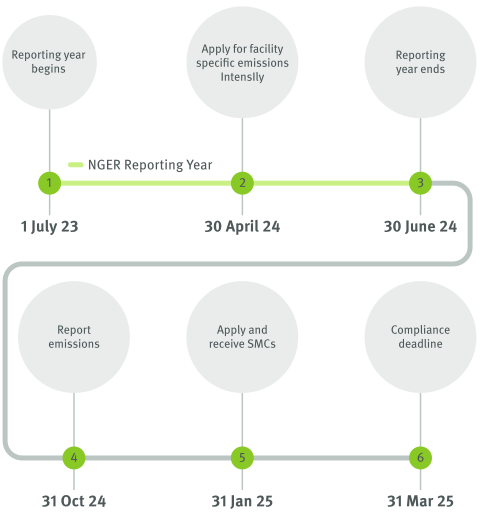
A timetable for proposed Safeguard Mechanism reform is provided below. For the first compliance period, between 1 July 2023 and 30 June 2024, facilities will need to ensure that their emissions are below their baselines by 31 March 2025.
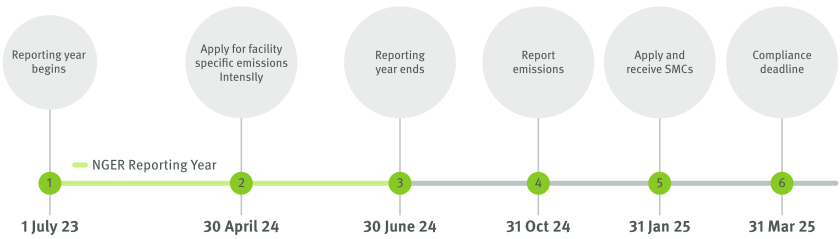
The reforms will directly impact approximately 215 facilities that account for more than 20 per cent of Australia’s emissions. The reforms do not mandate an emissions outcome for any one facility, but they allow organisations to earn tradeable credits, called Safeguard Mechanism Credits (SMCs) when their emissions fall below their baselines.
This will encourage facilities with low-cost abatement to do more, and at the same time help organisations facing more expensive abatement by allowing them to purchase credits if they’re cheaper than on-site measures.
The reforms are designed to ensure that the cost burden to using credits increases over time, encouraging on-site emission reductions wherever possible.
The launching-point for any organisation to achieve these reductions will be its decarbonisation strategy. A facility’s decarbonisation strategy should prioritise direct on-site emission reductions where this is achievable, but also be supplemented by a robust offsets acquisition and evaluation strategy.
There is no one-size-fits-all strategy here though, and each organisation will need to consider its most efficient decarbonisation pathway.
Whilst there are sizeable opportunities to abate emissions across the facilities covered by the legislation, some emissions reduction projects are reliant on emerging technology, and others will take time to implement. While carbon reduction projects will be favoured, organisations will still have the option to purchase offsets to transition a facility to a decarbonised future.
Access to domestic Australian Carbon Credit Units (ACCUs) through agriculture and land management will continue. If reliance on offsets to meet targets exceeds 30 per cent – due to cost or the availability of technology, among other factors – organisations will have to issue an explanation to the Clean Energy Regulator.
To manage organisational risk, and ensure offsets integrity, considerable thinking needs to go into developing an offsets strategy that meets a company’s needs. Further, to develop an offsets strategy, it is important for organisations to obtain up-to-date information on market dynamics, and price forecasting analytics around ACCUs and SMCs.
An organisation’s emissions profile will become public knowledge in the future so they will face public and stakeholder scrutiny on how they’re balancing offsets with capital investment in technology, and pathways to decarbonise operations.
With only a short time before the reforms take effect, there isn't much time to get ready. For organisations without a detailed decarbonisation strategy in place, it’s time to get the skates on.
For those with a strategy, it’s time to review the contents in context of the Safeguard Mechanism reforms. Organisations will need both a decarbonisation strategy and offsets strategy to balance the two, specific to each facility and each industry.
It’s now commonly accepted that achieving net zero by 2050 is the goal. With the reforms, it means that organisations now have a policy framework that provides the certainty needed for facilities to make investment decisions to decarbonise. The Australian Government, through this policy change, is trying to strike a balance between commercial competitiveness, bolder targets, further transparency, and adequate compliance.
Looking forward, decarbonisation won’t involve the flick of a switch – particularly in hard-to-abate sectors – but rather be defined by short-, medium- and long-term objectives that will be different for individual facilities, and industries. In addition, a decarbonisation and offset strategy will need to be monitored and reviewed as new emission reduction technologies become available.
For more detail, view the authors ’ recent panel discussion as they share their insights on the main outcomes and changes to the Safeguard Mechanism reforms and the Bill that was passed in early 2023.
[1] Australian Office of Financial Management, November 2022, Australian Government Climate Change commitments, policies and programs, accessed 20 April 2023.
Aurecon guides organisations through the complexity of carbon markets and offsets, managing uncertainty and creating clear steps to decarbonisation. It combines the experience of carbon market and offsets experts, together with its knowledge of individual facilities across multiple markets, and infrastructure advisory and sustaining capital expertise, to decarbonise facilities whilst retaining value in operations.
Contributing authors & reviewers: Nicole Joffe, Raphael Wood, James Turnbull and Taira Vora
Balancing priorities like decarbonisation and investment in aging infrastructure requires ongoing risk analysis, optioneering and trade-offs.
Transitioning to net zero carbon emissions requires decarbonising economies to challenge every aspect of their energy, resources and mobility decisions across every industry.
This paper explores three individual change scenarios for the Safeguard Mechanism, illustrating different pathways for greater emissions reductions in Australia.