Sharpening investment in climate resilience for Australia's infrastructure
As climate impact events become increasingly prevalent, there is a sharpening focus on resilience investment for Australia's infrastructure across every sector.


Change your location to view content tailored for you.
The need to decarbonise poses substantial resource challenges in an ever-changing geo-political and economic environment – and decarbonisation can’t be achieved without considering entire supply chains.
In this context, circular economy is gaining significant attention in helping businesses and society more broadly transition to net-zero. Australia can learn from Europe’s lead to take large-scale demonstrations of circular economy from theory into practice, writes ReLondon’s Wayne Hubbard with Aurecon’s Jodie Bricout.
In an era marked by climate change, resource scarcity, and environmental degradation, circular economy has emerged as a critical enabler of a sustainable future.
Europe in particular is making remarkable strides in transitioning towards a circular economy, making a substantial departure from the traditional linear model of ‘take, make, dispose’, towards a circular ‘design out, retain, regenerate’ system. Company Boards globally are increasingly demanding a comprehensive transition to net-zero strategy, just as they require traditional growth, portfolio or investment strategies.
That's quite a shift from a few years ago, when action on decarbonisation was limited to reducing operational energy consumption and boosting renewables. Now companies are looking at the impacts of their material consumption through the supply chain, and the impacts of their products and services in the hands of clients and consumers through to end-of-life.
While the United Nations has revealed the world must cut emissions by 45 per cent[1] to avoid irreparable damage, only 4 to 8 per cent of the UK’s total greenhouse gas emissions is generated from waste[2]. This figure is similar across most developed economies, as presented in research conducted by Aurecon on territorial emissions.
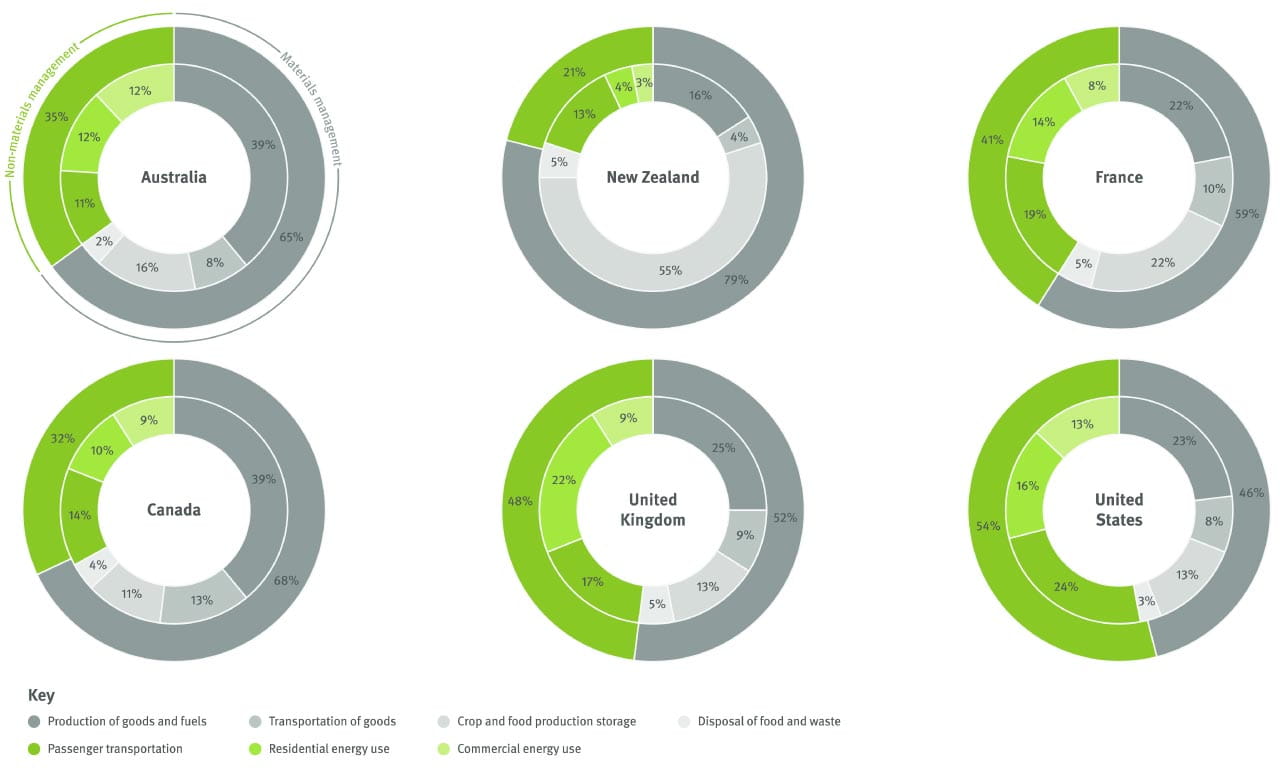
But waste is a very tiny part of the whole circular economy story, which looks at the way materials flow through our economy. Figure 1 shows that materials related emissions contribute to a considerable portion of emissions budgets, around half in the UK, and almost two-thirds in export-rich Australia. Research was conducted by Aurecon using UNFCCC data[3].


A circular economy is where stuff is recirculated at its highest value after first use. In order to do this, circular business models will become the business-as-usual, where waste is designed out; recycled material is used as an input to manufacturing; things are made to be easily recycled; underutilised things are more widely shared, leased or subscribed to; and they’re designed to be more durable and more easily repaired.
One of the standout successes in Europe's circular economy journey is its Green Deal. Ratified in 2015 by the European Commission to become the first climate neutral continent by 2050[4]. It also passed a Circular Economy Action Plan with targets on waste, reuse and recycling, and the identification of funding schemes for projects.
Many regions have since developed their own circular economy action plans, including London. The city’s circular economy route map provides guidance for local government and organisations to transition their business and operating models. London estimates its circular economy actions will contribute up to AUD$5.4 bn of net benefit for the city[5].
A well-developed circular economy application makes for an easily understood incentive to cut emissions.
By adopting its own measures and pathways, Australia can do the same to minimise the use of virgin materials, loop resources back into consumption and production systems, and retain valuable resources at their highest value.
In Australia’s case, five ambitious actions using a multifaceted approach will ensure whole value chains transition:
In closely examining circularity in Europe, cross-market collaboration in the form of circular economy hubs has had success. A similar mix of industries exists in Australia as Europe, so the idea is applicable here.
These may be physical hubs, such as a co-processing facility located alongside a water treatment plant, or a commercial precinct where waste is produced by one business and used as an input by another. However, they can also be virtual, with forums, networks and partnerships fusing knowledge and experience sharing across markets.
While Europe's progress in the circular economy is commendable, it's important to recognise there will always be challenges, such as resistance to change and the need for substantial investment in infrastructure. Australia should be prepared to address similar challenges as it progresses its circular economy transition.
Developed the right way, the circular economy in Australia will help to spur organisations onwards by bringing into focus what is truly in their commercial interest. A well-developed circular economy application makes for an easily understood incentive to cut emissions, while also ensuring equitable access to collective benefits for all segments of society.
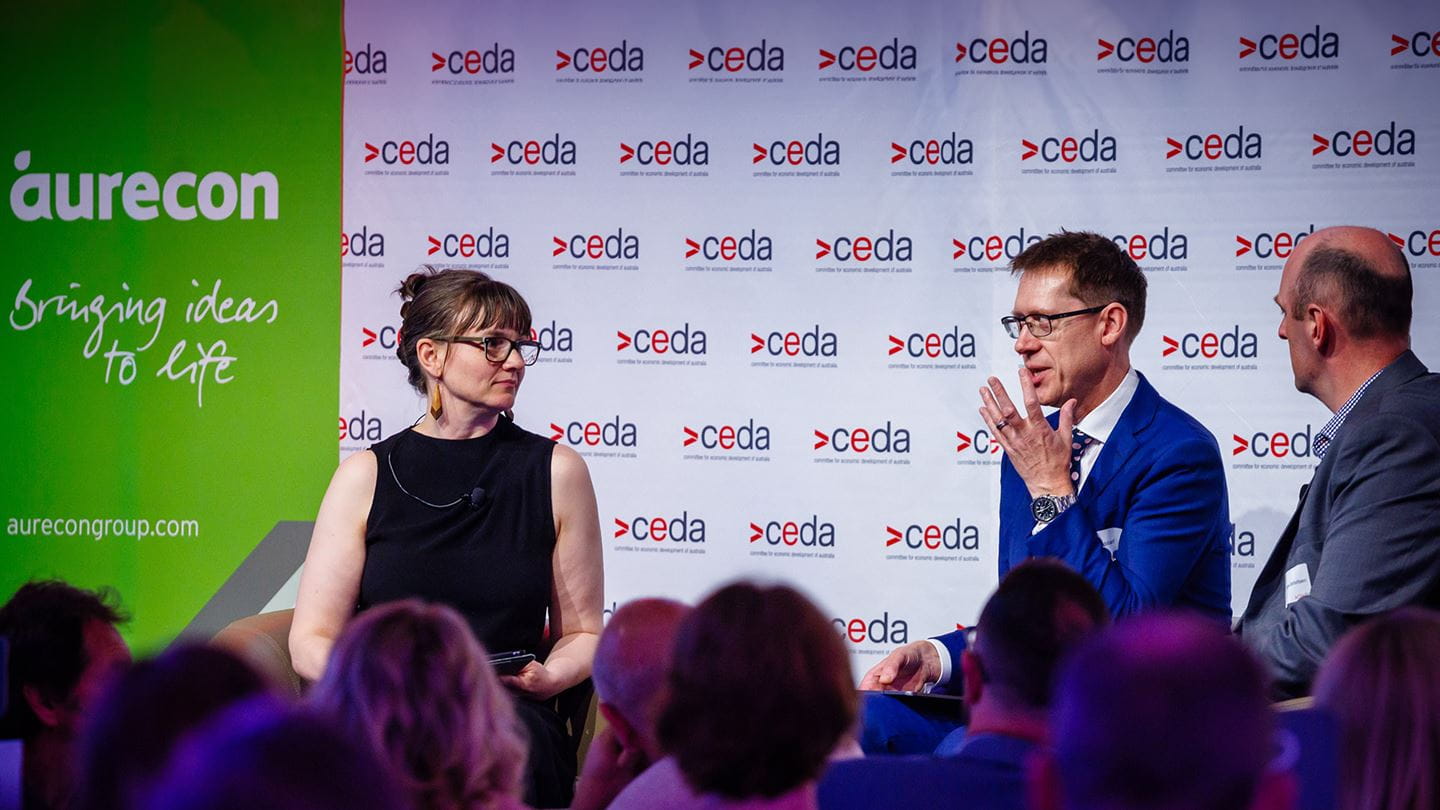
This article was first published for Committee for Economic Development of Australia (CEDA) by Wayne Hubbard and Jodie Bricout titled, "Five ambitious actions to transition to a circular economy in australia".
[1] United Nations Environment Programme, October 2022, Emissions Gap Report (EGR) 2022, accessed September 2023.
[2] Climate Change Comittee, December 2020. The Sixth Carbon Budget: Waste, accessed September 2023.
[3] United Nations Framework Convention on Climate Change, UNFCCC, 2022. National greenhouse gas inventory 2020, August 2023.
[4] European Commission, December 2019. Boosting the economy, improving people's health and quality of life, caring for nature, and leaving no one behind, accessed March 2023.
[5] London Waste and Recycling Board, June 2017, London’s Circular Economy Route Map, accessed September 2023.
Contributing authors & reviewers: Jodie Bricout and Wayne Hubbard, Chief Executive Officer of ReLondon.

Managing Director, Water & Environment – Australia
As climate impact events become increasingly prevalent, there is a sharpening focus on resilience investment for Australia's infrastructure across every sector.
This paper explores three individual change scenarios for the Safeguard Mechanism, illustrating different pathways for greater emissions reductions in Australia.
Australia's energy transition requires more than technical plans. Discover four ways to build the people, culture and capability to deliver infrastructure at scale.