

WestConnex M4-M5 Link Tunnels, Sydney, Australia
Aurecon and Jacobs are providing detailed design and construction phase services for Acciona Samsung Bouygues Joint Venture on the M4-M5 Link Tunnels project.



Change your location to view content tailored for you.
Sydney is a world-class business and tourism destination which makes high quality transport links essential. As one of Australia’s largest integrated transport projects at time of construction, WestConnex M8 duplicated the existing, heavily congested M5 East tunnel, to separate city bound and airport bound traffic from Sydney’s south-west suburbs.
This has helped to reduce travel time between Liverpool and south Sydney by up to 30 minutes, making it easier to connect people and places.
Aurecon, in a design joint venture with Jacobs, provided engineering design services and construction phase services to the CPB Dragados Samsung Joint Venture (constructor), for owner and operator, Transurban and Transport for NSW.
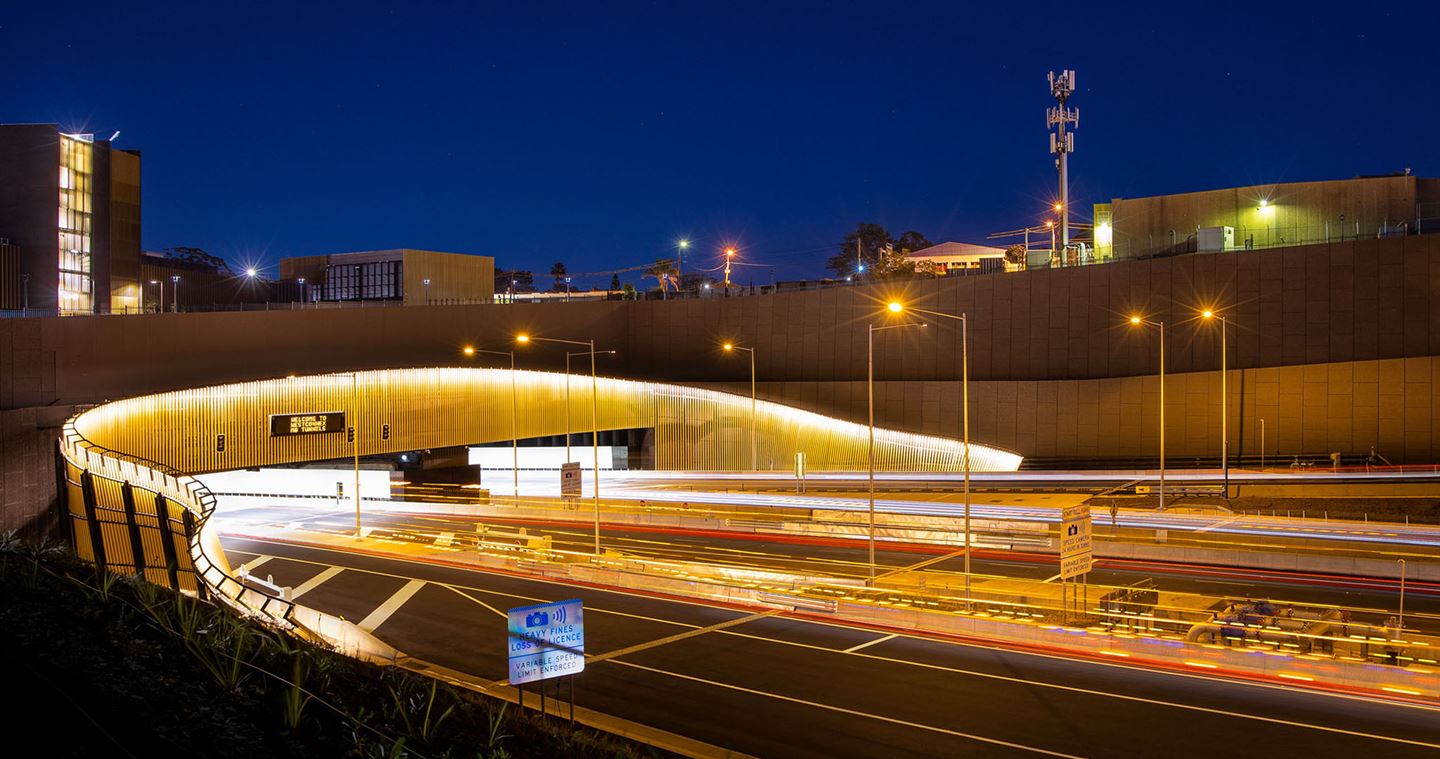
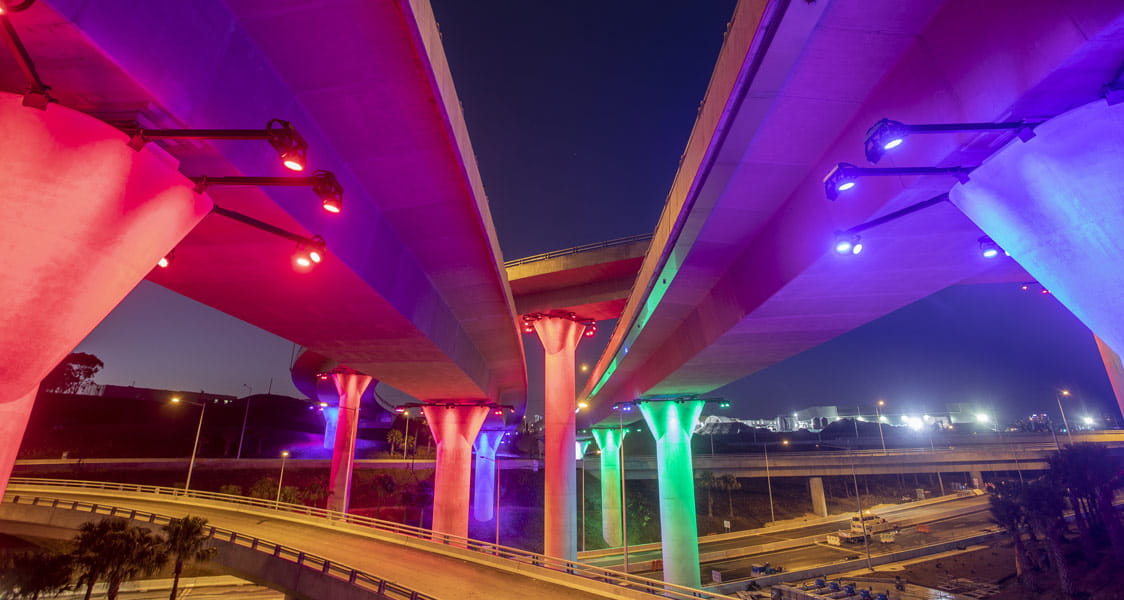
The duplicated twin underground 9 km motorway tunnels incorporate capacity for three lanes if required to accommodate potential future traffic growth. A new 4 level interchange, incorporating 12 complex precast segmental bridges at St Peters, connects the tunnels to surface routes through to Alexandria and Mascot, and Sydney International Airport.
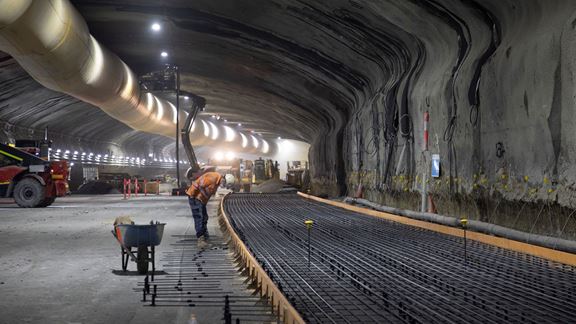
The WestConnex M8 tunnels are 5.1 m tall, significantly taller than the average 4.6 m for traditional road tunnels, in order to service future possible heights of freight vehicles. This project was an engineering design like no other, with a 20 m tunnel roof span, making it the widest in Australia at the time of construction.
A thinner layer of shotcrete for the tunnel lining was engineered to significantly reduce the overall volume and weight of shotcrete, making the span width possible while still meeting all tunnel design and safety requirements. Enhanced fire protection was achieved by adding fibre reinforcement polymers to the shotcrete to improve its strength and resistance to fire and heat.
The WestConnex M8 tunnels through the Arncliffe section were mined at a depth of 75 m to cross under a deep palaeochannel and the Cooks River. One section of the tunnels involved large numbers of sub-vertical inclined joints with open fractures up to 340 mm wide. To control water inflow into the tunnels in this section, the project team devised a solution to surface grout the fractures before tunnel excavation commenced. Borehole televiewers identified each fracture to be successfully filled, thus providing a foundation for a more cost-effective underground grouting programme during construction.
The scale and complexity of this project is not to be underestimated. More than 17,000 engineering drawings were delivered in 24 months. To enable this to be achieved, Aurecon developed a digital collaboration portal to house engineering designs, documents, and cost and performance tracking information for design approvals.





More than 2,000 kms of power cable, in addition to communication cabling, fire sprinklers and hydrants, and cameras, are nestled in the crown of the tunnel roof. To accommodate the tall height of the tunnel, the project team designed a modular construction sequence to compactly fit these services in the roof cavity and streamline the installation sequence.
To safely guide motorists through the tunnels, more than 7,500 LED lights were installed for wayfinding, security and safety. The project team designed a network of communications for electronic directional signage in the tunnels, traffic detection and monitoring devices and tunnel closure devices.
With so much cabling, lights and electronic signs, the project team departed from the traditional approach to host substations at surface level, instead bringing the four electrical substations underground. This used less electrical cabling, and created more efficient distribution of power to where it is needed in the tunnel.
The substations are housed in large cross passages to allow services to cross from one tunnel to the other, thus enabling a series of circuit rings for high-voltage power and water main services. The larger than average cross passages engineered for the project also provide escape routes for people from the incident tunnel to the non-incident tunnel in case of emergencies.
The digital engine developed by Aurecon was a collaboration portal housing engineering designs, documents, and cost and performance tracking information for design approvals.
It was not a traditional document management system. The team threw off the shackles of software constraints, and, instead, used digital engineering to power a live document management and control system to design the mega project.
The design and review workflows and processes were tailored to meet the needs of the project. It standardised collaboration using the BS 1192 standard framework to deliver automated data flows and information management.
It tracked where documents were in the approvals process, which individual a document was assigned to for review, and where interruptions were in the review process. Document progress was monitored and tracked over the course of the project, creating full assurance and auditability of document verification.
The portal contained a digital dashboard for reviewers to review their workflow tasks, find out when documents would be ready for review, and when their review was required by easily and quickly. This enabled designers and reviewers to streamline the process to resolve design issues efficiently and accurately, helping to maintain the project delivery timeline.
The project team was delivering design packages every week. What the digital engine enabled was the storage, review, approval and management of 12 to 15 design packages and 500 drawings every week.
The legacy of an auditable document review process for every project approval and stage is a robust and secure system able to be used on other major transport projects in the future.
WestConnex M8 directly benefits millions of people every day through safer connections to communities, and more efficient travel times for freight and cars. It is more than just a road, it is a vital piece of infrastructure that is getting Sydney moving now and into the future.
The project is one part of the WestConnex master plan to create a 33 km traffic-light free motorway network. Aurecon also contributed its engineering design capabilities to WestConnex M4–M5 Link as part of the masterplan.
Aurecon and Jacobs are providing detailed design and construction phase services for Acciona Samsung Bouygues Joint Venture on the M4-M5 Link Tunnels project.
Following community engagement and consultation, Aurecon was able to refine the designs for WestConnex M4-M5 Link that directly contribute to community satisfaction.
Aurecon is transforming Sydney Harbour, replacing dredging with TBM tunnel engineering to deliver a faster, safer and more sustainable second harbour crossing.