
Puhinui Station Interchange, Auckland, New Zealand
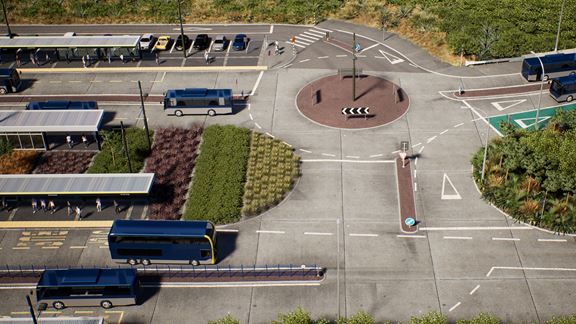
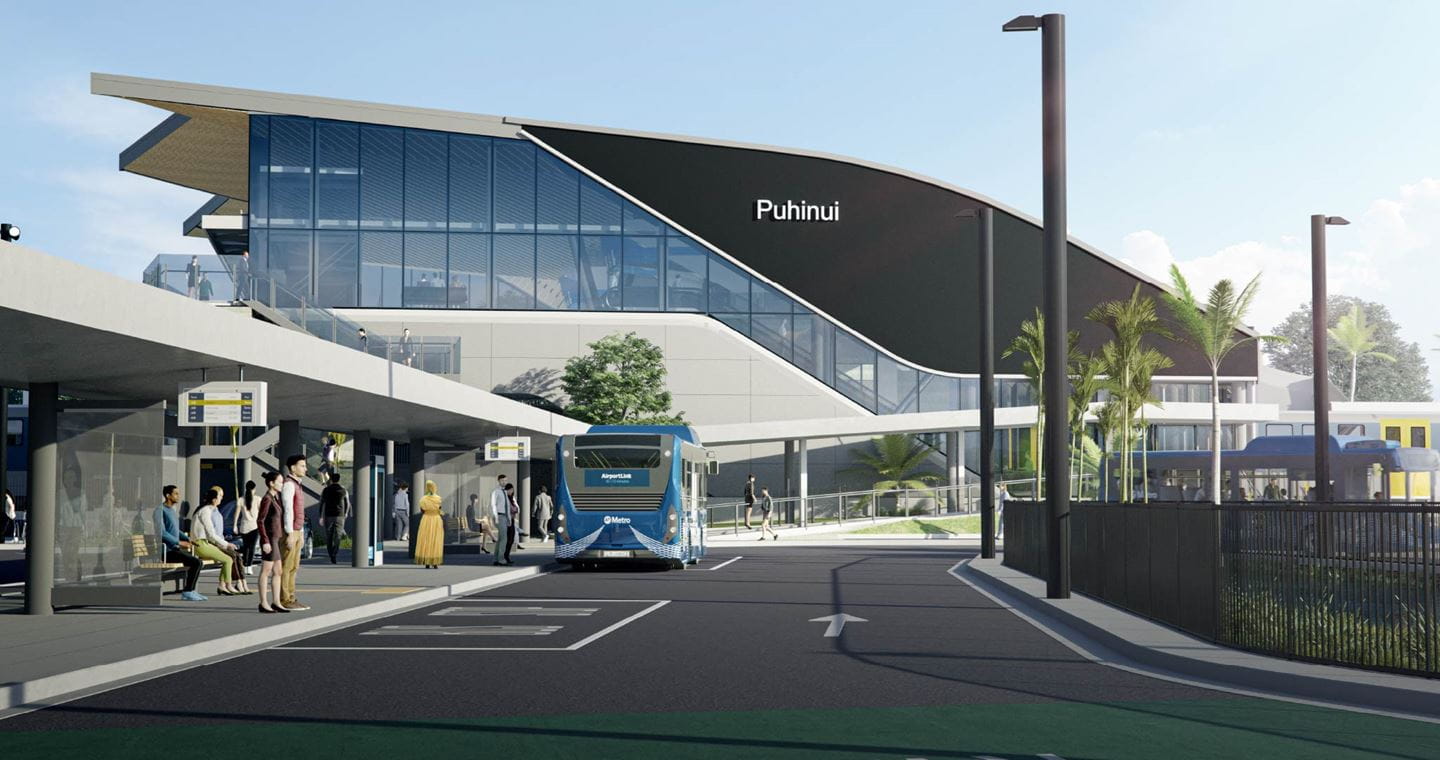
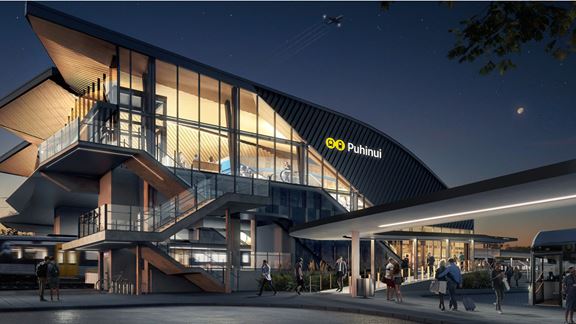
Aurecon's 3D digital model facilitates seamless stakeholder engagement and quick design delivery, helping to fast track approvals for this transport interchange.


Change your location to view content tailored for you.
Over the next 30 years, another million people will call Tāmaki Makaurau, Auckland, home. The city’s southern and eastern suburbs will be some of the fastest growing areas.
The Southwest Gateway programme is a series of transport projects that will provide choice and reliability for how people, and freight, travel around the south and east of Auckland, including to and from the airport. The programme aims to provide better public transport, walking/cycling facilities and safer, more efficient freight movements.
Waka Kotahi NZ Transport Agency, Auckland Transport and Auckland Airport engaged Aurecon in 2016 to develop a programme business case to look at options to reduce congestion, and improve travel options and journey-time reliability for customers travelling to Auckland Airport.
This initial business case formed the basis for the Southwest Gateway Programme and led to Aurecon developing specific business cases for a range of other short- and long-term projects that will make up the Southwest Gateway Programme:


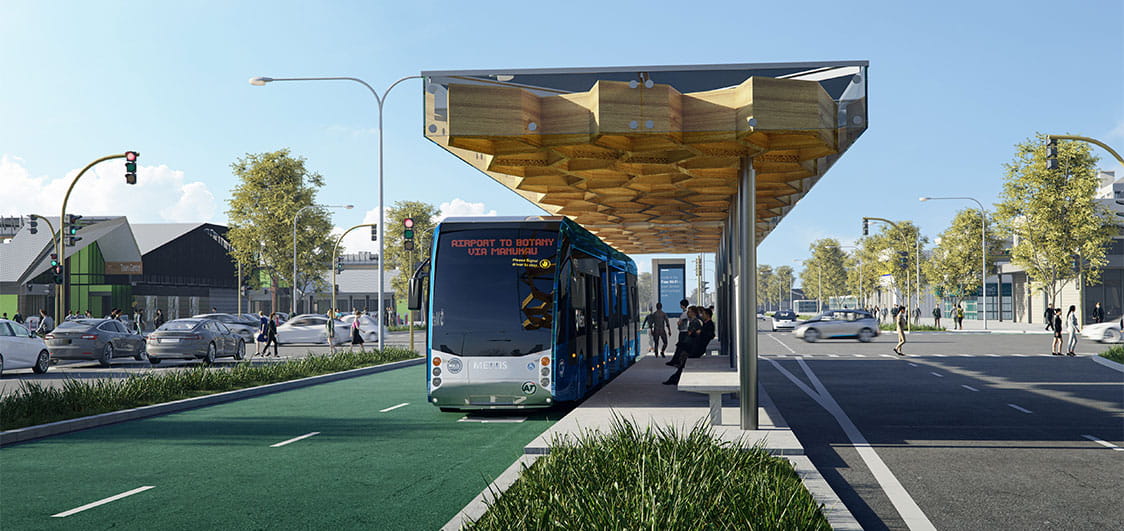
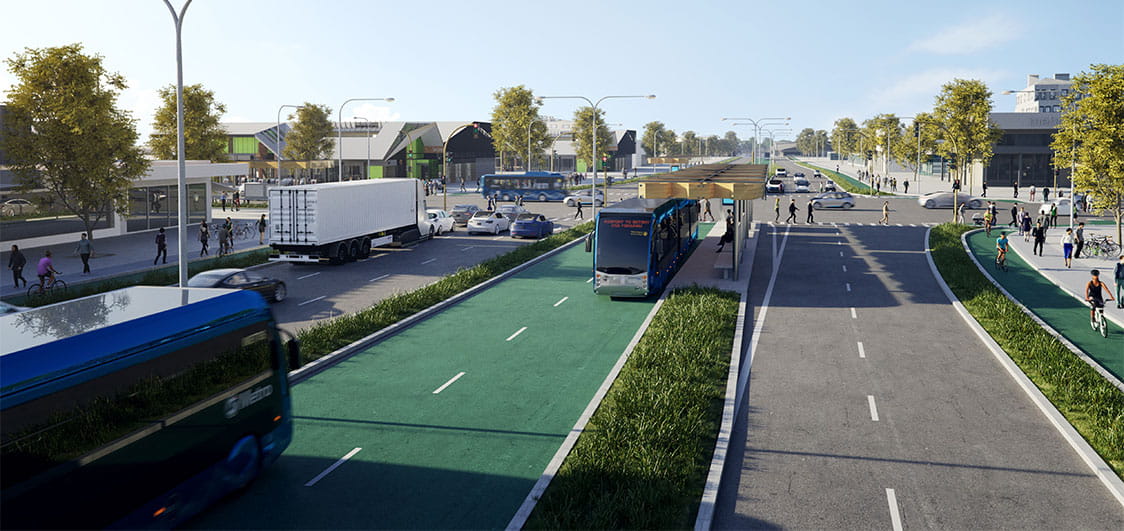

The Southwest Gateway is unique in that it delivered genuine early benefits while long term solutions were being formulated. Customers experienced immediate benefits from the redevelopment of Puhinui Interchange and the improvements to SH20B (which included bus lanes between the interchange and Auckland Airport and a new dedicated bus service AirportLink), while the $2B, 20-year programme for Airport to Botany Rapid Transit was being created. With a combined value of $150M, these were large projects in their own right. Importantly, these projects form an important part of the long-term intervention, and in effect, prime the corridor – getting communities shifting to public transport.
To manage the demands of delivering design for both short term and longer-term projects for two clients and across a large geographical area, we allocated five design teams to the project and set up a project integration group which enabled issues to be elevated early and decisions to be made quickly. Strong governance processes helped manage the complexity and integration of the issues, while keeping the overall programme progressing.
Unusually for a programme of this scale and complexity, Southwest Gateway moved from a programme business case to completion of construction on two major projects (upgraded Puhinui Interchange and improvements to SH20B) in four years. This speed has been possible due to Aurecon’s deep understanding of the issues, and ability to align three stakeholders towards a cohesive vision for this part of Auckland.
Aurecon was originally engaged separately to deliver two business cases for both NZ Transport Agency Waka Kotahi and Auckland Transport looking at short and long-term improvements. However, the decision was made to combine the two long-term business cases into a single business case, giving decision makers a full picture of benefits, and assurance that the two projects were fully integrated.
On a programme of this scale and duration, providing flexibility is important. We proposed a staged implementation of the rapid transit element to spread investment over 20 years and respond to future uncertainty regarding demands, mode shift and land use change.
Aurecon brought innovation throughout each phase, from using a highly graphical style for the progamme business case presentation to developing a short film integrating 3D visualisations and motion graphics to communicate the long-term vision for this area to the community.
We engaged specialist consultants to identify possible opportunities for private land use investment along the Airport to Botany Rapid Transit route and state highways 20, 20A and 20B to provide additional funding or land value uplift.
Similarly, on the Airport to Botany Rapid Transit, we looked beyond the short- and long-term improvements we were tasked with, to explore medium-term investments that could provide many of the long-term benefits at much less cost. These options have been well received by Auckland Transport, who is leading that package of work.
Thoroughly understanding our customers was vital to developing the right solutions for the Southwest Gateway Programme. For this reason, Aurecon opted to use mobile data for the initial programme business case, in place of traffic modelling to inform our decision making.
At a much lower cost, mobile data provided us with rich insights into driver behaviour, such as: where people were coming from; where they were travelling to; the frequency of their trip; whether they were a part- or full-time worker; whether they were travelling to the airport for a flight; and whether they worked within the airport itself or, within the airport precinct.
This showed us that the commuter peak to and from the airport was different to that of the wider network, as airport workers tend to start and finish earlier. We also learnt that the peak congestion when airport workers were leaving the airport tended to coincide with large numbers of people travelling to the airport to catch flights – causing a great deal of traffic.
The data also showed us that although airport workers actually had a preference for public transport, there were no options available early enough in the morning to enable them to make their morning shift. We recommended re-timing a common bus route into and out of the airport precinct to start earlier – greatly increasing bus patronage and helping to reduce morning and afternoon congestion.
The project has won the following awards:
Aurecon's 3D digital model facilitates seamless stakeholder engagement and quick design delivery, helping to fast track approvals for this transport interchange.
Aurecon delivers a business case providing affordable and pragmatic options to increase travel capacity on Auckland’s Northern Busway.
Auckland’s first underground railway system will reduce congestion, bring people closer to job and amenities, and unlock new development potential.