
Megabangna Mall, Bangkok, Thailand
Aurecon was the design engineer for the THB 10 billion (USD 300 million) Megabangna mall in Thailand.



Change your location to view content tailored for you.
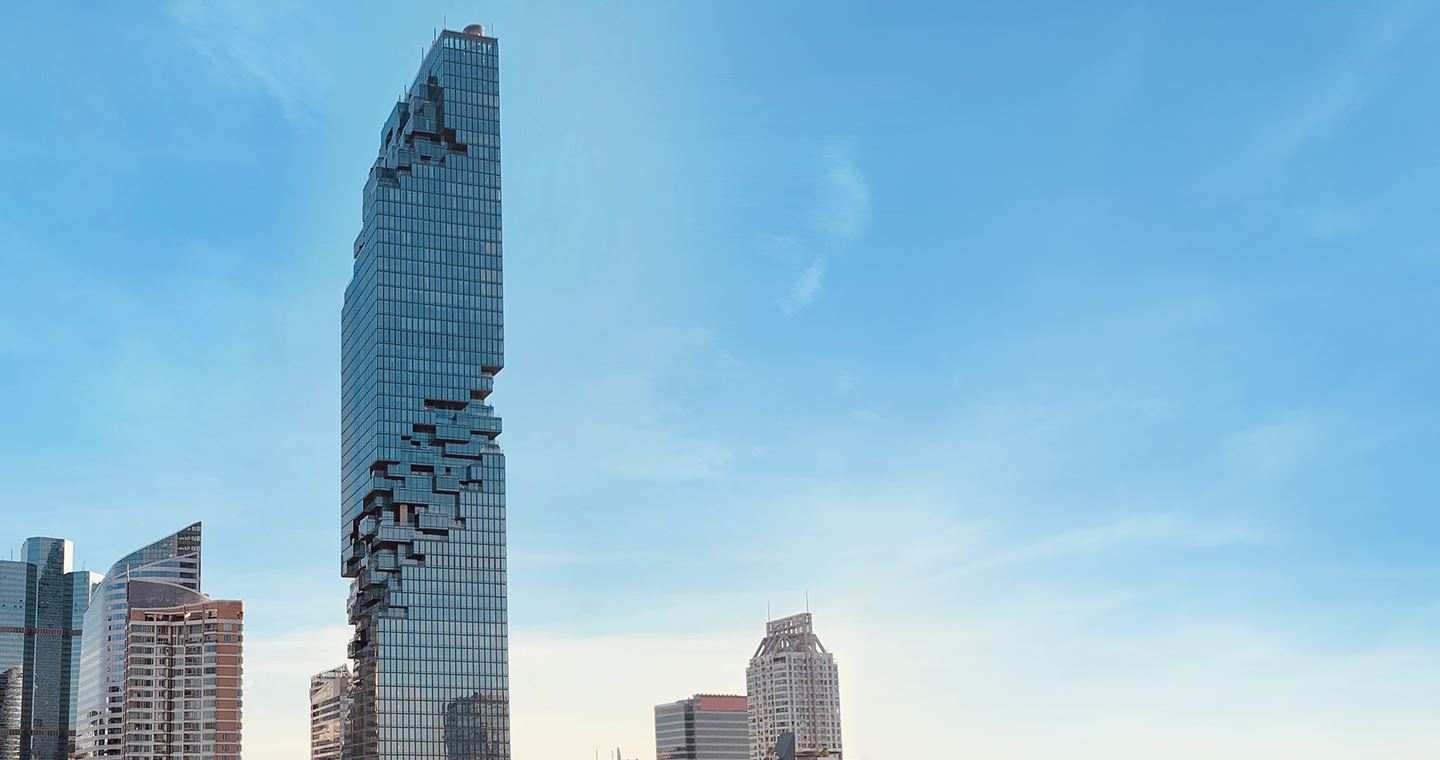
With a striking, pixelated design, the King Power MahaNakhon Tower is an iconic symbol, instantly recognisable on the Bangkok skyline.
At 314 m tall, the skyscraper was the tallest in the Thai capital at the time of its completion in late 2016. Designed by Ole Scheeren, the Tower is a luxury, mixed-use skyscraper located in the Silom/Sathon central business area of Bangkok, Thailand. It includes a five-star hotel, residences, an observation deck, and retail establishments.
To ensure its success, the Tower’s developer, PACE Development Corporation, appointed global engineering and infrastructure advisory company Aurecon to review the building’s design and construction.
As a trusted and leading consultant in designing supertall buildings, Aurecon conducted a comprehensive value engineering review of the construction methodology, structural design, and building services design so as to help PACE achieve greater confidence in the design as well as in building performance, statutory requirements on safety, and speed of construction.
In 2019, the Council on Tall Buildings and Urban Habitat (CTBUH) recognised King Power MahaNakhon as one of '50 Most Influential Tall Buildings of the Last 50 years'.
For a supertall building, construction methodology and sequencing are essential for its financial viability. The right construction method is a balance of structural integrity, cost-efficiency, buildability, and construction time. Aurecon’s team worked closely with the main contractor, Bouygues-Thai, to review the proposed methodology and used its deep-rooted understanding of supertall buildings to advise on the optimal approach.
Special attention was paid to the asymmetrical geometry of the Tower to ensure the right construction sequencing and deflection compensation. This was necessary to make sure the building delivered the correct verticality at completion. The team from Aurecon also analysed the potential impact of long-term creep and shrinkage in the concrete to ensure this would not adversely affect the building, especially given its pixelated and angular design.
Supertall structures are complex, so their design always requires higher levels of engineering consultation. One of the first areas Aurecon examined was the interaction with the soil-structure and the weight of the building, a particularly important task given Bangkok’s soft soil conditions. Bringing its experience and knowledge from other supertall buildings, Aurecon worked with the PACE and Bouygues-Thai teams to investigate the effects of the soft soil.
The team also analysed the performance of the Tower under wind and seismic activity. The aim of this work was to enhance building performance by fully understanding lateral vibration and ensure tenant comfort consistently met international standards and guidelines.
Ensuring the design can absorb those stronger wind forces required careful engineering. An over-engineered structure has unnecessarily high building material and construction costs; while an under-engineered one will adversely affect tenant comfort and structural integrity.
Adding to the complexity of the wind analysis, its asymmetrical design meant lateral sway could be influenced by gravity. To ensure this remained within acceptable limits, Aurecon ran detailed checks on all vertical structure members.
Aurecon was the design engineer for the THB 10 billion (USD 300 million) Megabangna mall in Thailand.
Aurecon provides structural engineering and innovative design to Soonthareeya Ratchadamri, one of the top five slimmest buildings in the world.
Aurecon provided full civil engineering and structural design consulting services to help bring the iconic Rosewood Bangkok Hotel to life.