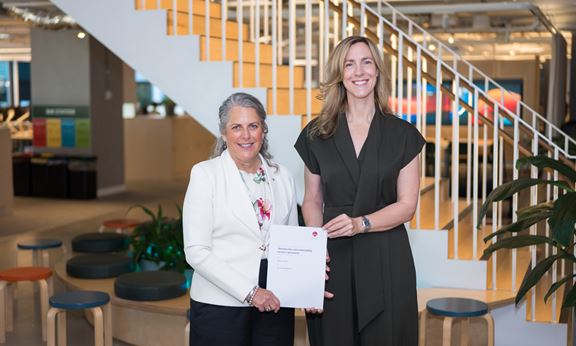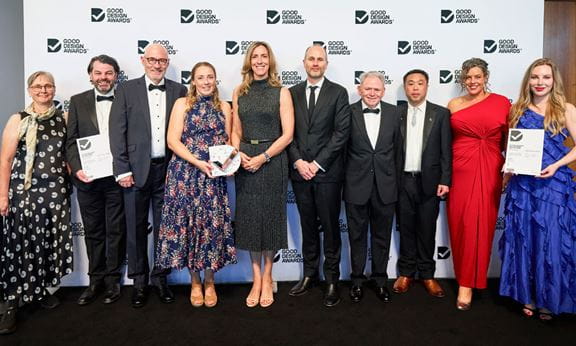
Aurecon Design Academy named Best in Class at Australian Good Design Awards
Aurecon Design Academy wins Best in Class at the 2026 Australian Good Design Awards, celebrating the company's decade-long investment in developing its people.


Change your location to view content tailored for you.
According to Australia’s National Science Statement, 70 per cent of employers identify STEM-skilled workers as the most innovative. However, to be innovative, there needs to be diversity of thought and skills.
Global engineering and infrastructure advisory company Aurecon continues to support increasing diversity and participation in STEM with the annual Aurecon Bridge Building Competition.


The National Science Statement recognises that science, technology, engineering and maths are fundamental to the economy and social wellbeing, with schools playing a key part as the first stage in building the talent pipeline.
These institutions introduce children to science and maths as pursuits of learning and help create a scientifically aware culture. Schools are vital in building early engagement with science, and sustaining that engagement as students move through the education system.
The annual Aurecon Bridge Building Competition engages approximately 250 schools, or around 1,000 students, throughout Australia and New Zealand to design and construct a model bridge using materials supplied by Aurecon. The competition works to cultivate a curiosity among students for STEM subjects.
It also helps to address the roadblocks keeping female students from engaging with STEM subjects by providing a unique learning experience that combines STEM skills with creativity in a fun and supportive environment.
In the New Zealand Government’s 2018 Budget, AUD 28 billion was earmarked for a 10 year transport investment package for Auckland alone. While in Australia, 24.5 billion has been carved out by the Australian Government for new infrastructure projects in the 2018-19 budget. The infrastructure pipeline therefore holds many opportunities across Australia and New Zealand for new graduates of engineering.
However, the concern is that the declining participation, particularly with girls, in STEM subjects in secondary schools could further contribute to the current skills shortage.
"STEM subjects are the building blocks for producing our future engineers and scientists, and this is why Aurecon has continued its commitment to the Bridge Building Competition. It’s why we, as a business, feel so strongly about providing a hands-on approach to what students might look forward to in the engineering industry," said William Cox, Managing Director – Australia & New Zealand, Aurecon.
The bridge building kits are sent out to all teams six weeks before the competition. Students work together in teams to plan and design their bridges before bringing them in to have them judged on specific Judging Days across the seven locations. Students also get a chance to talk to the Judges (who are senior engineers) about why and how they designed and built their particular bridge.
With digital now playing such a large part in the infrastructure industry, students are also given the option to create a digital design of their bridge using Sketch Up Make software.
"Digital disruption is something that is here. We want to emphasise the importance to students that the future engineer will need to embrace all things digital. Having students create a digital design of their bridge as part of the competition helps showcase within the school system how technology and engineering go hand in hand." said William.

Group Director, Brand, Marketing & Communications
Aurecon Design Academy wins Best in Class at the 2026 Australian Good Design Awards, celebrating the company's decade-long investment in developing its people.
Aurecon's Tanya de Hoog, Chief Engineering, Eminence and Innovation Officer, joins ATSE, recognising global her leadership in engineering excellence.
Aurecon extends Engineers Australia's Engineering Workforce Credentialling program nationally, supporting engineers across Australia towards Chartered status.